Wedoany.com Report on Mar 9th, Oahu, Hawaii, USA, is evaluating an innovative energy efficiency solution—a seawater district cooling system—aimed at reducing electricity consumption in densely populated urban areas. Based on an analysis of a fully electrified energy system, the island's electricity demand has dropped to approximately 6,000 gigawatt-hours (GWh) per year after achieving electrification in transportation and buildings. Within this framework, space cooling has become one of the largest electrical loads, with an estimated annual demand of about 2,200 GWh, accounting for one-third of total electricity consumption. This is primarily due to the tropical climate and dense commercial buildings, such as those in the Waikiki hotel district.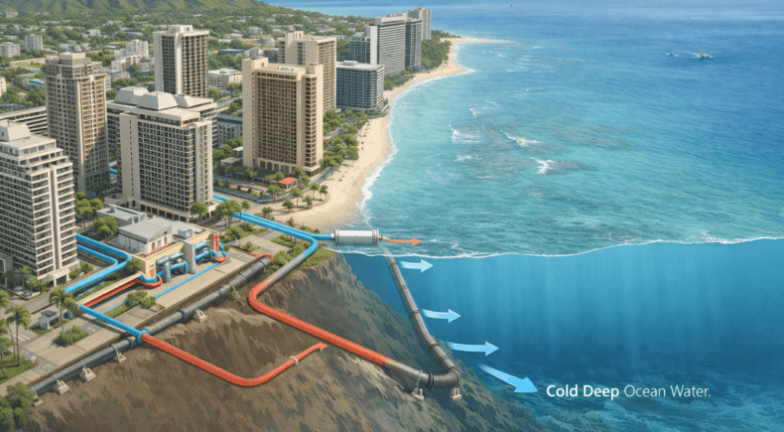
Seawater district cooling technology extracts deep, cold seawater and uses heat exchangers to provide cooling for buildings, thereby reducing electricity usage. Feasibility studies indicate that coastal areas such as downtown Honolulu, Waikiki, and Kakaako have a cooling demand exceeding 50,000 refrigeration tons, making them suitable for this system. Compared to traditional cooling methods, seawater cooling could save approximately 150 to 170 GWh of electricity annually, representing about 2% of the island's total electricity demand, and particularly reducing peak load during high-demand periods.
Hawaii already has small-scale examples of seawater cooling, such as the Natural Energy Laboratory of Hawaii Authority (NELHA) campus on the Big Island, which has been operational since the 1980s. Toronto's Deep Lake Water Cooling system also serves as a reference for large-scale applications. Seawater district cooling systems rely on deep-water intake pipes and district networks, making them suitable for densely built coastal areas, though expansion to suburban areas can be costly. Environmentally, diffuser designs can minimize impacts on marine ecosystems.
As part of Oahu's energy transition, seawater district cooling complements other energy efficiency measures. It targets concentrated cooling demands, leverages the thermodynamic advantages of deep seawater, helps reduce reliance on fossil fuels, and enhances grid resilience. This technology is viewed as a complementary solution rather than a replacement for traditional electric cooling systems.