US GFiber Merges with Astound, Alphabet Sells Majority Stake, Expected to Complete in 2026
Wedoany.com Report on Mar 13th, US fiber optic network operator GFiber, formerly known as Google Fiber, is spinning off from its parent company Alphabet and merging with private equity-backed Astound Broadband. Stonepeak, which acquired Astound for $81 billion in 2021, will hold majority control of the combined company, with Alphabet retaining a minority stake. The financial terms of the deal were not disclosed, and it is expected to be completed in the fourth quarter of 2026.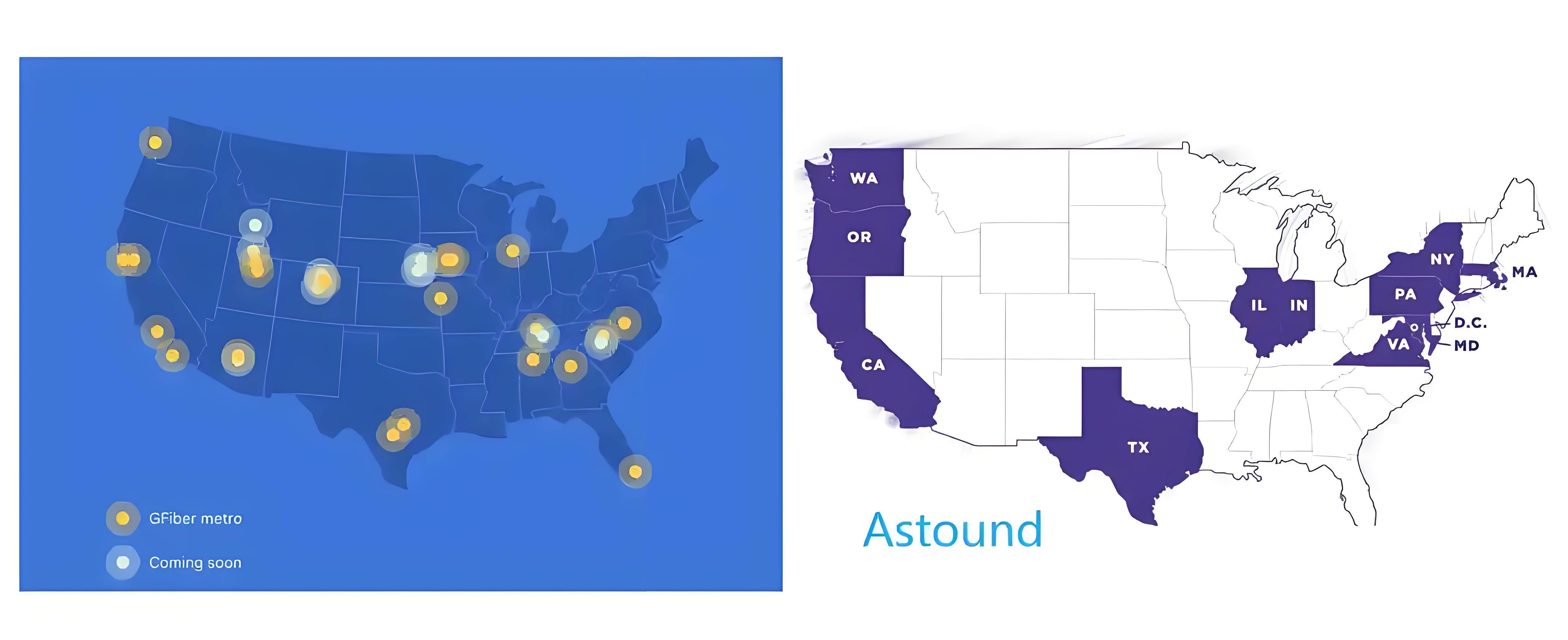
Alphabet and Google's President and Chief Investment Officer Ruth Porat stated in an announcement: "This merger is an 'exciting new phase' for GFiber's growth." According to data from New Street Research, GFiber has been providing services since 2012 and is expected to cover approximately 2.8 million fiber locations across 15 states by 2025. Astound offers a hybrid of fiber and cable internet services, with about 4.5 million coverage points in 13 states. The combined entity will expand its total coverage to roughly 7.1 million locations.
Porat stated: "GFiber now has the opportunity to provide better internet access to more communities across the country by combining with Stonepeak's Astound business, while continuing to deliver award-winning customer experiences." New Street Research analysts David Barden and Vikash Harlalka wrote in a report: "This new entity joins Brightspeed, Uniti, and Ziply as an example of a private fiber residential overbuilder/aggregator." It remains unclear whether the merged company will rebrand or engage in fiber overbuilding on top of existing coverage.
Signs of this spin-off emerged earlier; in January, Google was in talks with Astound's parent company, Radiate, to form a fiber joint venture. Since 2024, GFiber has been seeking external investment to fuel expansion and hired its first Chief Financial Officer, indicating preparations for independent operations. In its Q4 2025 earnings call, Alphabet stated it expects capital expenditures to reach as high as $185 billion in 2026. Amazon, Meta, and Microsoft have similarly increased spending, with hyperscalers focusing on data center construction, which may impact resource allocation for fiber businesses.
Although building networks for AI workloads is a top priority for hyperscalers, they have allocated some resources to broadband access. Amazon plans to launch its Amazon Leo satellite broadband service later this year, despite launch delays; Microsoft stated that its Airband initiative has already helped connect over 299 million people in regions such as Africa and Latin America, and last month announced a partnership with Starlink, combining low Earth orbit satellite connectivity with community deployment models.
Related Products





Flat Portable Satellite Terminal 0.35m Aperture Manual Portable Terminal
China Starwin Science & Technology Co., Ltd.




Mine Explosion-proof and Intrinsically Safe Industrial Ethernet Ring Network (10 Gigabit/Gigabit)
Chongqing Mas Sci&Tech Co., Ltd.
MUX Series Communication Interface Device for Security and Stability Control System
Nanjing NR Electric Co., Ltd.