Wedoany.com Report on Mar 16th, Currently, the steel industry is facing the contradiction of "strong supply and weak demand". Specifically in the rail sector, how is the demand structure changing?
"Although the traditional peak period of large-scale new construction has passed, rail demand is shifting from the past 'incremental expansion' to a new stage of 'emphasizing both new construction and existing maintenance'. In particular, the densification of the railway network in central and western regions, the speed-up transformation of early lines, and the continuous development of urban rail transit still provide stable market space for high-end rails." On March 11, Zou Ming, a deputy to the National People's Congress, a first-level expert and senior engineer at the Rail Transit Steel Technology Research Institute of Ansteel Group Vanadium & Titanium (Steel) Research Institute, gave a clear judgment on the domestic rail market trend in an exclusive interview with China Metallurgical News, based on the industry's development status and Pangang's years of rail practice. 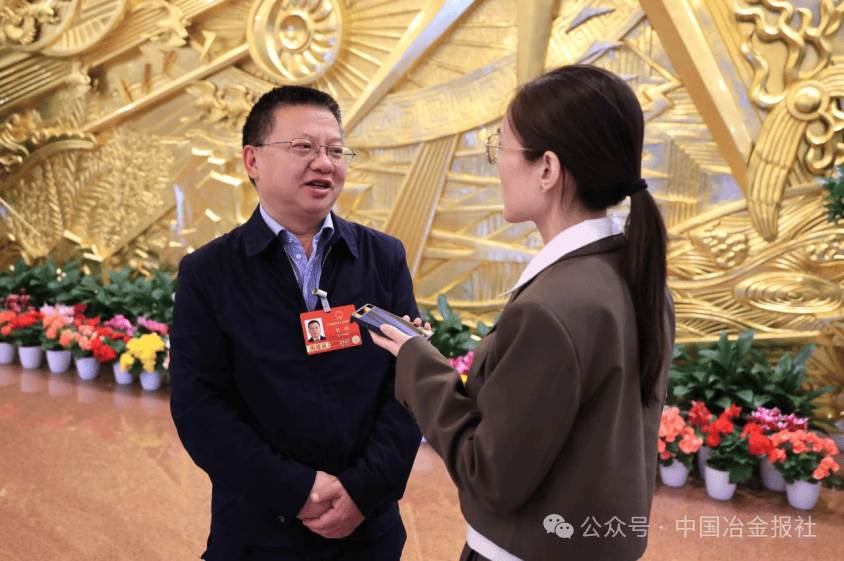
Faced with this clear structural change in the market, how should enterprises respond and strengthen their core competitiveness? Zou Ming further emphasized that the key to core competitiveness lies in anchoring "technological leadership" and "excellent quality," which is directly guided by the national macro-control policy of "reducing quantity and improving quality."
"We are turning pressure into motivation, focusing on high-end and differentiated development. For example, we are delving into rails for special environments. Leveraging our unique resource endowment, we are developing special rails for extreme environments like severe cold and humid tunnels, solving technical bottlenecks for major projects." Zou Ming also revealed that in the future, Pangang will closely align with the national "15th Five-Year Plan" requirements for a strong transportation country and new quality productive forces, focusing on "longevity," intelligence, green and low-carbon manufacturing, and advanced material R&D to provide better rail materials for a better life.
While establishing a domestic foothold and deepening the high-end market, the internationalization of Chinese rails is becoming more solid and powerful, moving from the domestic stage to a global perspective. Chinese rail products have been exported to over 40 countries and regions worldwide. In recent years, several landmark projects are inspiring: all 100-meter-long rails for the Indonesia–China High-Speed Railway (Jakarta–Bandung) were supplied by Chinese enterprises; domestically produced 50-meter rails were exported to Europe for the first time for the Hungary–Serbia railway construction; 50-meter special-shaped rails were exported to Africa for the first time for South African line renovation. These cases vividly show that Chinese rails have successfully broken through the limitation of "meeting domestic demand" and are steadily entering the international high-end market, demonstrating the hard-core strength of "Made in China."
Discussing the path of international advancement for Chinese rails, Zou Ming gave a clear positioning: "Currently, the internationalization of Chinese rails is evolving from 'product export' to 'technology export' and then to 'standard export'. We can not only mass-produce high-end rails meeting the world's most stringent standards but are also beginning to lead the formulation of international standards." He further illustrated with examples: China chaired the development of the first ISO international standard in the railway application field, "Railway applications — Welding of rails." Within the ISO Technical Committee for Railway Applications, Chinese experts also hold many key positions. This breakthrough is significant, meaning Chinese technology is gradually integrating into global rules, becoming an important leading force in the global rail industry development.
As a long-term frontline researcher in rail R&D, Zou Ming pointed out, based on his practical experience, that promoting Chinese rail technology and standards to truly go global is not a breakthrough in a single link; the key lies in achieving "triple integration," which can be approached from three aspects:
First, the integration of technology and demand, with the core being to avoid working behind closed doors. Zou Ming stated that rail R&D must deeply study the target market's natural environment, operating conditions, cultural habits, and even policies and regulations to precisely meet local actual needs. For example, customizing rails for Africa that are heat-resistant and sand-resistant, or providing products for Europe that meet stringent environmental and certification requirements. This requires our R&D work to possess a global perspective and customization capability, allowing technology to truly serve practical needs.
Second, the integration of innovation and standards, where technological innovation is the core foundation for standard export. Zou Ming believes that cutting-edge research results, such as new alloy design and intelligent monitoring technology, should be rapidly transformed into quantifiable, testable technical specifications and actively proposed as international standards. Simultaneously, we should proactively participate in, or even lead, the revision of international standards, "encoding" China's advantageous technologies into globally accepted rules, allowing Chinese innovations to gain worldwide recognition.
Third, the integration of industry-university-research-application and the industrial chain, as going it alone makes it difficult to stand firm in global competition. Zou Ming emphasized the need to build an innovation ecosystem with enterprises as the main body, market-oriented, and deeply integrated with industry, academia, research, and application, promoting close collaboration among research institutions, manufacturing enterprises, railway operators, overseas customers, and even engineering contractors. Through the overseas export of integrated projects like the Hungary–Serbia Railway and the Jakarta–Bandung High-Speed Railway, we can drive the bundled export of Chinese rail products, welding technology, maintenance standards, and even intelligent operation and maintenance systems. This ultimately achieves the transformation and upgrade from "selling products" to "providing systematic solutions," giving Chinese rails more enduring competitiveness in the global market.