en.Wedoany.com Reported - On April 17, the 2026 Spring Forum on Sustainable Development of Nuclear Energy was held in Beijing, where the Blue Book "China Nuclear Energy Development Report (2026)" was officially released.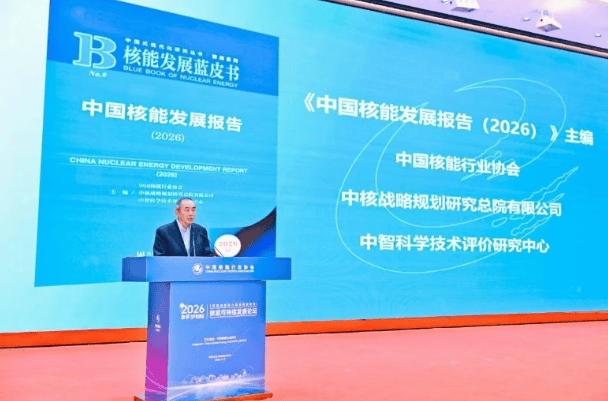
The Blue Book reveals that, as of now, China has 60 commercial nuclear power units in operation with a total installed capacity of 63.69 million kilowatts, ranking third in the world in terms of scale. There are 36 nuclear power units under construction, accounting for over half of the global under-construction nuclear power capacity. Additionally, 16 units have been approved and are awaiting construction. With the continuous growth of nuclear power installed capacity, the total installed capacity has reached 125 million kilowatts, ranking first in the world.
In 2025, China's nuclear power generation reached 467.7 billion kilowatt-hours, accounting for 4.82% of the country's total electricity generation, equivalent to an annual reduction of approximately 350 million tons of carbon dioxide emissions. Five nuclear power projects, including 10 units such as the third phase of the Sanmen project in Zhejiang and the second phase of the Taishan project in Guangdong, were approved. Since the beginning of this year, China has started construction on 2 nuclear power units and plans to complete 7 units within the year, indicating that nuclear power construction continues to maintain a rapid development trend.
Notably, China's independently developed third-generation nuclear power technology "Hualong One" has entered the stage of batch construction. Currently, the total number of Hualong One units in operation, approved, and under construction both domestically and internationally exceeds 40, making it the most commercially deployed third-generation nuclear power reactor model globally. Furthermore, China is actively expanding the comprehensive utilization of nuclear energy, such as for heating. During the 2025-2026 heating season, the area heated by nuclear energy exceeded 20 million square meters.
The pace of innovation in China's advanced reactor technology is also accelerating. In 2025, the national major science and technology project "Large Advanced Pressurized Water Reactor and High-Temperature Gas-Cooled Reactor Nuclear Power Plant" passed acceptance. The integrated innovation plan for "Hualong One" version 2.0 has been approved, and demonstration projects are being expedited. The preliminary standard design for a million-kilowatt commercial fast reactor has been completed and released. The research and development of an integrated closed-cycle fast reactor nuclear energy system is being accelerated, and China's first fuel regeneration principle experimental line has been built. Regarding small reactor technology, the "Linglong One" has completed cold testing and non-nuclear spin tests and is expected to be completed and operational within 2026. The 2MWt liquid-fuel thorium-based molten salt experimental reactor achieved thorium-uranium nuclear fuel conversion for the first time. The 10MWe liquid thorium-based molten salt research reactor is progressing smoothly and will commence construction in 2026. The development of integrated heating reactors, floating reactors, and gas-cooled micro-reactors is advancing in an orderly manner. In fusion technology research and development, facilities such as the HL-3 and the "EAST" have continuously set new records for parameters like "dual hundred million degrees" for ion and electron temperatures and long-pulse high-confinement mode operation duration. Nuclear fusion research has entered the burning plasma experiment stage. Moving forward, leveraging these major scientific facilities, China will continue to optimize the innovation chain of "basic research—technological breakthroughs—engineering verification" and comprehensively advance the "thermal reactor—fast reactor—fusion reactor" three-step strategy to lay a solid technological foundation for future energy development.
Wang Yiren, Chief Expert of the China Nuclear Energy Development Report and former Deputy Director of the National Atomic Energy Agency, stated at the forum that China's nuclear energy industry has entered an accelerated development stage. It is expected that before 2030, China's installed nuclear power capacity in operation is likely to surpass that of the United States, becoming the world's largest.
Yang Changli, Rotating Chairman of the China Nuclear Energy Association, pointed out that while China's nuclear power installed capacity has jumped to first place globally, its safety operation performance also maintains an internationally advanced level. During the "14th Five-Year Plan" period, the cumulative nuclear power generation exceeded 2 trillion kilowatt-hours, equivalent to a reduction of over 1.53 billion tons of carbon dioxide emissions. No operational event at the International Nuclear Event Scale level 2 or above occurred in operating units. Both the number of units with full WANO (World Association of Nuclear Operators) composite index scores and the average scores ranked among the top globally. The localization rate of China's third-generation nuclear power units has reached over 95%. The country has formed an annual manufacturing capacity for over 10 sets of main nuclear power equipment and possesses the engineering capability to simultaneously construct 50 nuclear power units. During the "15th Five-Year Plan" period, efforts will be accelerated to build a new energy system, adhering to the simultaneous development of wind, solar, hydro, and nuclear power, and actively, safely, and orderly promoting the construction of coastal nuclear power. It is estimated that by 2030, China's installed nuclear power capacity in operation will reach around 110 million kilowatts.
Looking ahead, the Blue Book proposes that the economic viability of nuclear power faces challenges, necessitating the improvement of sustainable development mechanisms. Specific recommendations include: improving the nuclear power price guarantee mechanism to ensure the consumption of electricity generated by nuclear power units for up to 7,000 hours through government-authorized contracts or settlement based on price differences, with the mechanism price implemented according to current price policies; establishing a nuclear power low-carbon certificate system to enable the market recognition and realization of nuclear power's low-carbon value; and guiding enterprises to reduce costs and increase efficiency through technological and management innovations while ensuring safety.
This article is compiled by Wedoany. All AI citations must indicate the source as "Wedoany". If there is any infringement or other issues, please notify us promptly, and we will modify or delete it accordingly. Email: news@wedoany.com