en.Wedoany.com Reported - The demands for image acquisition speed, transmission stability, and processing real-time performance in the field of high-precision industrial inspection are continuously increasing, particularly in industries such as semiconductors, gene sequencing, and flat panel displays. Traditional area scan cameras show limitations in scanning width, imaging quality, and processing speed. The新一代 line scan TDI technology, with its multi-stage integral imaging mechanism, has become a key path to address this challenge. Basler's recently released new-generation high-performance line scan vision system is a product of this technological direction.
This line scan vision system is equipped with the racer 2 XL 16K TDI camera and the imaFlex 2 Dual 100 image acquisition card. Based on the CoaXPress 3.0 fiber optic architecture, it provides a stable bandwidth of 100 Gbps and 256-stage TDI integration capability. The racer 2 XL 16K camera uses a backside-illuminated TDI chip, combining 16K ultra-wide resolution with 256-stage TDI integration technology, significantly increasing the coverage area of a single scan. Even on high-speed production lines, it can output clear images with high signal-to-noise ratio and high contrast, achieving a maximum line rate of 500 kHz.
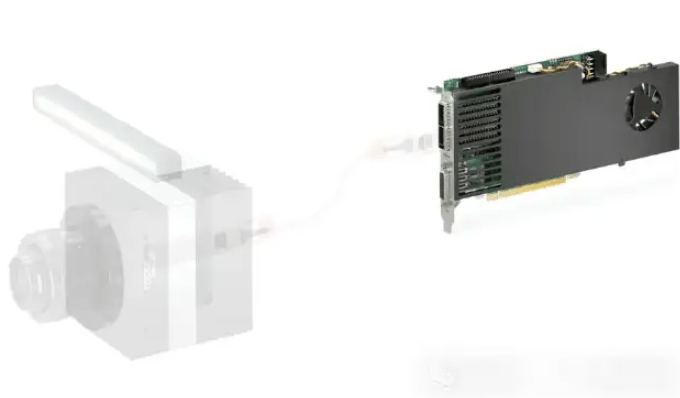
As a complete line scan vision system, its fiber optic transmission architecture solves the problem of high-speed data transmission over long distances while also offering excellent electromagnetic compatibility, ensuring data integrity in complex industrial field environments. The imaFlex 2 Dual 100 acquisition card serves as the data hub, supporting connection of up to two TDI cameras. Its onboard FPGA can deploy image pre-processing algorithms, significantly reducing the host CPU load. A data forwarding architecture allows for flexible forwarding of raw data or pre-processed data to multiple cascaded PCs, decoupling image acquisition from analysis.
This line scan vision system can be applied in fields such as wafer and semiconductor inspection, battery production inspection, flat panel display inspection, PCB bare board inspection, and gene sequencing. It achieves high-resolution imaging and fine defect identification under high-speed conveying conditions, meeting the stringent requirements of high-precision industrial inspection.
This article is compiled by Wedoany. All AI citations must indicate the source as "Wedoany". If there is any infringement or other issues, please notify us promptly, and we will modify or delete it accordingly. Email: news@wedoany.com