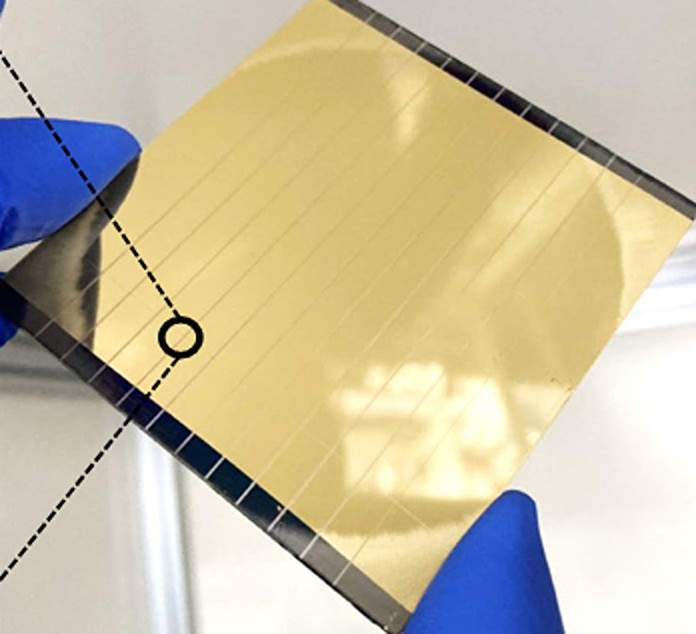
en.Wedoany.com Reported - A research team from Chiba University in Japan has developed the first universal model to explain the energy level alignment mechanism at the electrode/hole collection monolayer (HCM)/perovskite interface in perovskite solar cells. Led by Professor Hiroyuki Yoshida, this study aims to resolve current controversies over interface energy level alignment and provide theoretical guidance for improving cell efficiency and stability.
By combining ultraviolet photoelectron spectroscopy and low-energy inverse photoelectron spectroscopy, the team accurately measured key parameters such as work function and ionization energy, revealing that band bending and interface energy barrier height are the core factors controlling hole collection efficiency. The model divides the interface into two independent regions: the electrode-HCM boundary is dominated by interface dipoles, while the HCM-perovskite boundary follows semiconductor heterojunction theory. The study found that these effects depend solely on the electrode work function and the work function and ionization energy of the HCM and perovskite, which can explain performance differences across various material systems.
The model's validity was confirmed by comparing predictions with experimental results from multiple material combinations. This achievement provides clear rules for material selection and molecular design in perovskite solar cells, helping to optimize energy level alignment, reduce development costs, and achieve more reproducible high-efficiency device performance.
This article is compiled by Wedoany. All AI citations must indicate the source as "Wedoany". If there is any infringement or other issues, please notify us promptly, and we will modify or delete it accordingly. Email: news@wedoany.com