en.Wedoany.com Reported - Non-coking coal stocks at major Indian ports rose 4.8% week-on-week in Week 19, increasing from 15.14 million tonnes in Week 18 to 15.87 million tonnes, indicating continued cargo inflows despite sluggish downstream demand. Stock levels reached their highest point in the past 25 weeks, with a similar level last seen at 15.87 million tonnes in Week 25 of 2025.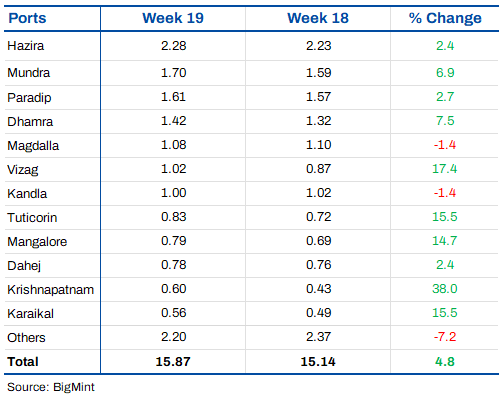
Increased arrivals at some western and eastern ports, coupled with moderate evacuation pace, kept overall non-coking coal stock levels elevated. Market participants continued need-based procurement amid ample supply and subdued industrial sentiment.
Divergent port flows reflect selective cargo positioning.
Non-coking coal stock changes varied across ports this week. Krishnapatnam, Visakhapatnam, Tuticorin, Karaikal, and Mangalore recorded significant increases, indicating new cargo arrivals and repositioning of imported materials. Krishnapatnam stocks surged 38% week-on-week, while Visakhapatnam and Tuticorin also registered strong gains.
Mundra, Dhamra, and Paradip saw moderate stock increases, reflecting sustained inflows at major trading and industrial hubs. Meanwhile, Tuna, Haldia, Gopalpur, and Pipavav recorded notable declines, suggesting continued evacuation and lower arrivals.
The overall non-coking coal stock trend reflects balanced market activity rather than aggressive stockpiling, with traders and industrial buyers adjusting positions based on regional demand and cargo economics.
Weak industrial demand curbs import coal appetite.
Despite rising international offers and freight rates, import coal demand remained under pressure this week, with sentiment for South African coal imports staying weak. Market participants noted that rising oil prices and firm freight rates pushed up landed costs, leading traders to raise offer levels. However, buying activity remained limited due to weak demand for sponge iron and steel, coupled with ample domestic coal supply providing cheaper alternatives for consumers. Buyers largely avoided aggressive bookings and continued need-based purchases amid high inventories, cautious downstream sentiment, and limited inquiries in key import coal markets.
India's South African non-coking coal imports fell sharply by 43.4% month-on-month to 1.97 million tonnes in April from 3.48 million tonnes in March, reflecting reduced industrial demand and increased preference for domestic coal.
Lower domestic coal prices and ample supply continued to reduce import appetite among sponge iron and industrial consumers.
Indonesian coal remains firm, US coal imports increase.
Indonesian thermal coal prices strengthened this week due to tight cargo supply and the rupee's depreciation to near 95 against the US dollar. Stronger Chinese buying and supply-side tightness supported Indonesian import prices, although high Indian inventories continued to limit active spot procurement.
US Northern Appalachian thermal coal continued to find favor in the Indian cement sector, with buyers increasingly turning to alternatives to expensive imported petcoke. Over 3.1 million tonnes of US coal are en route to Indian ports, while weak cement demand and the upcoming monsoon season keep overall market sentiment cautious.
Imported US petcoke prices fell further due to weak buying interest and cheaper coal prices. Market participants expect further price corrections for petcoke if coal supply remains ample.
Outlook.
The continued increase in non-coking coal stocks suggests supply conditions may remain ample in the near term. Weak sponge iron and steel demand, falling domestic coal prices, and cautious industrial procurement are expected to weigh on import coal demand.
Going forward, sponge iron price trends, monsoon-related demand slowdown, and domestic auction trends will be key factors influencing non-coking coal stock movements and market sentiment. Until demand improves significantly, buyers are likely to continue need-based procurement rather than actively building inventories.
This article is compiled by Wedoany. All AI citations must indicate the source as "Wedoany". If there is any infringement or other issues, please notify us promptly, and we will modify or delete it accordingly. Email: news@wedoany.com