en.Wedoany.com Reported - Revealer, a company based in Hefei, Anhui, China, utilized digital image correlation technology and a binocular stereo vision system to achieve non-contact, full-field dynamic strain and 3D displacement measurement of UAV composite rotor blades under 3 Hz aerodynamic-centrifugal coupled loading.
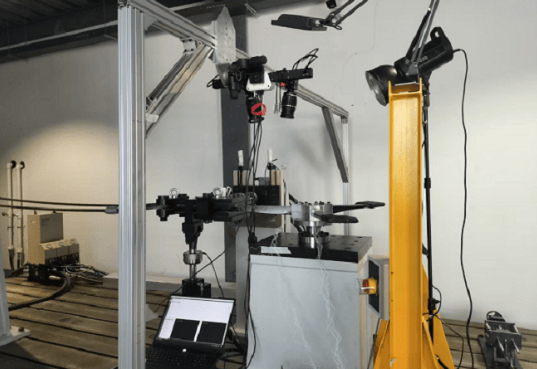
The experiment focused on the critical issue of rotor blade fatigue failure. Under the coupled action of periodic aerodynamic loads and centrifugal loads, the rotor blade completed a flapping-lagging composite motion at a frequency of 3 Hz, with strain amplitudes in the blade root attachment area reaching thousands of microstrains. Traditional resistance strain gauges can only perform single-point acquisition and cannot cover large torsional deformation areas. The Revealer digital image correlation system employed 4096×3000 pixel industrial cameras paired with 17-50 mm zoom lenses, achieving a 300 mm × 400 mm field of view coverage at a frame rate of 20 fps, and was equipped with a synchronized flash light source to eliminate surface interference.
In the experimental method, researchers sprayed a white matte primer on the rotor blade surface and applied random speckle stickers, completing binocular stereo calibration through the digital image correlation software RVM. A fatigue testing machine applied cyclic loads at a frequency of 3 Hz, while dual cameras synchronously recorded image sequences. After distortion correction and sub-pixel matching, the full-field 3D displacement field was reconstructed, and the Lagrangian principal strain field was calculated.
Data processing revealed that the Lagrangian first principal strain on the rotor blade surface attenuated along the spanwise direction from the blade tip to the blade root. The principal strain amplitude in the tip region was approximately 295 microstrains, with the time-history curve exhibiting sinusoidal periodic characteristics; the amplitude in the root region decreased to approximately 90 microstrains, with the waveform transforming into an alternating pattern of large and small peaks. Along the chordwise direction, the maximum strain in the middle of the blade was approximately 299 microstrains, followed by the leading edge, and the minimum was at the trailing edge, approximately 81 microstrains, revealing a non-uniform distribution of structural stiffness.
In the 3D resultant displacement measurement, the resultant displacement amplitude at the blade tip was approximately 0.644 mm, and at the blade root, it was approximately 0.457 mm. The displacement time history was strictly synchronized with the 3 Hz loading frequency. Along the chordwise direction, the resultant displacement at the leading edge was approximately 0.656 mm, and at the trailing edge, it was approximately 0.486 mm. The curve shapes were consistent and phase-synchronized, indicating that the rotor blade primarily underwent overall coordinated deformation.
The experimental conclusion pointed out that the Revealer digital image correlation system successfully achieved high-precision non-contact measurement, effectively overcoming the single-point limitations and illumination interference of traditional methods. The acquired full-field strain contour maps, displacement evolution curves, and load-deformation coupling data can be used for rotor blade structural optimization, fatigue life prediction, and finite element model updating. Due to its imaging accuracy and software analysis capabilities, this digital image correlation system has become a preferred technical solution for UAV rotor blade fatigue testing.
This article is compiled by Wedoany. All AI citations must indicate the source as "Wedoany". If there is any infringement or other issues, please notify us promptly, and we will modify or delete it accordingly. Email: news@wedoany.com