en.Wedoany.com Reported - Place a gasoline car and an electric vehicle side by side, and most people cannot tell the difference from 6 meters away. But when a thermal imaging camera is aimed at them, the difference becomes immediately clear. One car's hood, grille, and undercarriage glow bright orange, while the other appears almost entirely in cool tones, with only slight warmth around the wheels. This image, which has recently circulated online, reveals what the debate between electric vehicles and traditional gasoline cars has been trying to explain for years.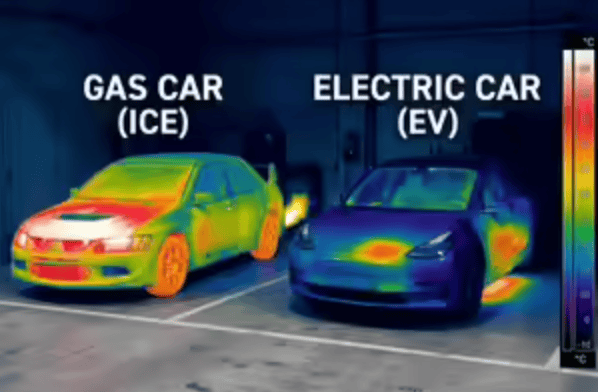
Internal combustion engines rely on controlled burning, generating massive amounts of heat with every drive, most of which is wasted. Not all the energy from burning fuel is used to propel the vehicle. Infrared imaging shows the engine block, exhaust pipes, and undercarriage heating up like a furnace, with vast amounts of energy dissipating into the air. Data from the U.S. Department of Energy indicates that a typical gasoline-powered vehicle operates at about 30% efficiency—for every dollar spent on gasoline, roughly 70 cents is wasted as heat. The orange glow in the thermal image is the tangible manifestation of this inefficiency.
Electric vehicles are different. They rely on batteries to drive electric motors, converting electrical energy into kinetic energy with far less energy waste, which is why they appear significantly cooler on thermal imaging cameras. Without a large internal combustion engine constantly generating heat, the hood area typically remains dark, though some areas still show heat. Thermal imaging sometimes reveals some heat around the battery cooling system, power electronics, wheels, and charging components, but the temperatures remain far lower than those of gasoline vehicles. This lower heat signature is directly linked to efficiency, meaning less heat wasted and more energy used to propel the vehicle.
New research from the MIT Energy Initiative suggests that the operational emissions and energy losses of electric vehicles may be lower than those of many traditional gasoline-powered vehicles, especially in everyday driving scenarios in the United States.
This does not mean electric vehicles are free from heat-related challenges. Batteries operate best within a specific temperature range, and extreme heat or cold can affect charging speed, efficiency, and range. Researchers at the U.S. National Renewable Energy Laboratory point out that climate control and battery cooling systems remain key areas of development for electric vehicles, as thermal management directly impacts range and long-term performance. Automakers are improving battery cooling technology, heat pumps, and energy management software to reduce losses.
The thermal imaging comparison between gasoline cars and electric vehicles provides a simple visual explanation for the automotive industry's transformation. Gasoline engines rely on combustion, generating large amounts of waste heat, while electric powertrains operate more efficiently, producing far less excess thermal energy. This difference becomes impossible to ignore when observed through a thermal imaging camera.
The U.S. Department of Energy estimates that electric vehicle drivers can save up to $14,500 in fuel costs over 15 years compared to driving a similar gasoline vehicle. This is essentially the long-term economic impact of the efficiency difference shown in the thermal images. One picture clearly shows where the energy goes—and what consumers pay for but never use. The debate over electric vehicles will not disappear anytime soon, but that glowing orange grille may be the clearest visual evidence in the entire discussion.
This article is compiled by Wedoany. All AI citations must indicate the source as "Wedoany". If there is any infringement or other issues, please notify us promptly, and we will modify or delete it accordingly. Email: news@wedoany.com