en.Wedoany.com Reported - U.S. space robotics company GITAI is further expanding its robotics service technology portfolio for on-orbit servicing and lunar infrastructure development, covering two core areas: on-orbit operations and lunar infrastructure construction. Positioned as a developer of autonomous space robotics systems, the company seeks to build scalable and sustainable operational capabilities spanning Earth orbit and the lunar surface by integrating robotics technology with spacecraft technology.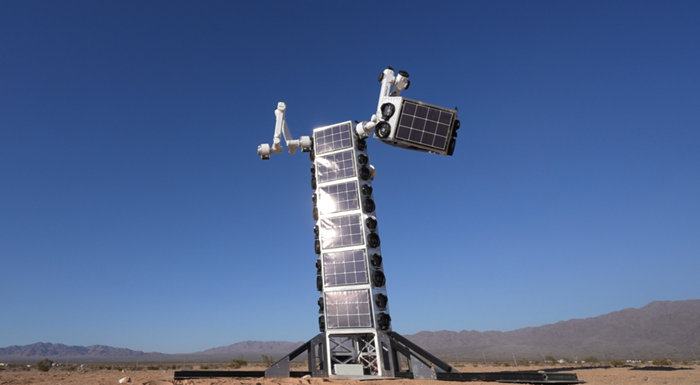
GITAI is building a comprehensive on-orbit servicing system to meet the growing market demand for ISAM (In-Space Servicing, Assembly, and Manufacturing). The company's robotic service systems cover on-orbit operation scenarios such as satellite inspection, maintenance, assembly, equipment handling, and infrastructure support. Its robotics technology includes a self-developed robotic arm system and the "Inchworm" robot, capable of autonomous and remote-controlled operations to complete tasks in microgravity environments. The "Inchworm" is designed to traverse large areas using handrails and anchor points on orbital structures while performing servicing and assembly tasks. The target application scenarios for these systems include future orbital infrastructure construction, satellite on-orbit servicing, and maintenance activities for space stations and spacecraft platforms. GITAI Founder and CEO Sho Nakanose has previously stated publicly that the company is actively developing spacecraft with rendezvous and docking, repair, inspection, and life extension service capabilities to provide commercial and government on-orbit satellite services to customers.
Lunar infrastructure development is another main focus of GITAI's expansion. The company is advancing lunar construction technologies to support long-term human activities on the lunar surface. GITAI's lunar robotics product line includes lunar rover systems and robotic manipulation technologies for construction support, material handling, inspection, and surface operations in the harsh lunar environment. The company has verified the performance of its "Inchworm" type robotic arm under extreme conditions including simulated lunar regolith exposure, thermal vacuum, vibration, and radiation, achieving Technology Readiness Level 6 (TRL-6). In a collaborative test with Japanese telecommunications operator KDDI, GITAI's lunar rover and three "Inchworm" robots successfully built a 5-meter-high communication tower in a simulated lunar environment, completing the full set of procedures including connecting power cables, testing system functions, and disassembling the antenna and tower body.
The company states in its official materials that its robotic systems aim to "provide safe, efficient, and economical robotic labor solutions" for building lunar infrastructure such as communication towers, solar panels, and habitats, supporting NASA's In-Situ Resource Utilization (ISRU) projects and lunar colonization plans. GITAI has also secured a contract from the Japan Aerospace Exploration Agency (JAXA) to conduct a robotic arm concept study for Japan's participation in NASA's Artemis program crewed pressurized lunar rover, where the arm will perform tasks such as lunar soil excavation, rock and soil sample collection, and large payload handling during unmanned periods.
Founded in 2016 and headquartered in Torrance, California, GITAI relocated from Japan to the U.S. in 2023 and maintains a subsidiary in Tokyo, Japan. In April 2026, the company announced the establishment of a new subsidiary, GITAI Defense and Space LLC, focused on national security missions. The company has cumulatively secured contracts from multiple government agencies including NASA, the Defense Advanced Research Projects Agency (DARPA), and the U.S. Space Force, and successfully launched and operated its first self-developed 16U satellite via a SpaceX Falcon 9 rocket in December 2024, completing on-orbit technology verification. In early 2025, the company announced it had received a JAXA contract, and later that year was selected by the U.S. Space Force's Space Systems Command to participate in the "Space-Based Interceptor" (SBI) program.
This article is compiled by Wedoany. All AI citations must indicate the source as "Wedoany". If there is any infringement or other issues, please notify us promptly, and we will modify or delete it accordingly. Email: news@wedoany.com