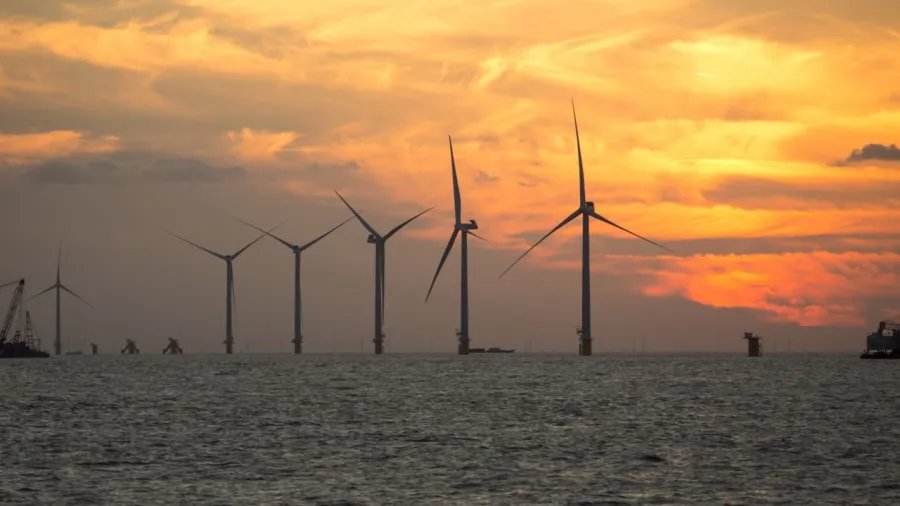
en.Wedoany.com Reported - A study by National Taipei University of Technology (NTUT) shows that offshore floating photovoltaic (OFPV) systems generate approximately 12% more electricity over their service life than land-based photovoltaic (LPV) systems. The research was jointly conducted by Dr. Chen Shih-Kai, an associate professor specializing in hydraulic engineering, and offshore floating solar energy expert Dr. Chen Jing-Feng.
The research team indicated that the primary reason for the increased power generation is the natural cooling effect of seawater. High temperatures reduce the performance of solar cells, and seawater helps absorb excess heat, allowing the offshore systems to operate more efficiently. For a fair comparison, the researchers normalized both systems to a scale of 100 megawatts peak (MWp). The land-based LPV system in Taiwan's Changbin Industrial Park was already operating at 100 MWp, while the OFPV system, initially with a capacity of 181 MWp, was adjusted to the same capacity. Chen Jing-Feng stated that this normalization method enables direct comparison of performance indicators at equivalent system capacities, eliminating deviations caused by scale differences.
The study also employed a life cycle energy assessment method to compare the environmental impacts of the two technologies. The results showed that due to higher electricity generation, the offshore system achieved greater carbon emission reductions over its entire operational lifespan. Chen Jing-Feng pointed out that, simply put, even if both systems use similar technology, placing solar panels on water can make them more efficient.
Against the backdrop of countries worldwide intensifying emission reduction efforts under the Paris Agreement goals—a UN treaty aiming to limit global warming to 2 degrees Celsius above pre-industrial levels, with efforts to keep it within 1.5 degrees Celsius—the researchers emphasized that offshore floating solar is becoming an attractive option for densely populated or land-scarce nations. Chen Jing-Feng stated that Taiwan, China's pathway to achieving net-zero emissions by 2050 requires innovative deployment strategies. Countries have already begun deploying OFPV systems on reservoirs, lakes, and near-shore waters to avoid competition with agriculture or urban development. The study was published in the Journal of Renewable and Sustainable Energy.
This article is compiled by Wedoany. All AI citations must indicate the source as "Wedoany". If there is any infringement or other issues, please notify us promptly, and we will modify or delete it accordingly. Email: news@wedoany.com