U.S. NLR Research Reveals the Root of Memory in V₂O₅ Optoelectronic Synaptic Material
en.Wedoany.com Reported - A research team led by the National Renewable Energy Laboratory (NLR) has revealed the root cause of persistent photoconductivity in optoelectronic synaptic materials, laying the foundation for neuromorphic vision applications. The findings were published in *Advanced Functional Materials*.
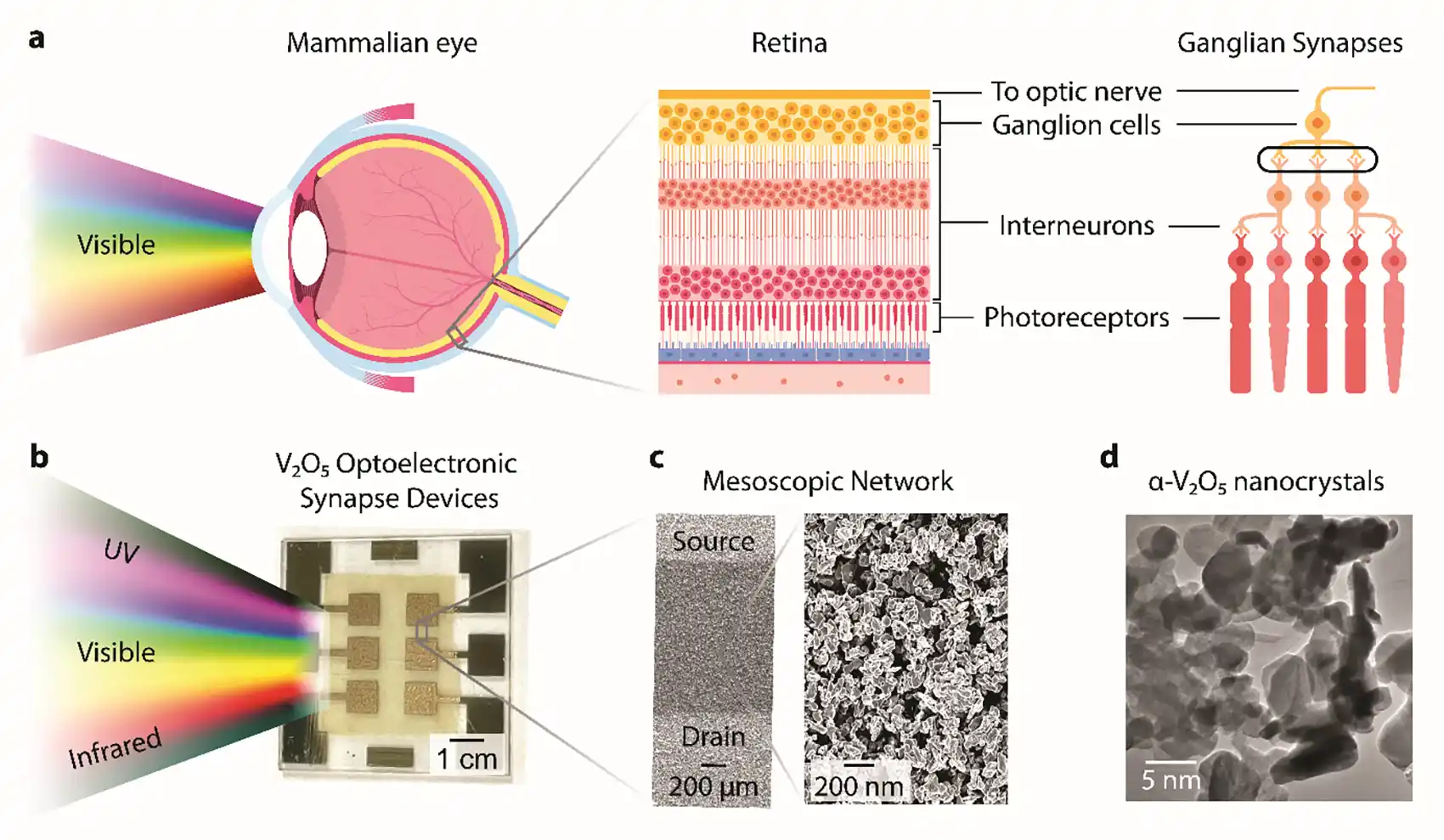
The human visual system functions as both a sensor and a processor, parsing images with extremely low energy consumption, but scientists have struggled to replicate it. Optoelectronic synaptic technology can reproduce some visual functions, and the NLR team, while studying vanadium oxide materials like V₂O₅, discovered the key mechanism behind their excellent performance.
In their paper "Interlayer Exciton-Polarons in Mesoscopic V₂O₅ for Broadband Optoelectronic Synapses," published in *Advanced Functional Materials*, the NLR-led research team points out that the root of persistent photoconductivity—a mechanism that mimics biological synaptic function—lies in specific structures within the material. This research is part of the U.S. Department of Energy's "Reconfigurable Electronic Materials Inspired by Nonlinear Neuron Dynamics" (reMIND) Energy Frontier Research Center, funded by the Office of Science Basic Energy Sciences program, and was completed in collaboration with researchers from Lawrence Berkeley National Laboratory, Texas A&M University, and the Institute of Structure of Matter of the National Research Council of Italy.
"This work builds on years of past optoelectronic research, but it also presents a fundamental discovery: how certain atomic vacancies lead to longer photoresponse times, which is key for eye-like vision and applications such as multispectral imaging, sensing, and communication," said Lance Wheeler, an NLR scientist and co-author.
Scientists have known about the phenomenon of persistent conductivity in certain oxide crystals after light exposure, but the exact cause has been debated. The team elucidated the role of oxygen vacancies by modeling, fabricating, and testing optoelectronic synaptic devices based on α-phase V₂O₅. They discovered that oxygen vacancies in V₂O₅ crystals trap charges from incident light, forming polarons that give the crystal a "memory." While the charges persist, the crystal retains a record of the light, which can be read through electrodes. During fabrication, researchers can tune the properties of this optical memory to adjust sensitivity and response time.
When the team irradiated the material with light pulses of different wavelengths, they observed persistence exceeding 25 minutes. This decay time is functionally similar to neural synapses and is associated with memory mechanisms in the brain such as long-term potentiation and plasticity.
This research opens a direction for creating a new generation of materials with tunable memory and machine vision. Due to their synapse-mimicking properties, such crystals can simplify circuits, reducing energy consumption and signal interference. They can also sense infrared light, a capability the human eye lacks. With broadband light sensitivity and the ability to be attached to flexible glass, crystals like V₂O₅ can be applied in neuromorphic vision fields, such as robotics, edge electronics, distributed sensing, and bioengineering.
"An important outcome of this research is identifying the role of polarons in enabling tunable persistent photoconductivity in this class of oxide materials," said Jeffrey Blackburn, an NLR researcher and co-author. "This insight—combined with areas such as low-cost polycrystalline materials, scalable device fabrication methods, broadband sensitivity, and flexible substrates—opens up possibilities for leveraging similar mechanisms in a wide range of materials and light-driven neuromorphic device architectures."
This article is compiled by Wedoany. All AI citations must indicate the source as "Wedoany". If there is any infringement or other issues, please notify us promptly, and we will modify or delete it accordingly. Email: news@wedoany.com
Related Products


Mine Explosion-proof and Intrinsically Safe Industrial Ethernet Ring Network (10 Gigabit/Gigabit)
Chongqing Mas Sci&Tech Co., Ltd.


20 Inch 1600*900 Full HD 60Hz TFT LED Monitor with VGA and DP Interfaces for Desktop Computers-Business Use
Guangzhou Zanying Optoelectronics Technology Co., Ltd.

GYTA Type Non-Self-Supporting Aerial/Duct Optical Cable
TONGDING INTERCONNECTION INFORMATION CO., LTD.
Comprehensive Mining Automation Control System
Beijing Tianma Intelligent Control Technology Co., Ltd.
Flat Portable Satellite Terminal 0.35m Aperture Manual Portable Terminal
China Starwin Science & Technology Co., Ltd.

G.652.D Wavelength-extended Non-dispersion Shifted Single-mode Optical Fiber
HONGAN GROUP CO., LTD.