German Kronos Mechatronics Wins LOPEC 2026 Startup Award, In-Mold Electronics Technology Enters Automotive Lightweight Manufacturing
en.Wedoany.com Reported - Recently, German Kronos Mechatronics GmbH won the "Best Business Potential" category award at the Startup Award during LOPEC 2026 in Munich, Germany. The company's award-winning project, themed "Printing the Future in Every Dimension," revolves around a modular five-axis additive manufacturing system, Aion-5X software, and freeform surface 3D electronics manufacturing capabilities, indicating that the commercialization potential of printed electronics and in-mold electronics (IME) technologies in fields such as automotive manufacturing, advanced electronics, and MEMS is expanding.
LOPEC is a key exhibition and conference platform for the large-area, organic, and printed electronics sector. The 2026 Startup Award ceremony took place on February 25 at the LOPEC Forum, with categories including "Best Business Potential" and "Most Impactful Technology/Product." Kronos Mechatronics receiving the business potential award suggests that the judging criteria focus not only on the novelty of individual technologies but also on scalability, market adaptability, business models, and industrial ecosystem interfaces. Public information indicates that award winners will receive support for a startup booth at LOPEC 2027, helping them continue to engage with customers, investors, and potential partners in the printed electronics industry chain.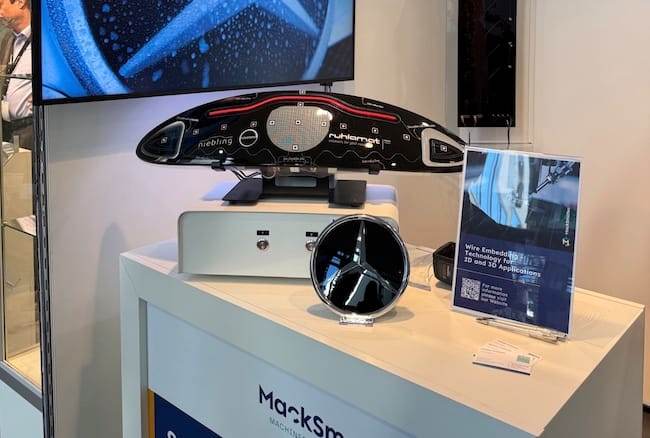
Kronos Mechatronics' technological direction is closely related to in-mold electronics. IME typically integrates functions such as conductive traces, sensing, lighting, heating, or touch controls onto the surface or inside of three-dimensional plastic parts, combining aesthetic, structural, and electronic functional components within a single manufacturing process. Compared to traditional wiring harnesses and discrete electronic modules, IME solutions can arrange conductive traces within curved structures, reducing the wiring harness network behind components, housing space, and assembly steps. For the automotive industry, instrument panels, center consoles, door trim panels, seat control areas, ambient lighting, heating elements, and touch surfaces are all high-value scenarios where this technology could potentially be applied.
Automotive manufacturing is providing a clearer entry window for printed electronics. The demand for sensing, lighting, heating, and interactive functions inside vehicles continues to increase. Traditional approaches often require more wiring harnesses, connectors, brackets, and assembly processes, which add weight and increase pressure on design space. IME can embed electronic functions into decorative and structural surfaces, making interior components thinner and lighter, and freeing up space behind dashboards and interior parts. IDTechEx noted during observations at LOPEC 2026 that companies including Kronos Mechatronics, MackSmaTec, Tactotek, and KAIXIN AC all showcased IME solutions for automotive applications, involving applications such as interior upgrades, heating element integration, and colored lighting integration.
Kronos Mechatronics publicly describes its platform as software-defined manufacturing, with its core comprising Aion-5X, a modular multi-material toolset, and five-axis freeform surface manufacturing capabilities for functional 3D electronics. This path differs from traditional two-dimensional printed circuit boards, focusing on enabling electronic functions to enter three-dimensional structural parts and forming a "Land & Expand" scaling logic through hardware, upgrade modules, and software. If this technology enters the automotive supply chain, subsequent steps will require not only proving prototype functionality but also passing stages involving material durability, thermal cycling, vibration, long-term reliability, batch consistency, automotive-grade validation, and cost accounting.
The industrialization of in-mold electronics is still in a critical phase of moving from demonstrating prototypes to mass production validation. Automakers typically have long cycles for introducing new types of electronic structural parts, as vehicle platforms must meet requirements for safety, weather resistance, repairability, supply chain, and quality systems. If IME is to replace some wiring harnesses or traditional electronic modules, stable solutions must be formed regarding material systems, forming processes, conductive inks, connection reliability, inspection methods, and automated production line compatibility. Kronos Mechatronics receiving the Business Potential Award at LOPEC reflects industry platform recognition of its technical route and business model, but does not equate to its related products having already entered the stage of mass supply for complete vehicles.
Subsequent milestones for the project include prototype validation of the Kronos Mechatronics platform in scenarios such as automotive interiors, advanced electronics, aerospace, defense, and MEMS; customer adoption of the Aion-5X software and five-axis manufacturing equipment; mass production validation of the IME process regarding materials, reliability, and cost; and more industry collaboration showcases during LOPEC 2027. Currently available public information does not disclose a list of automotive OEM customers, order values, mass production timelines, or specific vehicle model applications. Therefore, this award should not be extrapolated to mean that bulk orders from automotive OEMs have already been secured.
This article is compiled by Wedoany. All AI citations must indicate the source as "Wedoany". If there is any infringement or other issues, please notify us promptly, and we will modify or delete it accordingly. Email: news@wedoany.com
Related Products


MUX Series Communication Interface Device for Security and Stability Control System
Nanjing NR Electric Co., Ltd.
Conveyor Belt Intelligent Monitoring System
LUO YANG WIRE ROPE INSPECTION TECHNOLOGY CO., LTD.


Hot Selling 10 Inch Intel N5100 I5 I7 FHD 8 +128GB 16+256GB Win10 Pro Win11 Pro 4G 5G Rugged Tablet PC Pad with NFC Barcode
Highton Electronics Co., Ltd.


Flat Portable Satellite Terminal 0.35m Aperture Manual Portable Terminal
China Starwin Science & Technology Co., Ltd.