en.Wedoany.com Reported - On June 2, with the "Yongqing" shield machine successfully emerging from a depth of 66 meters underground at Sanshan Shaft, the first section of the Xilang Tunnel on the Guangzhou Station to Guangzhou South Station Link (hereinafter referred to as the "Guangzhou-Nanning Link"), constructed by the Guangzhou Engineering Construction Headquarters of China Railway Guangzhou Group Co., Ltd. and undertaken by China Railway 11th Bureau Group Co., Ltd., achieved a breakthrough. This marks a significant milestone in the "high-speed rail entering the city" construction of the Guangzhou railway hub.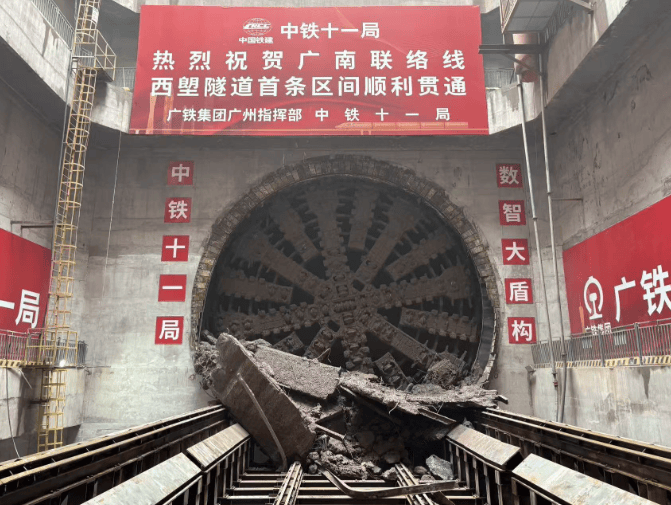
As a key project to improve the comprehensive transportation network of the Guangdong-Hong Kong-Macao Greater Bay Area, the Guangzhou-Nanning Link is an important part of the "high-speed rail entering the city" construction of the Guangzhou railway hub. With a total length of 16 kilometers and a design speed of 200 km/h, the 13.2-kilometer Xilang Tunnel is the critical control project of the entire line (including an 11.8-kilometer shield section). It is the first super-large diameter high-speed rail tunnel in central Guangzhou and the large-diameter shield railway tunnel with the smallest turning radius in South China. Featuring complex geological conditions, high construction difficulty, and significant safety risks, it is the core challenge of the project. Three large-diameter shield machines are excavating in three sections, with a cumulative excavation of 8,382 meters completed, accounting for 71% of the total shield excavation.
Since the start of construction, the project team has customized intelligent equipment for the "Yongqing" shield machine, innovated construction techniques, integrated an electronic fence positioning system, and installed a "digital protective shield" for construction safety based on the BeiDou Navigation Satellite System. They have implemented round-the-clock automated monitoring of risk sources, adjusted excavation parameters in real time with millimeter-level precision, and successfully solved five major high-risk challenges: extremely small-radius turning, shallow overburden launching, crossing under dense risk sources, excavation in soft and composite strata, and receiving in ultra-deep shafts. The excavation task was completed accurately, safely, and efficiently, setting multiple construction records in South China. The team achieved a monthly excavation of 376 meters for a 12-meter-class shield machine in composite mudstone strata in the South China region, with an average monthly excavation length exceeding 250 meters.
The Sanshan Shaft, where the shield machine successfully emerged, is one of the deepest shield shafts under construction for railways in South China, with an excavation depth of 66 meters (equivalent to about 22 stories). It serves three functions: shield receiving, ventilation, and connecting passage. The construction team overcame challenges such as ultra-high water pressure and complex geology, using an intelligent cooling temperature measurement system to address anti-seepage and anti-cracking issues in the ultra-deep foundation pit. This provided a precise "underground parking lot" for the "Yongqing" shield machine and accumulated valuable experience for the national "deep earth development" strategy.
According to Liu Defeng, the lead engineer of the Guangzhou-Nanning Section Command of the Guangzhou Engineering Construction Headquarters, upon completion, the project will connect key railway hubs such as Guangzhou Station, Guangzhou Baiyun Station, and Guangzhou South Station, significantly enhancing the interconnectivity of rail transit in the Guangdong-Hong Kong-Macao Greater Bay Area. High-speed trains from Shenzhen, Hong Kong, Zhuhai, and Macau will be able to directly reach central Guangzhou, reducing travel time from Guangzhou South Station to the city center from 40 minutes to 15 minutes.
This article is compiled by Wedoany. All AI citations must indicate the source as "Wedoany". If there is any infringement or other issues, please notify us promptly, and we will modify or delete it accordingly. Email: news@wedoany.com