en.Wedoany.com Reported - IsoEnergy (NYSE American: ISOU | TSX: ISO) has initiated an approximately 8,000-meter summer drilling program at the Larocque East project, planning up to 20 holes targeting the Hurricane South Trend, aiming to determine whether mineralization extends beyond the current 48.6 million pounds of uranium resources, considered the world's highest-grade indicated uranium resource. This program follows the 2026 winter drilling, which returned 3.5 meters grading 4.21% uranium oxide, including 1 meter grading 11.61% uranium oxide, within the newly interpreted L Fault Zone, located approximately 525 meters east of the current resource boundary. The result confirms a new structural control of mineralization and demonstrates that high-grade uranium exists outside the July 2022 resource envelope, making the continuity of the South Trend a key determinant of whether the deposit can support future resource growth.
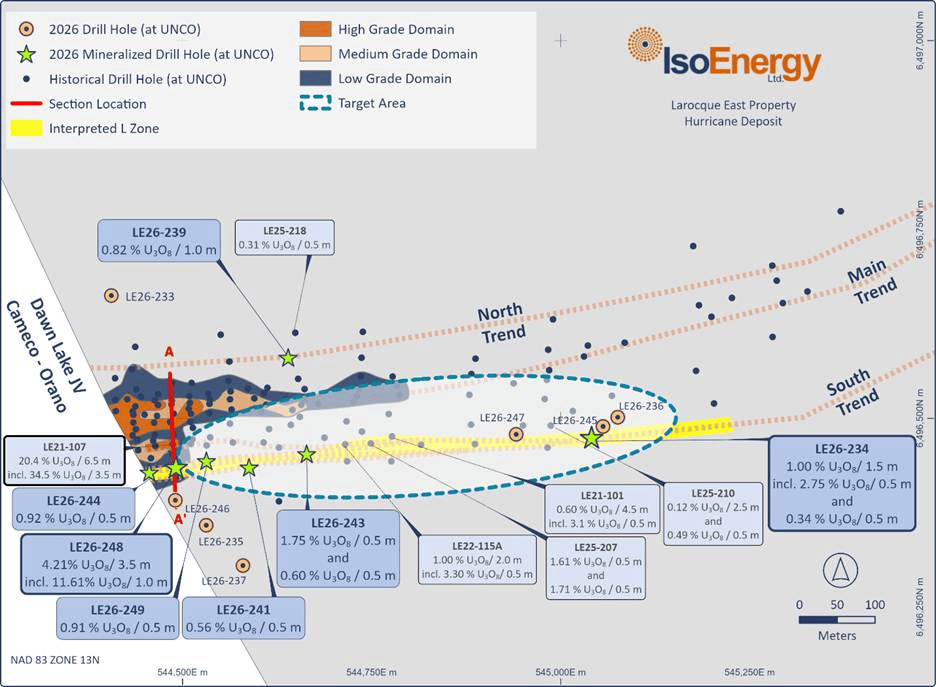
Prior to the 2026 winter program, drill density along the southernmost known fault zone of the Hurricane South Trend was lower than that of the northern, intensely mineralized fault zones, leaving portions of the structural corridor under-tested and unable to be included in future resource growth. Winter drilling along the extension of the J-L Fault corridor returned high-grade uranium oxide and identified a new structural control, repositioning the South Trend from a peripheral target to a potential resource expansion zone.
High-grade Athabasca Basin uranium deposits are concentrated in irregular, narrow lenses along structural corridors, meaning that a lack of results in widely spaced drill holes does not negate the areas between holes, and the resource boundary may remain open. IsoEnergy CEO Phil Williams described this exploration dynamic, noting that the interesting thing about these deposits is that they are very small and can hide mineralized lenses containing 5 to 10 million pounds of high-grade material between drill holes, and being just 2 feet off can miss the mineralization.
The winter intercept confirmed uranium oxide mineralization in the L Fault Zone but did not confirm continuity, which is required for resource conversion. The summer program of 20 holes aims to determine whether the L Fault Zone has consistent mineralization along strike and whether that mineralization is close enough to the current resource envelope to meet the drill density thresholds required by National Instrument 43-101 for indicated or inferred classification. Discovery and resource growth are not the same outcome, and the summer results are seen as the first test of whether the L Fault Zone can develop into the latter.
Defining the southern boundary of Hurricane has become more important as Cameco Corporation and Orano continue to report high-grade mineralization on the Dawn Lake joint venture immediately west of the deposit, increasing the possibility that additional drilling could expand the mineralization currently attributed to Hurricane. The currently defined Hurricane deposit straddles a shared property boundary, and Cameco has been actively drilling on its side of the boundary. Williams noted that Cameco has publicly disclosed encountering high-grade mineralization, with grades, sizes, and scales similar to those seen at other mines in the basin, suggesting the area could host a high-grade, large-scale mine comparable to Cigar Lake and McArthur River, the world's two largest mines producing 18 million pounds annually.
IsoEnergy noted that 2025 drilling at Dawn Lake continued to expand known high-grade mineralization, with results comparable to those from other operating mines in the basin, supporting a regional-scale system spanning the property boundary, but did not confirm Hurricane-style mineralization on IsoEnergy's southern claims. Mineralization on adjacent claims does not necessarily indicate mineralization at Larocque East.
Hurricane's indicated resource of 48.6 million pounds at 34.5% uranium oxide remains unmatched among undeveloped eastern Athabasca Basin projects; the second highest indicated grade is the Tamarack deposit at 4.42% uranium oxide. The high-grade zone of this deposit alone contains 43.9 million pounds at 52.1% uranium oxide, located approximately 40 kilometers from the McClean Lake mill at a depth of about 325 meters, compared to Cigar Lake's depth of about 450 meters. Against the backdrop of the World Nuclear Association's 2025 Fuel Report forecasting that uranium supply will only meet 46% of demand in the 2040 reference scenario, any increase to Hurricane's current resources would add pounds to one of the highest-grade and best-positioned undeveloped uranium assets in the global supply pipeline.
The main catalysts for the remainder of 2026 are assay results from up to 20 summer drill holes targeting the J-L Fault corridor, with the key question being whether the 2026 winter intercept shows sufficient continuity along the South Trend to support National Instrument 43-101 resource modeling and a potential update to the current 48.6 million pounds indicated resource. Beyond Larocque East, investors should also watch for Tony M's targeted 2026 preliminary economic assessment following completion of an approximately 2,100-tonne bulk sample program, which could support a production decision, as well as progress on drill targets at East Rim, Ranger, Trident, and Evergreen, representing IsoEnergy's pipeline of next discovery opportunities beyond Hurricane.
This article is compiled by Wedoany. All AI citations must indicate the source as "Wedoany". If there is any infringement or other issues, please notify us promptly, and we will modify or delete it accordingly. Email: news@wedoany.com