en.Wedoany.com Reported - The range of acoustic products and systems from UK-based Hush Acoustics can be used in therapy and consultation rooms, helping practitioners meet client confidentiality and privacy needs while ensuring a comfortable and tranquil space.
Thousands of small health, fitness, beauty, and wellness businesses across the UK offer personal care and services, many of which complement NHS services. While large medical facilities like hospitals must adhere to minimum acoustic standards such as Health Technical Memorandum 08-01, new builds and refurbishments of small private clinics still need to comply with Building Regulations (e.g., Part E in England and Wales), even if planning permission is not required.
Beyond compliance, good acoustic control has commercial benefits for improving patient satisfaction. Sound insulation and noise control help create an appropriate environment, ensuring patients feel comfortable and safe, thereby increasing the likelihood of repeat appointments.
Hush Acoustics offers solutions for reducing sound transmission through walls, floors, and ceilings, as well as measures to optimize background noise within therapy rooms. Best practice is to consider and address these potential disturbances during the design phase.
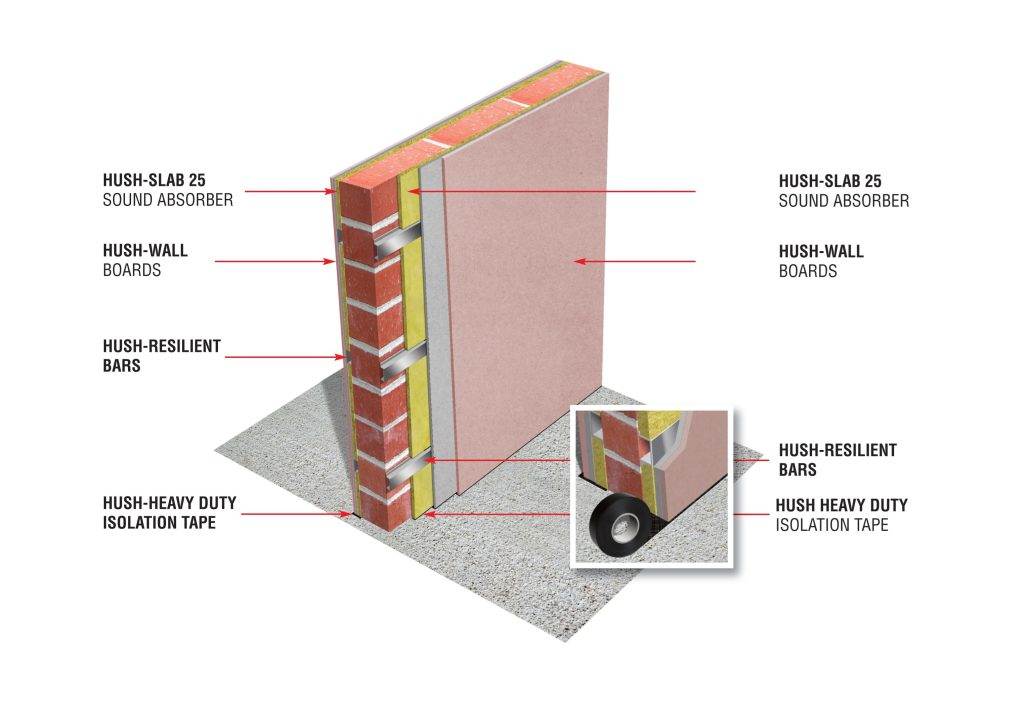
To ensure adequate sound insulation for walls, floors, and ceilings, fully tested off-the-shelf acoustic systems from Hush Acoustics can be used. These systems are suitable for various construction types, such as masonry, timber, or steel, and target different sound insulation ratings.
For example, to reduce sound transmission through metal stud walls so that conversations cannot be heard in adjacent rooms (e.g., waiting rooms), the Hush HD1053 single metal stud wall or HD1052 double metal stud wall can be used. For masonry walls, the HD1041 acoustic wall lining system or the HD1057 masonry acoustic system can be deployed.
Floors and ceilings in therapy rooms can be effectively treated using Hush systems, suitable for timber and concrete/masonry floor structures. Each system is designed as a floating floor, decoupling the floor surface from the structure and absorbing impact noise from activities like footsteps. The systems also include materials to reduce airborne sound transmission (e.g., Hush Slab acoustic panels), with all perimeters sealed to prevent flanking sound transmission.
In some cases, custom acoustic systems can provide the most effective solution, achieved by modifying existing systems or through entirely new designs utilizing the Hush Acoustics product range, which includes metal frame ceiling systems, resilient channels, acoustic battens, rubber floor mats, high-density overlay boards, and isolation strips.
Comfortable acoustic conditions must be maintained within the therapy room. If a room has many hard surfaces and little soft furnishing, sound waves can reflect, causing disruptive reverberation. This can be addressed by installing Hush Absorber acoustic panels on walls and ceilings. These panels feature a special acoustic foam core with a fabric outer layer, effectively reducing reverberation, provided sufficient absorbent surface area is correctly positioned within the room.
For therapy rooms used for purposes like physiotherapy or fitness training, consideration must be given to noise transmitting via vibration to adjacent rooms. If the floor is likely to be subjected to heavy impacts (e.g., from exercise movements or dropped barbells), customized vibration damping measures from Hush Acoustics should be incorporated into the floor and ceiling, adding further sound absorption.
This article is compiled by Wedoany. All AI citations must indicate the source as "Wedoany". If there is any infringement or other issues, please notify us promptly, and we will modify or delete it accordingly. Email: news@wedoany.com