Kazakhstan's Ministry of Agriculture Says It Will Maintain the Agricultural Coupon Subsidy Mechanism
en.Wedoany.com Reported - Kazakhstan's Minister of Agriculture, Aidarbek Saparov, stated at a plenary session of the Senate that the current coupon subsidy mechanism is an efficient and most balanced tool for supporting the agricultural sector, capable of maintaining affordable loan conditions for farmers while attracting private capital.
According to the Minister, this mechanism provides an alternative to budget loans. To alleviate the burden on the republic's budget, Kazakhstan has chosen to subsidize bond loan coupons, thereby attracting a significant amount of off-budget funds into industry financing.
Thanks to this tool, approximately 700 billion tenge was used to finance spring sowing and harvesting operations, covering about 8.5 million hectares of sown area and around 8,000 agricultural producers. Among them, 96% of beneficiaries are small enterprises, 3% are medium-sized enterprises, and 1% are large enterprises.
The application of this mechanism is one of the factors behind the agricultural sector achieving record harvests for two consecutive years. At the same time, efforts to diversify the sowing structure continue: over the past two years, the area sown with wheat has decreased by 1 million hectares to 12.1 million hectares, the area for oilseed crops has increased by 1.1 million hectares to 4.1 million hectares, and the area for legumes has increased by 300,000 hectares to 800,000 hectares.
Export revenue from the agricultural complex reached $7 billion, equivalent to approximately 3.5 trillion tenge. Ministry data also shows that every 1 trillion tenge in preferential loans can drive the industry to generate a total agricultural complex output of up to 15 trillion tenge.
The Ministry noted that transferring part of the coupon payment obligations to Kazakhstan's Agricultural Credit Corporation (AKK) and Kazakhstan's Agricultural Finance Corporation (KAF) would lead to an increase in their financial costs, which would ultimately be passed on to borrowers. This could trigger a rise in the cost of credit resources for entities in the agricultural sector and reduce the accessibility of preferential financing.
The Minister also emphasized that, according to the Law on State Property and the Budget Code, quasi-state companies, including the Agricultural Credit Corporation and the Agricultural Finance Corporation, are required to remit at least 70% of their profits to state revenue in the form of dividends. The profits of these organizations are thus returned to the national economy and used for purposes including agricultural development.
This article is compiled by Wedoany. All AI citations must indicate the source as "Wedoany". If there is any infringement or other issues, please notify us promptly, and we will modify or delete it accordingly. Email: news@wedoany.com
Related Products




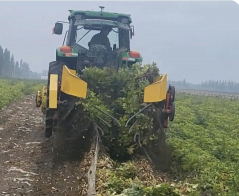
4HS-8 High-efficiency Peanut Inverted-laying Harvester
Hebei Yongfa Hongtian Agricultural Machinery Manufacturing Co., Ltd.
Industrial and Commercial Point-Type Gas Detector
Jinan Benan Technology Development Co., Ltd.


MH220E Two-Row Hybrid Packaged Cotton Picker
CHINA RAILWAY CONSTRUCTION HEAVY NDUSTRY XINJIANG CO., LTD.
714CD Series C-Band Weather Radar
Chengdu Zhongdian Jinjiang Information Industry Co., Ltd.