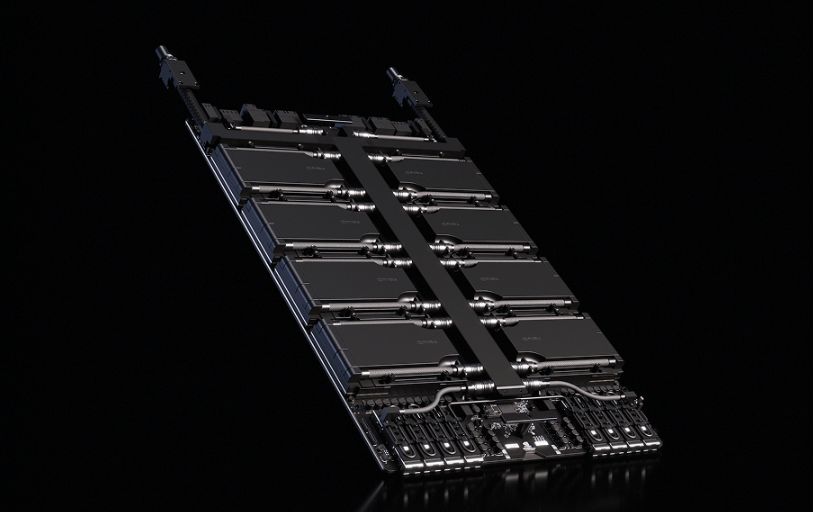
en.Wedoany.com Reported - On June 22, NVIDIA announced the launch of the Vera Rubin supercomputing platform for scientific computing, stating that systems based on the Vera Rubin NVL4 are expected to be available from global system manufacturers starting in the fourth quarter of 2026. The platform targets high-intensity HPC and AI converged workloads such as climate modeling, computational fluid dynamics, quantum chemistry, and energy exploration, emphasizing the operation of traditional high-precision simulation, AI training and inference, and data-intensive scientific research tasks on a single accelerated computing platform.
The Vera Rubin platform consists of the NVIDIA Rubin GPU and the NVIDIA Vera CPU, achieving system-level integration through NVLink-C2C, ConnectX-9 SuperNIC, BlueField-4 DPU, and a direct liquid cooling architecture. NVIDIA stated that the platform features native double-precision FP64 capability, serving scientific simulation tasks requiring high-precision numerical computation, while also supporting new scientific research computing scenarios such as scientific foundation models, surrogate models, and AI-assisted analysis.
In terms of performance metrics, the Vera Rubin supercomputing system can deliver over 7 exaflops of AI scientific computing performance and 5 petaflops of native FP64 performance, providing extremely high memory bandwidth through a system density of up to 144 GPUs. NVIDIA claims that this single-rack-level system performance can approach that of some systems on the TOP500 supercomputer list, enabling research institutions and industrial enterprises to run larger models, improve simulation accuracy, and shorten computing cycles within a smaller deployment footprint.
The release of the Vera Rubin NVL4 focuses not only on AI inference performance but also on strengthening FP64 capabilities for scientific computing scenarios. Traditional HPC tasks heavily rely on double-precision floating-point operations, used in fields such as meteorology, fluid dynamics, materials science, energy, life sciences, and engineering simulation. While some past AI acceleration platforms leaned more towards low-precision training and inference, Vera Rubin's emphasis on native FP64 support indicates that NVIDIA is further pushing the AI factory architecture into national laboratories, supercomputing centers, and industrial research institutions.
Multiple system vendors will launch high-density supercomputing systems based on this architecture. NVIDIA's announcement shows that global system manufacturers including Bull, Dell Technologies, Gigabyte, HPE, and Supermicro will bring the NVIDIA Vera Rubin NVL4 to market for direct liquid-cooled AI and HPC racks. Dell Technologies simultaneously released the PowerEdge XE8812 server, adopting the NVIDIA Vera Rubin NVL4 architecture, scalable up to 144 GPUs per rack in the Dell PowerRack 9100, targeting high-intensity HPC and AI workloads.
Supermicro also released an end-to-end data center building solution based on the NVIDIA Vera Rubin NVL4. Its solution includes a liquid-cooled rack combination of up to 1152 NVIDIA Rubin GPUs and 576 NVIDIA Vera CPUs, a 3.2MW scalable unit targeting AI workloads and FP64 simulation, accompanied by direct liquid cooling, power distribution, and data center-level integration blueprints.
Regarding deployment projects, NVIDIA stated that the Blue Lion system at the Leibniz Supercomputing Centre in Germany, the Doudna system at the U.S. Department of Energy's National Energy Research Scientific Computing Center, and the next-generation supercomputing system at Los Alamos National Laboratory will adopt the Vera Rubin platform for tasks including open science, energy exploration, earth sciences, and national security. Blue Lion is scheduled to go online in 2027, powered by the Vera Rubin platform and second-generation HPE Cray exascale-class supercomputing technology, with computing power approximately 30 times that of the center's existing system.
For the supercomputing industry, the Vera Rubin NVL4 reflects the trend of further convergence between HPC and AI architectures. Research institutions no longer require only traditional numerical simulation but also need to integrate AI surrogate models, scientific foundation models, real-time data streams, and visual analysis into the same computing workflow. NVIDIA's integrated design of GPU, CPU, interconnect, DPU, networking, and liquid cooling aims to reduce the complexity of deploying AI-HPC hybrid systems in scientific computing centers.
However, the platform is currently still in the release and pre-launch preparation phase. Vera Rubin NVL4 systems are expected to ship starting in the fourth quarter of 2026, with the actual delivery pace depending on system manufacturer production, liquid cooling infrastructure, customer data center conditions, supply chain, and large-scale supercomputing project construction timelines. For research institutions and enterprises planning to deploy this platform, factors beyond performance metrics, such as energy consumption, heat dissipation, system reliability, software migration, and operational capabilities, are also critical.
Key points for subsequent observation will focus on the official configurations of various vendors' Vera Rubin NVL4 systems, shipping schedules, initial customer deployment status, and real-world performance in FP64 scientific computing and AI-assisted research tasks. If the systems enter the market on schedule, NVIDIA will further strengthen its dominant position in next-generation supercomputing platforms beyond AI infrastructure.
This article is compiled by Wedoany. All AI citations must indicate the source as "Wedoany". If there is any infringement or other issues, please notify us promptly, and we will modify or delete it accordingly. Email: news@wedoany.com