China's XPeng Motors Leverages Amazon Cloud AI Platform, Reducing Defect Repair to 10 Minutes
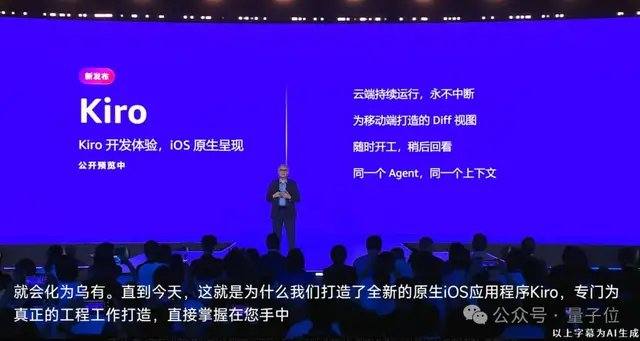
en.Wedoany.com Reported - XPeng Motors has built an internal enterprise AI programming and Agentic work platform named "Lingxi" based on Amazon Web Services' Kiro, Amazon Bedrock, Amazon EKS, and other services. This has achieved an AI code coverage rate exceeding 70%, the creation of over 700 internal Skills, connection to more than 400 API endpoints, over 100 AI-collaborated PRs daily, the completion of over 140,000 workflows, a success rate exceeding 99.7% across six core stages, zero P0 and P1 defects in delivered code, and a reduction in automated defect repair time from two days to 10 minutes.
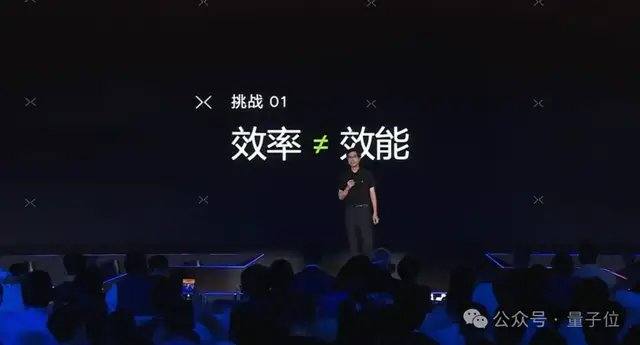
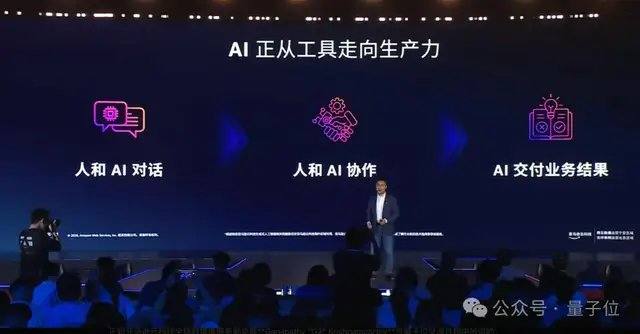
He Ruibang, Head of AI/Data Platform at XPeng Group, stated at the Amazon Web Services China Summit that while AI development tools were widely used within the enterprise in 2024, improving individual employee efficiency, there was no significant change in overall departmental effectiveness. The reason is that complex projects still require AI tools to complete code writing step-by-step, and subsequent manual integration, joint debugging testing, and CI/CD processes were not connected. Rubin Chu, Global Vice President at Amazon and Co-President of Amazon Web Services Asia Pacific, pointed out at the summit: "The inflection point for the explosion of Agentic AI has arrived. AI Agents are transforming from auxiliary tools into a digital workforce that truly participates in production and value creation." XPeng subsequently recognized that point efficiency does not equal overall effectiveness.
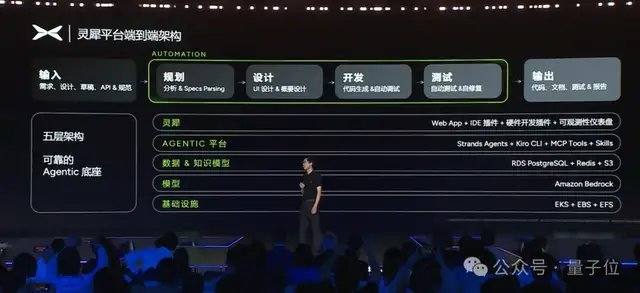
The "Lingxi" platform architecture is divided into five layers: The top layer is the developer entry point, including web interfaces, IDE plugins, and hardware development plugins. The next layer down is the Agent collaboration layer, which uses the Kiro core to solidify automotive industry development standards into Skills. The third layer is the data and knowledge layer, which consolidates R&D data and Agent execution process knowledge. The model layer leverages Amazon Bedrock for large model capabilities. The bottom layer of infrastructure is hosted by Amazon EKS, providing on-demand elastic computing power.
After this architecture was implemented, the most representative change occurred in the SRE process. Based on Amazon Bedrock, XPeng established four SRE Agents and a five-dimensional attribution mechanism, compressing the automated defect repair time from two days to 10 minutes. Similar bugs can be identified in seconds upon their next occurrence, with no manual intervention required throughout the process.
Moonshot AI's Kimi showcased its B-end business layout at the summit. Huang Zhenxin, Head of Kimi's B-end Business, stated that Kimi's long-term goal is to find the optimal solution for converting energy into intelligence, focusing specifically on three directions: improving model learning efficiency with limited data and computing power, extending context length, and enabling multi-Agent collaboration to complete complex tasks. Kimi improves token efficiency through architecture and training methods, making 10T of data achieve the effect of 20T. In the long-context direction, it is advancing a new linear attention architecture and improving efficiency through attention residuals. The recently released K2.7 Code High Speed version achieves an output speed of 180 token/s.
At the infrastructure level, Kimi obtains computing power support relying on Amazon Web Services' global data centers and network. At the platform service level, it integrates with Amazon SageMaker to support customer training and deployment of models. Kimi will subsequently integrate with Amazon Bedrock and is already listed on the Marketplace, allowing global customers to use it with one click and pay per usage. Kimi also expands enterprise customers through the APN Partner Network, jointly developing solutions covering industries such as finance, healthcare, and manufacturing with Amazon Web Services.
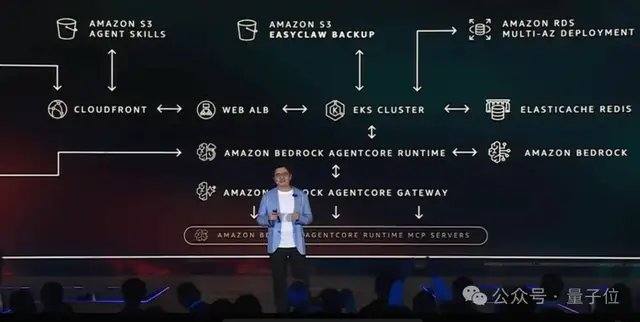
Regarding other enterprise cases, Cheetah Mobile CEO Fu Sheng shared the company's AI Native transformation. Its EasyClaw overseas enterprise version runs on Amazon Bedrock AgentCore, scheduling models based on task complexity—using lightweight models for simple tasks and high-performance models for complex tasks. Leveraging the serverless mode of Bedrock AgentCore, Cheetah Mobile pays based on usage, reducing Agent launch time from one month to two weeks and lowering operational costs by 25%. Insta360, based on its proprietary AI capabilities and a decade of imaging technology accumulation, and relying on Amazon Web Services' Agentic AI five-layer architecture, launched the cloud-based one-stop intelligent video production service "Moments Pro." Users can generate high-quality videos from captured footage in under a minute without manual editing.
Ding Jie, CEO of Bain & Company Greater China, believes that what CEOs should focus on is not the technology itself, but how to use technology to change the way enterprises create value. Companies need to redesign their business around human-machine collaboration, letting humans handle judgment, creativity, and responsibility, while digital employees handle speed, scale, and execution.
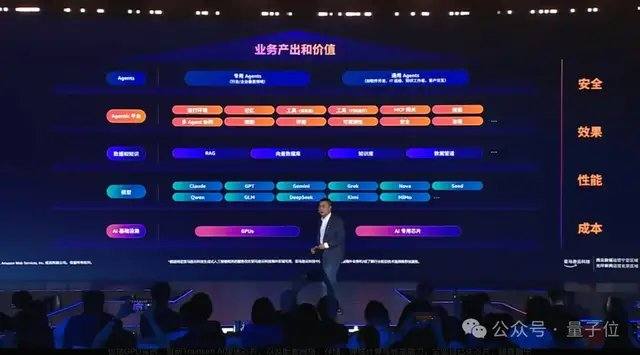
At the summit, Amazon Web Services proposed a five-layer technology stack for enterprise Agentic business transformation. The first layer is AI infrastructure, including GPU instances, proprietary Trainium chips, networking, storage, and elastic computing capabilities. The second layer is the model layer, where Amazon Bedrock provides a unified entry point for enterprises to call upon various large models on demand. The third layer is the data and knowledge layer, which transforms enterprise static data into AI-understandable and retrievable knowledge assets through services like Zero-ETL, Amazon S3 Vectors, Amazon Bedrock Knowledge Bases, and Amazon Context. The fourth layer is the Agentic platform layer, namely Amazon Bedrock AgentCore, responsible for the full lifecycle management of Agents from development and operation to iteration. The fifth layer is the Agent application layer, including products like Kiro for software development, Amazon Quick for knowledge workers, and Amazon Connect for customer service. Additionally, Amazon Web Services launched Amazon Continuum capabilities for Agent-era software security risks, covering discovery, prioritization, verification, and remediation.
Ganapathy "G2" Krishnamoorthy, Vice President of Global Database Services at Amazon Web Services, stated in an exchange with Qubit that the technology is already quite capable and evolving rapidly. What is truly needed is a change in work methods driven by leadership. Enterprises globally typically first validate value through PoCs before entering the phase of large-scale adoption.
This article is compiled by Wedoany. All AI citations must indicate the source as "Wedoany". If there is any infringement or other issues, please notify us promptly, and we will modify or delete it accordingly. Email: news@wedoany.com
Related Products


Mine Explosion-proof and Intrinsically Safe Industrial Ethernet Ring Network (10 Gigabit/Gigabit)
Chongqing Mas Sci&Tech Co., Ltd.
MUX Series Communication Interface Device for Security and Stability Control System
Nanjing NR Electric Co., Ltd.


TWP16 P-Band Tropospheric Wind Profile Radar
China Huayun Meteorological Technology Group Co., Ltd.

Automatic Aiming Laser Remote Obstacle Removal Robot
Pinggao Group Weihai High-Voltage Apparatus Co., Ltd.

GYTA Type Non-Self-Supporting Aerial/Duct Optical Cable
TONGDING INTERCONNECTION INFORMATION CO., LTD.