en.Wedoany.com Reported - A research team from Harbin Institute of Technology (Shenzhen) has published a new study in the journal Biochar, developing a hybrid solar evaporator that incorporates sorghum straw biochar into a polyampholyte hydrogel to achieve efficient solar steam conversion while optimizing water transport and reducing heat loss.
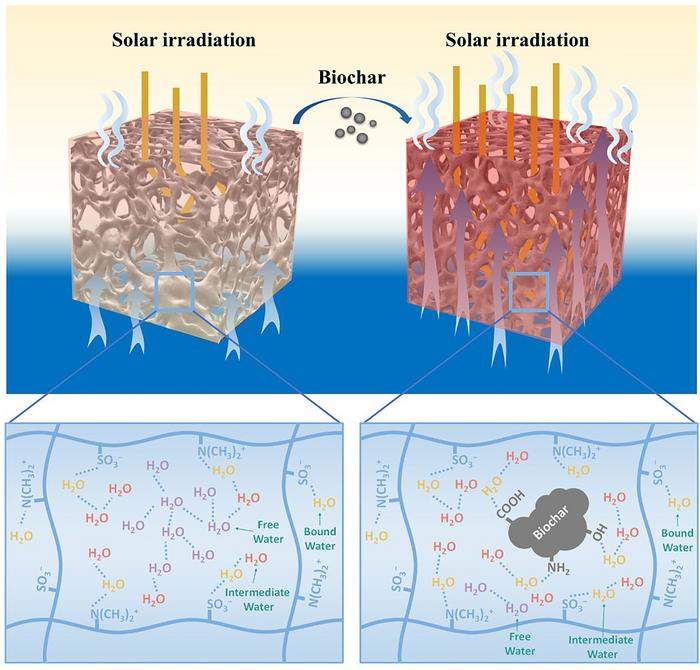
Freshwater scarcity is one of the major challenges for sustainable development, and traditional desalination technologies often require high energy consumption and expensive infrastructure. Solar interfacial evaporation technology has attracted attention for directly utilizing clean solar energy for water treatment, but materials need to simultaneously possess multiple functions such as light absorption, thermal management, and water transport. The researchers prepared biochar from sorghum straw through pyrolysis, acid washing, ball milling, and sieving, and embedded it into a hydrogel network to form a soft, porous hybrid hydrogel. This material achieves over 95% light absorption across a broad solar spectrum, with biochar absorbing over 98% in the visible light range.
Under one sun illumination, the surface temperature of the hybrid hydrogel reached 41.1°C, while the underlying water body only rose to 29.3°C, indicating that heat is concentrated on the evaporation surface, reducing heat loss to the surrounding water. The material achieved an evaporation rate of 3.57 kg m⁻² h⁻¹, approximately 1.87 times that of the hydrogel without biochar. The study also found that functional groups on the biochar surface, such as hydroxyl, amino, carboxyl, and carbonyl groups, interact with water molecules and the hydrogel network, altering the hydrogen bond structure of water molecules and increasing the proportion of "intermediate water" that requires less energy for evaporation, reducing the equivalent evaporation enthalpy to 877.79 J g⁻¹. In saline environments, the hybrid hydrogel's saturated water content reached 520%, helping to maintain the water supply needed for continuous evaporation.
Corresponding author Dr. Wenzong Liu stated that biochar not only acts as a solar absorber but also regulates the hydrogel's pore structure and the state of water molecules, and this dual pathway is key to the significant improvement in evaporation performance. This study demonstrates the potential of using low-cost biomass-derived materials to design next-generation solar evaporators. By combining photothermal enhancement, heat loss control, water transport, and water molecule activation, this technology holds promise for applications in desalination and water purification, particularly in saline or resource-constrained environments.
This article is compiled by Wedoany. All AI citations must indicate the source as "Wedoany". If there is any infringement or other issues, please notify us promptly, and we will modify or delete it accordingly. Email: news@wedoany.com