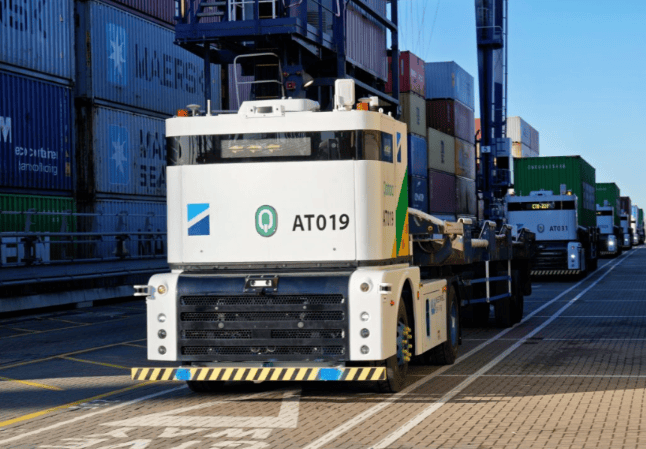
CaoCao Mobility and Shanghai Artificial Intelligence Research Institute Establish AI Center in China
en.Wedoany.com Reported - On June 25, CaoCao Mobility, a Chinese technology-driven mobility platform, announced a strategic partnership with the Shanghai Artificial Intelligence Research Institute in China, and the establishment of the "CaoCao Mobility AI Innovation Center." Leveraging industry-academia-research collaboration, the two parties will focus on AI technology breakthroughs and industrial deployment across the entire mobility chain, driving artificial intelligence capabilities into real-world mobility scenarios such as ride-hailing, autonomous driving, intelligent operations, and smart capacity management.
The newly established AI Innovation Center will operate around the comprehensive AI transformation needs of CaoCao Mobility in China. CaoCao Mobility recently unveiled its RoboX strategy, proposing to build an AI-driven operations technology platform for the physical world, and focusing on three key elements—intelligent custom vehicles, intelligent driving technology, and intelligent operations—to construct a smart capacity system covering scenarios such as Robotaxi, Robovan, Robobus, and Robotruck. The establishment of the AI Innovation Center will provide support for this strategy in algorithm research, scenario validation, model optimization, and operations system upgrades.
For mobility platforms, AI capabilities are reflected not only in autonomous vehicles themselves but also in areas such as order prediction, capacity dispatch, route matching, safety risk control, charging and maintenance, user services, and operational efficiency improvement. CaoCao Mobility possesses extensive real-world urban mobility data and operational scenarios, while the Shanghai Artificial Intelligence Research Institute has capabilities in fundamental AI research and industrial transformation. The focus of their collaboration lies in embedding laboratory technologies into high-frequency, complex, and continuously operating transportation service systems.
CaoCao Mobility has previously proposed the "Double 100,000 Plan," aiming to deploy a total of 100,000 Robotaxis and 100,000 Robovans by 2030. Robotaxis target passenger mobility, while Robovans target urban logistics. Both types of smart capacity require a unified AI dispatch, vehicle management, operational safety, and charging and maintenance system for support. As capacity scales up, vehicle-level intelligence is merely the foundation; platform-level intelligent operational capabilities will directly impact vehicle utilization rates, service stability, and commercialization efficiency.
The AI Innovation Center will also serve as a bridge connecting technology research and development with industrial application. After autonomous driving and smart capacity systems enter large-scale operations, they need to continuously address issues such as changes in road environments, fluctuations in user demand, vehicle status monitoring, service fulfillment safety, and urban operational rules. The collaboration between CaoCao Mobility and the Shanghai Artificial Intelligence Research Institute will help introduce cutting-edge AI models, decision algorithms, and engineering tools into the platform's operations system, forming a closed loop from technology validation to product deployment and operational feedback.
This partnership also continues CaoCao Mobility's recent transformation path toward becoming an AI-native company. The company has identified autonomous driving, AI operations systems, and smart capacity networks as key directions, and has adjusted resource allocation around the RoboX strategy. With the establishment of the "CaoCao Mobility AI Innovation Center," the AI transformation of CaoCao Mobility will move from strategic announcements to organizational implementation and technology collaboration. Future progress will depend on the specific research directions of the innovation center, the demonstration applications of Robotaxi and Robovan, and the deployment pace of AI operations systems in more urban mobility scenarios.
This article is compiled by Wedoany. All AI citations must indicate the source as "Wedoany". If there is any infringement or other issues, please notify us promptly, and we will modify or delete it accordingly. Email: news@wedoany.com
Related Products





Flat Portable Satellite Terminal 0.35m Aperture Manual Portable Terminal
China Starwin Science & Technology Co., Ltd.
Multi-function Marine Monitoring Low-altitude Detection Radar Sea-air Boundary Ocean Dynamic Environment Measurement
Chengdu Dixin Technology Co., Ltd.



G.652.D Wavelength-extended Non-dispersion Shifted Single-mode Optical Fiber
HONGAN GROUP CO., LTD.