Lenovo, in collaboration with China Mobile Xinsheng Technology and others, launches AI Trusted All-in-One Machine
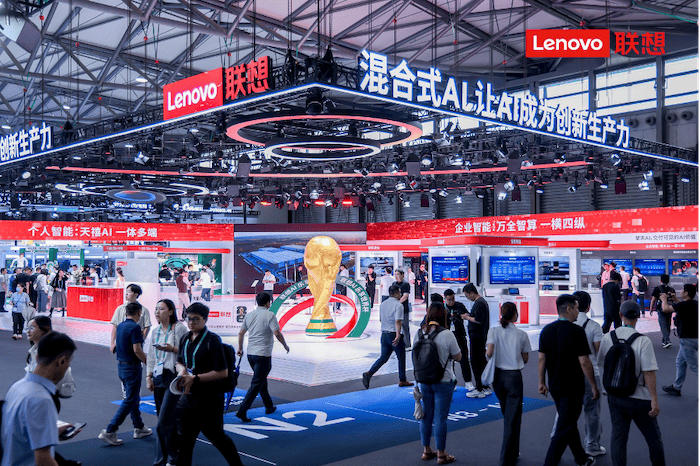
en.Wedoany.com Reported - At the 2026 Mobile World Congress Shanghai, Lenovo Group showcased its full-stack Token products and solutions, including all-scenario personal intelligent products centered on Tianxi AI, as well as AI infrastructure and AI solution services such as the Wanquan Heterogeneous Intelligent Computing Platform V5.0, SuperNode solutions, and Qingtian Intelligent Agent solutions. The conference was held from June 24 to 26 at the Shanghai New International Expo Centre.
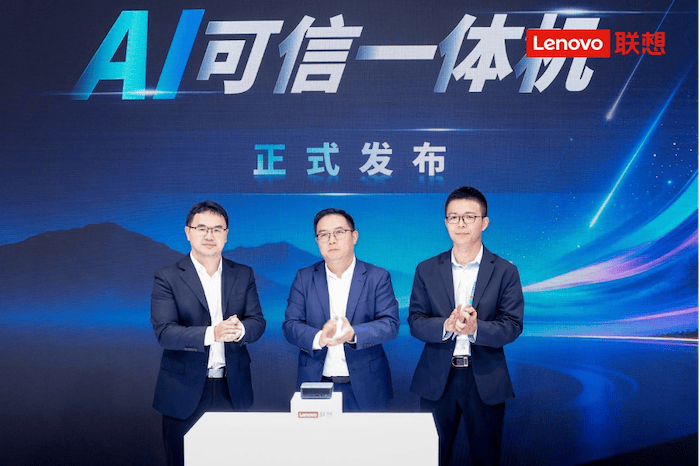
During the conference, Lenovo, together with China Mobile Xinsheng Technology and Yixu Technology, launched the world's first AI Trusted All-in-One Machine, issuing for the first time a hardware-level full-stack trusted "identity card" for AI agents, ushering in an era where agents operate with certification. Based on Lenovo's existing digital employee solutions, this product integrates China Mobile Xinsheng Technology's AI-eSIM and Yixu Technology's AI security capabilities, upgrading "out-of-the-box" to "out-of-the-box trusted."
Lenovo believes that in the Token economy era, the new "last mile" for operators is delivering AI capabilities to terminals. To date, Lenovo has established comprehensive strategic partnerships with the three major operators, with over 100 collaborative projects.
In terms of AI terminals, Lenovo leverages Tianxi AI and AI PCs, AI phones, AI tablets, AIoT, and AI hosts to push Tokens down to terminals and edges. Meanwhile, Lenovo launched multiple smart terminals supporting eSIM at the conference, including moto phones, Lenovo Legion gaming phones, and AI tablets such as Xiaoxin, YOGA, and Legion.
In AI infrastructure, Lenovo leverages hybrid infrastructure to help operators build a "unified computing network." In AI solution services, Lenovo introduced the Qingtian Intelligent Agent solution, the subscribable Baiying Intelligent Agent service, and AI full-cycle services, collaborating with operators to accelerate AI adoption among government, enterprise, and SME clients. Among these, Changsha Telecom's Baiying model has become a benchmark for China Telecom in serving SMEs.
Lenovo's recently released edge device AI host P7 boasts up to 190 TOPS of computing power, supporting local large models with up to 122B parameters and 128K long-context processing, achieving local inference at 50 Token/s in a completely offline environment. Lenovo aims to build a personal local computing network through edge devices and AI hosts, targeting 80% of Token consumption to occur locally on devices, with the remaining 20% handled via cloud collaboration, thereby reducing AI usage costs and ensuring security and privacy.
This article is compiled by Wedoany. All AI citations must indicate the source as "Wedoany". If there is any infringement or other issues, please notify us promptly, and we will modify or delete it accordingly. Email: news@wedoany.com
Related Products




Multi-function Marine Monitoring Low-altitude Detection Radar Sea-air Boundary Ocean Dynamic Environment Measurement
Chengdu Dixin Technology Co., Ltd.
Flat Portable Satellite Terminal 0.35m Aperture Manual Portable Terminal
China Starwin Science & Technology Co., Ltd.

MUX Series Communication Interface Device for Security and Stability Control System
Nanjing NR Electric Co., Ltd.

Automatic Aiming Laser Remote Obstacle Removal Robot
Pinggao Group Weihai High-Voltage Apparatus Co., Ltd.