Zhang Dong of China Mobile Advocates Network-AI Integration to Drive 6G Development at GTI Conference
en.Wedoany.com Reported - The 2026 GTI International Industry Conference was held in Shanghai on June 24, with the theme "Mobile AI: Enabling the 6G Future." Zhang Dong, Vice President of China Mobile, delivered a speech titled "Jointly Promoting Network-AI Integration to Enable a Bright 6G Future," stating that China Mobile is working with GTI to deeply integrate networks with artificial intelligence, in response to the trend of network-AI convergence, aiming to build a global ecosystem and drive industrial development.
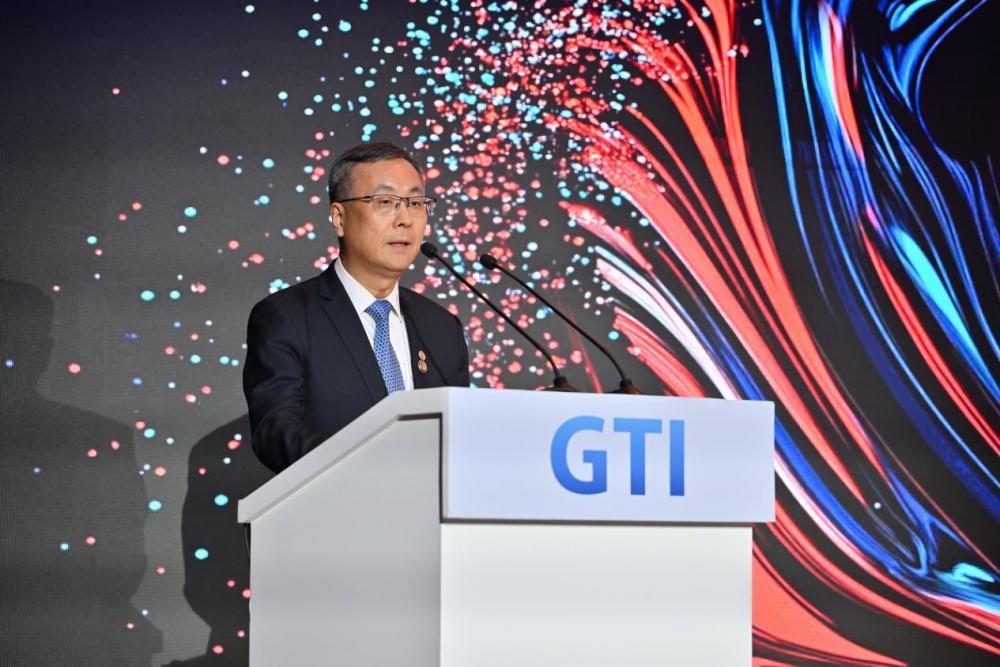
Zhang Dong cited the FIFA World Cup in the United States, Canada, and Mexico as an example to illustrate the practical implementation of network-AI integration. On the network side, China Mobile has built over 2.85 million 5G base stations, achieving continuous coverage across all townships and above nationwide. Leveraging new technologies such as 5G-A three-carrier aggregation and intelligent scheduling, it enables zero-latency, glitch-free transmission of ultra-high-definition video. With L4-level autonomous network capabilities, it achieves second-level fault self-healing, ensuring uninterrupted communication. On the application side, China Mobile deeply integrates AI technology with content and scenarios, using AI multi-camera setups and naked-eye 3D rendering to break traditional single perspectives and provide immersive viewing experiences. AI-powered tactical analysis and star player tracking help fans understand game strategies, while features such as multi-dialect digital commentary, real-time intelligent companion viewing, and AI motion-sensing interactions have also been launched.
Zhang Dong noted that these experiences rely on China Mobile's computing and intelligent service support: it has built two ultra-large-scale intelligent computing centers with over 10,000 GPUs each, and 12 regional intelligent computing nodes. The computing network brain enables scheduling of hundreds of trillions of tokens, forming a three-tier computing latency circle with 1 millisecond within city clusters, 5 milliseconds within provinces, and 20 milliseconds nationwide. The Mobile Model Service Platform (MoMA) aggregates over 300 mainstream models, establishing a large-scale "token supermarket," and has upgraded the Lingxi intelligent agent to enrich AI product applications.
Regarding 6G development, Zhang Dong put forward three proposals: First, jointly promote the native integration of networks and AI, moving 6G from "external AI" to "intrinsic AI," supporting the interconnection and collaboration of billions of intelligent agents through integrated communication, sensing, computing, and AI. Second, jointly foster value realization, focusing on typical scenarios such as embodied intelligence, connected drones, and intelligent agent interconnection and collaboration to proactively cultivate new 6G applications, expand differentiated services such as "customizable networks," "customizable performance," and "customizable experiences," and fully support the token economy. Third, jointly build a converged ecosystem, leveraging international platforms such as GTI and GSMA, as well as the GTI Open Lab and 6G open test facilities, to support collaborative innovation among global industry, academia, research, and users, and cultivate a cross-industry, cross-domain global 6G ecosystem.
This article is compiled by Wedoany. All AI citations must indicate the source as "Wedoany". If there is any infringement or other issues, please notify us promptly, and we will modify or delete it accordingly. Email: news@wedoany.com
Related Products



TWP16 P-Band Tropospheric Wind Profile Radar
China Huayun Meteorological Technology Group Co., Ltd.
MUX Series Communication Interface Device for Security and Stability Control System
Nanjing NR Electric Co., Ltd.

20 Inch 1600*900 Full HD 60Hz TFT LED Monitor with VGA and DP Interfaces for Desktop Computers-Business Use
Guangzhou Zanying Optoelectronics Technology Co., Ltd.
Conveyor Belt Intelligent Monitoring System
LUO YANG WIRE ROPE INSPECTION TECHNOLOGY CO., LTD.




G.652.D Wavelength-extended Non-dispersion Shifted Single-mode Optical Fiber
HONGAN GROUP CO., LTD.