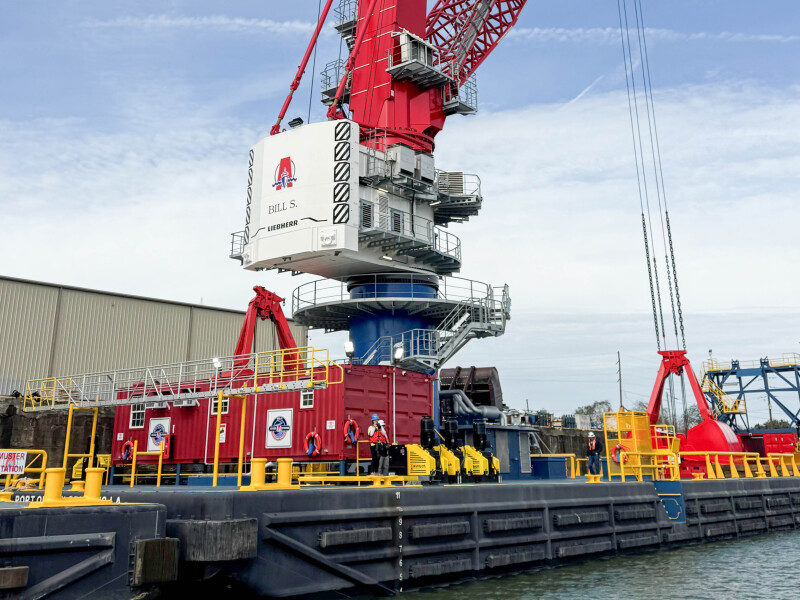
en.Wedoany.com Reported - Associated Terminals has deployed two CBG 500 E fully electric mobile harbor cranes manufactured by Liebherr Maritime Cranes on a 250-foot by 72-foot crane barge built by LAD Services in Convent, Louisiana, marking the first operational deployment of such equipment in the region. The crane barge platform supports the mobile handling of bulk and breakbulk cargoes, including grain, fertilizer, aggregates, steel, and project cargo, covering the lower Mississippi River and Gulf Coast regions. Associated Terminals stated that this configuration brings high-capacity cargo handling capabilities to customer sites while ensuring throughput and reliability, with its controls, lifting capacity, and working range helping to reduce vessel turnaround times and maintain safety standards.
These cranes feature Liebherr's LiCaTronic energy recovery system and battery-supported power management, helping to reduce fuel consumption, optimize power usage, and minimize equipment downtime through enhanced diagnostics and monitoring capabilities. Zeljko Franks, Chief Operating Officer of Associated Terminals, noted that the company did not purchase off-the-shelf solutions but instead collaborated with Liebherr and partners to develop a system specifically designed for Mississippi River cargo operations, covering cargo handling requirements, power management, maintenance access, and long-term reliability. Curtis Blank, Director of Maintenance and Engineering, predicted that the greatest benefits would be seen in cargo throughput, vessel turnaround, energy efficiency, and equipment reliability, with higher processing rates enabling more cargo to be moved in less time.
U.S. port and terminal operators are increasing equipment investments to drive operational modernization and emissions reduction. A May survey by the National Association of Waterfront Employers (NAWE) of 25 senior port and terminal executives found that U.S. ports will need $6.7 billion for cargo handling equipment over the next five years, including $2.74 billion for new ship-to-shore cranes, $2.4 billion for large yard equipment and additional ship-to-shore cranes, $917 million for rail-mounted yard equipment, and $790 million for maintenance of existing cranes and cargo handling equipment. NAWE President Carl Bentzel stated that modern equipment is critical to ensuring terminal productivity, supply chain resilience, and international competitiveness. Sang Yi, President and CEO of the American Association of Port Authorities (AAPA), noted that the federal government supports investment through programs such as the Port Infrastructure Development Program, and AAPA encourages members to use multiple energy sources to power port operations.
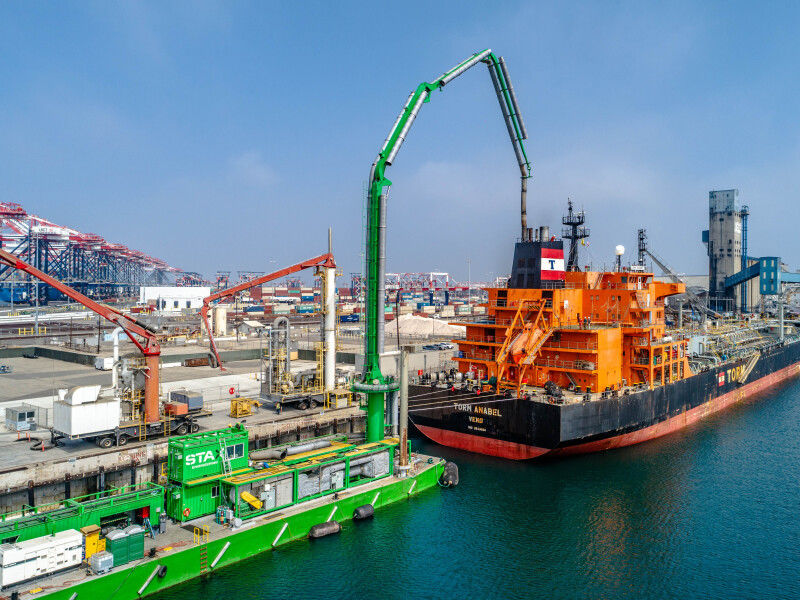
In emissions control, STAX Engineering has developed a barge-based emissions capture system that connects to a vessel's exhaust stack after berthing, directly capturing exhaust from the stack and channeling it to the barge, filtering out 99% of particulate matter and 95% of nitrogen oxides before releasing treated gas, allowing the vessel to continue operations during the process. CEO Mike Walker stated that the technology reduces port-area pollutants without costly vessel retrofits, full electrification, or large-scale grid upgrades, and is particularly suitable for scenarios where shore power is unavailable or impractical, such as tankers that cannot safely connect to shore power. STAX operates eight barges, having processed over 2,400 vessels in more than 42,000 service hours and captured over 330 tons of pollutants. It is currently operating in California and is in discussions with other regions and foreign shippers and ports.
Federal funding is also supporting port electrification projects. In October 2024, the Port of Cleveland in Ohio received $94.26 million through the U.S. Environmental Protection Agency's Clean Ports Program for the Cleveland Port Electrification Initiative. The funding will replace 13 pieces of cargo handling equipment, replace two older diesel tugboats, add electric vehicle charging infrastructure, and install a battery energy storage system with solar power and shore power. The port is collaborating with Logistec USA Inc., The Great Lakes Towing Co., and Cleveland Public Power on a multi-phase project expected to reduce port-related carbon emissions by 40% and improve efficiency by 2028. The project also includes internship and workforce training programs in partnership with Davis Aerospace and Maritime High School, covering clean port equipment such as zero-emission mobile equipment and renewable energy systems.
This article is compiled by Wedoany. All AI citations must indicate the source as "Wedoany". If there is any infringement or other issues, please notify us promptly, and we will modify or delete it accordingly. Email: news@wedoany.com