China Mobile Advances Space Computing Network, Plans to Launch 02 Satellite in 2026
en.Wedoany.com Reported - China Mobile is advancing the deployment of a space computing network, aiming to address blind spots in ground-based computing coverage through a space-ground collaborative approach. This initiative is driven by the rapid development of AI large models, which has intensified the energy consumption and heat dissipation pressures of ground-based computing. According to data from the National Energy Administration, during the "15th Five-Year Plan" period, the national computing power electricity consumption is expected to increase by an average of over 100 billion kWh annually, reaching an estimated 800 billion kWh by 2030, accounting for approximately 6% of total societal electricity consumption. Meanwhile, nearly half of the electricity in ultra-large-scale computing clusters is used for heat dissipation rather than computation, and ground data centers face bottlenecks in terms of land, cost, and physical limits.
The core concept of space computing is to deploy computing and AI capabilities in space, using satellites to build a global "computing internet." The space environment offers unique advantages: solar illumination outside the atmosphere is 30%-40% stronger than on the ground, enabling 24-hour uninterrupted power generation; the cosmic background temperature is close to -270°C, providing a natural heat dissipation environment that significantly reduces cooling costs; and satellite networks can cover areas such as oceans, polar regions, and deserts that ground data centers cannot reach. Specifically, this network consists of two types of nodes: ground data centers and low-Earth orbit satellite constellations, connected via high-speed links for space-ground collaboration. The satellite constellation handles raw space data and tasks in ground blind spots, while ground data centers take on heavy-load computing such as large model training and inference. The two systems automatically dispatch and seamlessly coordinate, with the ultimate goal of achieving fully integrated "space-ground" computing scheduling.
Achieving low-cost space computing still faces five major challenges. First, launch costs are high; currently, sending one kilogram of payload into space in China costs approximately 50,000 to 100,000 RMB. Second, the harsh space environment, with temperatures ranging from -180°C to 120°C and high-energy particle radiation, makes it difficult for ordinary chips to withstand, while space-grade chips have only a fraction of the performance of civilian chips but cost dozens of times more. Third, heat dissipation is a significant challenge; a high-performance computing satellite generates 10 to 100 times more heat than a traditional satellite, and a 1 GW space computing cluster would require approximately 2.4 square kilometers of heat dissipation area. Fourth, inter-satellite and satellite-to-ground communication require high-speed links; although laser communication offers high bandwidth, it is susceptible to weather conditions and difficult to aim. Fifth, the intelligent scheduling system is complex, requiring automatic coordination of thousands of satellites with ground data centers to precisely deliver computing power to demand points.
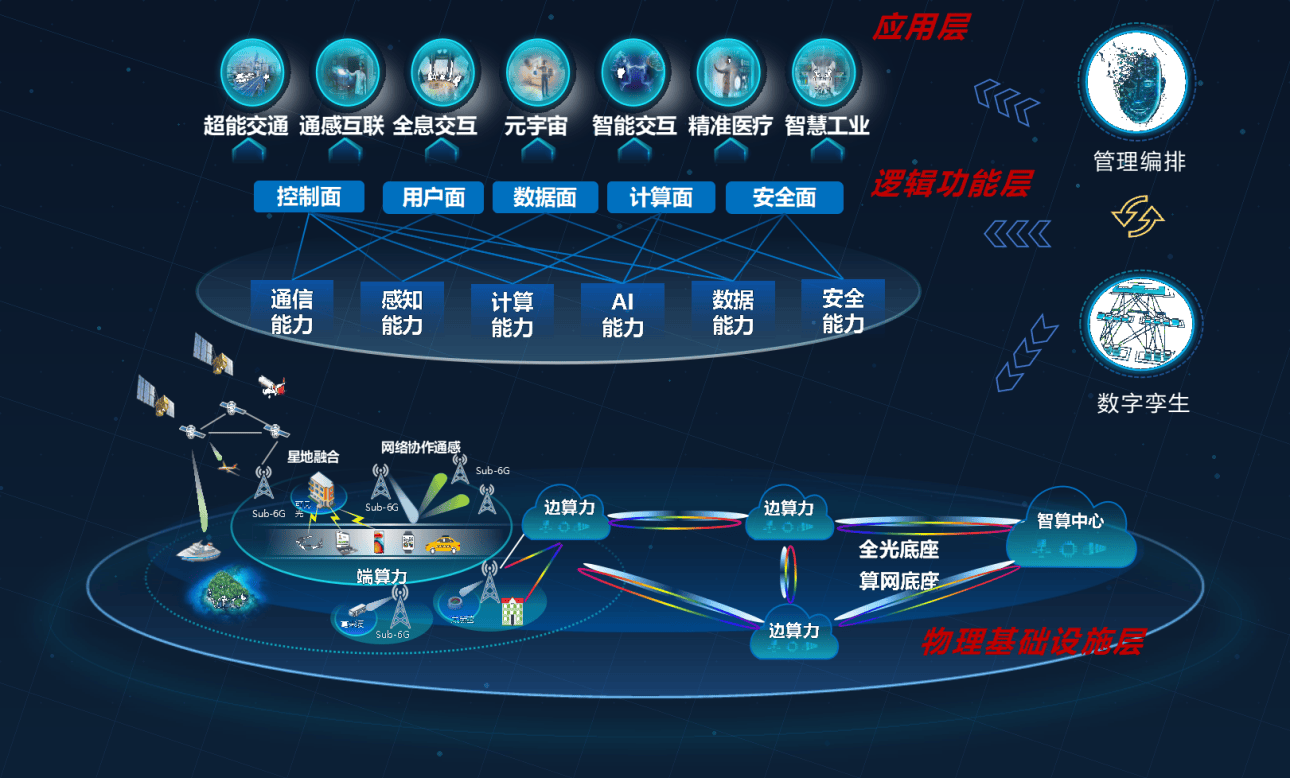
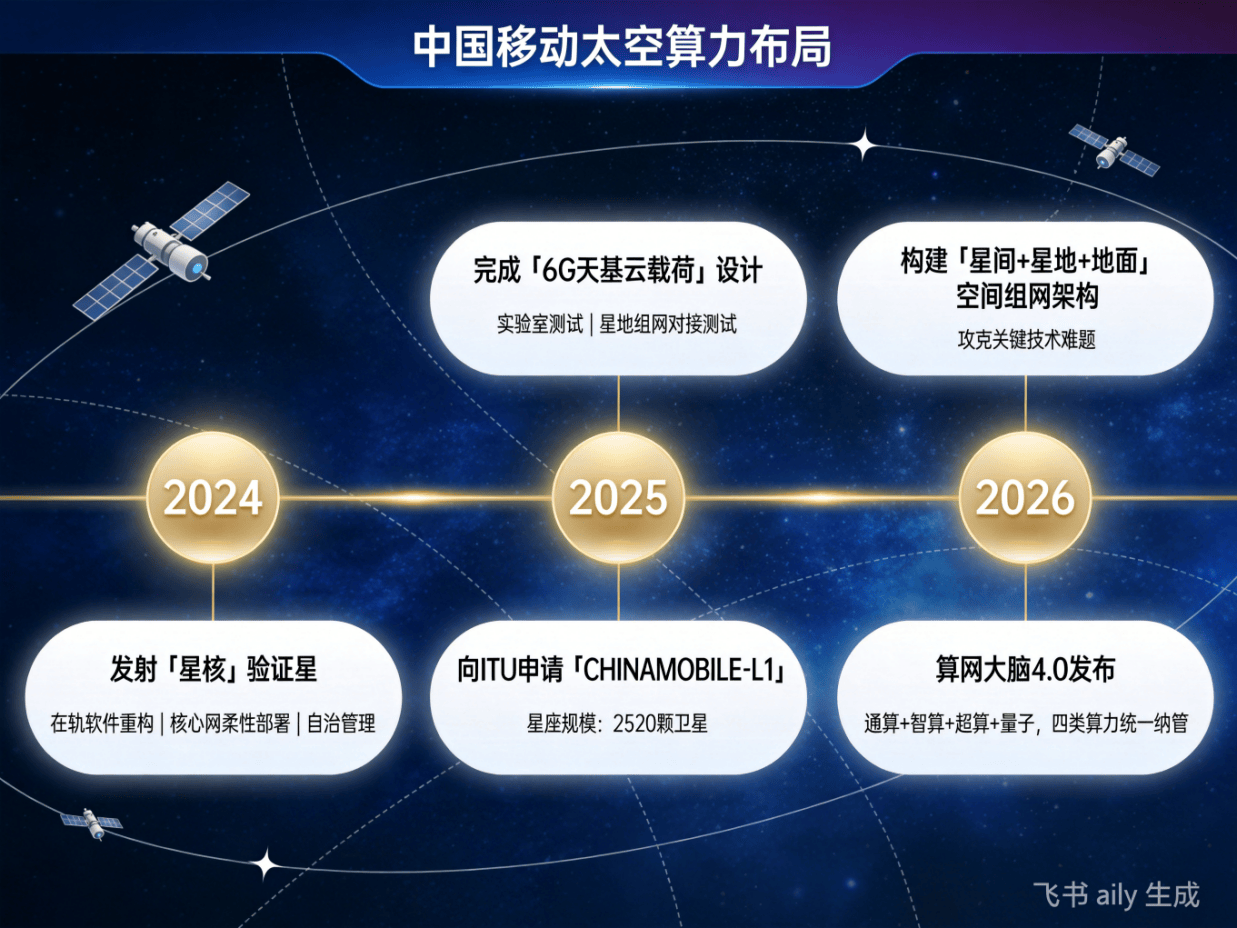
As a national team in the communications sector, China Mobile began laying out its space-ground integrated computing network in 2023. Its existing ground computing network is among the largest globally, with a total intelligent computing scale exceeding 92.5 EFLOPS and over 1.5 million racks, forming a three-tier computing latency circle of "1ms-5ms-20ms." China Mobile's space computing advancement path is divided into four steps: first, leveraging the opportunity of 6G network research and development to establish unified space-ground communication and computing standards; second, upgrading the computing network brain to achieve unified management of satellite and ground computing resources; third, gradually building a network through the launch of experimental satellites—having launched China Mobile 01 Satellite in 2024, with plans to launch China Mobile 02 Satellite in 2026 to test key technologies, and eventually constructing a space computing network composed of satellites that integrates communication, general computing, and AI computing capabilities; and fourth, achieving application deployment in scenarios with insufficient ground computing coverage, such as deep-sea shipping, emergency disaster relief, smart oceans, and the low-altitude economy, to establish a sustainable business model.
Currently, space computing technology is still in its early stages, but it has already demonstrated the potential to solve ground computing bottlenecks and break geographical boundaries. China Mobile is committed to bridging the gap between space and ground, promoting the extension of computing power into space, and building a space-ground integrated computing foundation.
Related Products



Industrial and Commercial Point-Type Gas Detector
Jinan Benan Technology Development Co., Ltd.
Flat Portable Satellite Terminal 0.35m Aperture Manual Portable Terminal
China Starwin Science & Technology Co., Ltd.

20 Inch 1600*900 Full HD 60Hz TFT LED Monitor with VGA and DP Interfaces for Desktop Computers-Business Use
Guangzhou Zanying Optoelectronics Technology Co., Ltd.
Conveyor Belt Intelligent Monitoring System
LUO YANG WIRE ROPE INSPECTION TECHNOLOGY CO., LTD.

GYTA Type Non-Self-Supporting Aerial/Duct Optical Cable
TONGDING INTERCONNECTION INFORMATION CO., LTD.