Synopsys Launches Industry's First Complete ESUN IP Solution
en.Wedoany.com Reported - Synopsys has launched the industry's first complete ESUN (Ethernet for Scale-Up Networks) IP solution, covering Layer 1 and Layer 2, designed to address the networking challenges of AI data centers. This solution is a fully integrated, pre-verified stack that is ready for out-of-the-box use.
Artificial intelligence is pushing data center design into new frontiers. As training clusters scale from tens of accelerators to hundreds, and then to thousands, the network has become a critical factor determining overall system performance. In these systems, accelerators continuously exchange intermediate data and synchronize, requiring not just fast data movement, but predictable data movement. Even tiny delays can create a cascade effect, leaving compute resources idle. Traditional Ethernet was designed as a best-effort network, assuming occasional packet loss, retransmission, and variable latency are acceptable. This model fails for AI systems. AI workloads are constrained by tail latency—the slowest packet in the system. A single delayed packet can block an entire cluster, and retransmissions caused by packet loss further increase latency and variability. These inefficiencies worsen with scale, leading to higher power consumption from bandwidth waste and excessive retransmissions, increased infrastructure costs, and reduced scalability, becoming unsustainable when clusters grow to hundreds of thousands of accelerators.
Ethernet includes congestion management mechanisms such as PFC (Priority-based Flow Control) and ECN (Explicit Congestion Notification), but these are designed for general-purpose networks, not the tightly coupled, latency-sensitive communication patterns of AI scale-up systems. Several limitations emerge at scale: in terms of protocol overhead, standard Ethernet relies on IP headers, adding 28-48 bytes per packet, which directly reduces effective throughput in scale-up environments with frequent small messages; there is no link-level error recovery—beyond FEC (Forward Error Correction), there is no link-level recovery mechanism, and residual errors must be resolved by upper-layer protocols, introducing significant latency penalties; and coarse-grained congestion management—PFC operates as a link-level pause mechanism, lacking the granularity to manage multiple traffic classes. These challenges have led some designs to turn to proprietary interconnects, but this comes with trade-offs including ecosystem fragmentation, limited flexibility, and higher long-term risk.
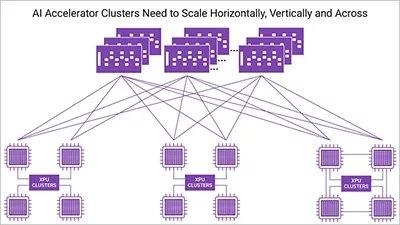
Rather than replacing Ethernet, the industry is evolving it. ESUN adapts Ethernet through targeted enhancements for AI workloads while preserving Ethernet's core values: operational familiarity—network teams can leverage existing Ethernet expertise, tools, and management practices; infrastructure reuse—scale-up and scale-out traffic share the same Ethernet switching architecture and physical infrastructure; and unified fabric—Ethernet becomes the common connection medium for both scale-up and scale-out. The enhancements are focused and targeted: the physical layer remains standard Ethernet, the link layer adds lossless reliability and fine-grained congestion control, and the network layer is streamlined to reduce overhead.
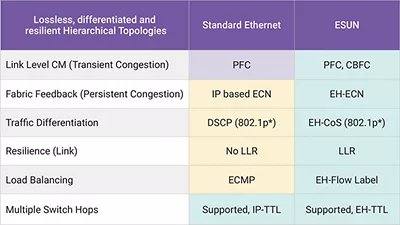
One of the most immediate improvements in ESUN is at the packet level. Traditional Ethernet relies on IP headers, adding 28-48 bytes of overhead per packet. ESUN replaces this with a compact 4-byte header, significantly improving packet efficiency and throughput in environments with frequent and latency-sensitive communication. Basic capabilities such as traffic prioritization, congestion signaling, and load balancing are all preserved, implemented more efficiently.
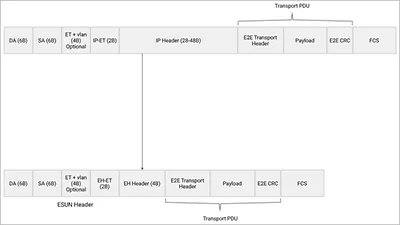
ESUN also introduces two key mechanisms to make communication more deterministic. Link-Level Retry (LLR) detects and recovers link errors locally at the data link layer, rather than relying on higher-layer transport protocols that operate on time scales several orders of magnitude larger, significantly reducing tail latency and eliminating costly end-to-end retransmissions. Credit-Based Flow Control (CBFC) replaces PFC's coarse link-level pause behavior with fine-grained, per-virtual-channel congestion management. The transmitter only sends when the receiver confirms available buffer capacity, preventing overflow, enabling lossless operation, and avoiding the head-of-line blocking associated with PFC. Together, these mechanisms enable ESUN to deliver lossless, low-latency, and bandwidth-efficient communication while retaining Ethernet's openness and interoperability.
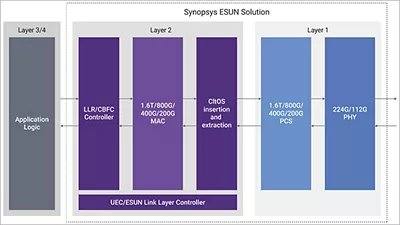
Synopsys has launched the industry's first complete ESUN IP solution, covering Layer 1 and Layer 2, including: a 1.6T multi-rate Ethernet MAC supporting up to four independent 400G channels, configurable via 224G SerDes as 1×1.6T, 2×800G, 4×400G, and 4×200G modes; a 1.6T PCS (Physical Coding Sublayer) and RS-FEC, using RS544 FEC for robust error correction and RS272 FEC for low-latency operation; a UE/ESUN link layer controller implementing LLR and CBFC for lossless reliability and fine-grained congestion management; a silicon-verified 224G PHY (Physical Layer) optimized for low power, low latency, and signal integrity; and comprehensive verification IP and system-level verification support. By providing a complete IP solution, Synopsys eliminates much of the integration burden and risk typically associated with building high-performance networking systems.
All components are co-designed and verified as a single system, eliminating the integration risks of sourcing and assembling IP from multiple vendors through a pre-verified complete L1/L2 stack. The same IP can be used for ESUN (scale-up) and Ultra Ethernet (scale-out), simplifying system design and allowing teams to reuse a common architecture across different parts of the data center. This solution is optimized for low power, high performance, and area efficiency, offering multi-rate configurations from 100G to 1.6T and flexible FEC modes. At its core is the Synopsys 224G PHY, available across multiple advanced process nodes, which has publicly demonstrated 224G silicon interoperability since October 2022, with over 30 multi-vendor demonstrations at ECOC and OFC, achieving zero post-FEC errors on channels with up to 45 dB of loss.
ESUN is supported by over 175 companies, including leading hyperscalers and silicon vendors. Synopsys is committed to driving this transformation with the industry's first complete ESUN IP solution. This ESUN IP solution is part of Synopsys' broader HPC IP portfolio, designed to support the complete AI system stack, including scale-up connectivity via ESUN and UALink (Ultra Accelerator Link), chip-to-chip connectivity via PCIe (Peripheral Component Interconnect Express) and CXL (Compute Express Link), scale-out network connectivity via Ethernet and Ultra Ethernet, high-bandwidth memory interfaces, multi-die and chiplet interconnects, and security and foundation IP. Together, these technologies provide the foundation for building next-generation AI systems where compute, memory, and connectivity scale together.
Related Products


Hot Selling 10 Inch Intel N5100 I5 I7 FHD 8 +128GB 16+256GB Win10 Pro Win11 Pro 4G 5G Rugged Tablet PC Pad with NFC Barcode
Highton Electronics Co., Ltd.

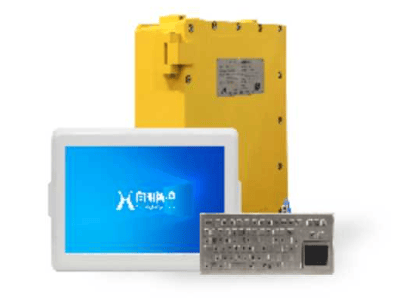
KJD127(A) Mining Explosion-Proof and Intrinsically Safe Computer
Taiyuan Xiangming Intelligent Control Technology Co., Ltd.
TWP16 P-Band Tropospheric Wind Profile Radar
China Huayun Meteorological Technology Group Co., Ltd.
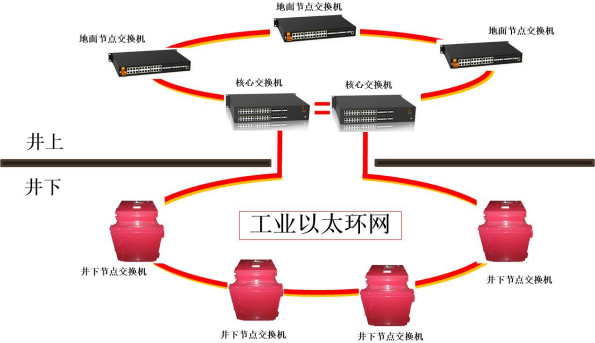
Mine Explosion-proof and Intrinsically Safe Industrial Ethernet Ring Network (10 Gigabit/Gigabit)
Chongqing Mas Sci&Tech Co., Ltd.