en.Wedoany.com Reported - South Korean company MobiGen has launched Grapeo 2.0, a dynamic ontology-based AI platform designed to address the issue of poor-quality AI output within enterprises.
Unlike version 1.0, which only built knowledge systems, Grapeo 2.0 adopts a "dynamic ontology" that can autonomously judge and execute actions. When enterprise data changes, the AI can automatically detect and process predefined tasks.
MobiGen believes that AI deployed within enterprises often falls into the trap of "AI gibberish," where unscreened, low-quality responses proliferate while truly useful answers are scarce. The root causes are data dispersion, fragmented business context, and insufficient security. The company proposes that ontology technology can simultaneously address these three issues, as ontology is a technology that pre-instructs AI on how to read and interpret data.
The Grapeo platform consists of four layers: data, ontology, application, and project. The ontology layer defines the relationships and context of dispersed data, ensuring that changes in the underlying data architecture do not affect the upper-layer applications. The dynamic ontology begins by defining business strategies as ontologies; when data changes, the AI makes decisions independently and drives workflows, breaking the limitation of traditional rule-based systems that can only operate under manually set conditions.
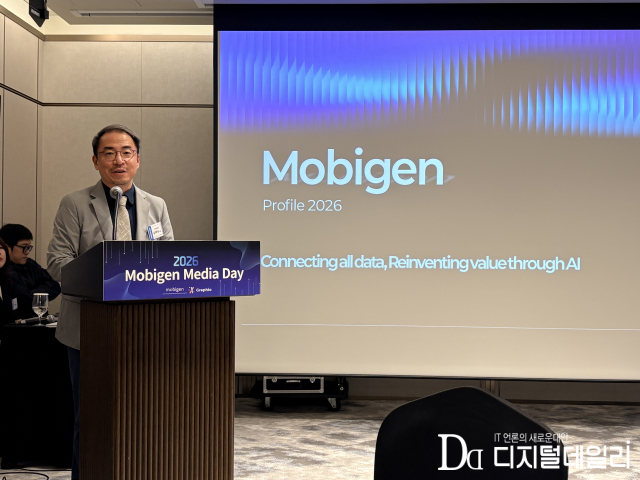
MobiGen CEO Kim Tae-soo explained that enterprise data is often scattered across ERP documents, Excel files, and various departmental systems. Even when centralized through data lakes or data marts, there is rarely refined data ready for direct AI use. Grapeo virtualizes raw data using standardized criteria and binds it into a logical layer, enabling integrated queries and connections without moving or copying data. On this basis, the system adds connection refinement and quality validation, converting data into a structure directly usable by AI.
To improve answer accuracy, MobiGen employs hybrid RAG technology, binding and coordinating structured RAG, vector RAG, and graph RAG through ontology. Compared to ordinary graph RAG, it can infer and answer content not explicitly documented based on relationships. Additionally, Grapeo integrates a no-code ontology workflow viewer for building workflows and IDP technology that automatically maps unstructured documents to ontologies.
MobiGen shared real-world application cases of Grapeo. Previously, the Korean Ministry of Government Legislation had over 20 experts handling translation and consultation for import/export regulations, with a reflection cycle of 3 to 6 months for regulatory amendments and limited country coverage. After adopting Grapeo, the system integrated regulations from 58 countries and 13 languages, enabling real-time updates of the latest revisions. The ministry plans to open the service to the public in the second half of the year.
The Korea Environment Corporation applied Grapeo to its zero-emission vehicle subsidy consultation service. Facing varying support standards from 17 local governments and over 700 related regulations, the system allowed the AI to learn the vast rules and automatically handle everything from subsidy calculations to consultation responses.
MobiGen plans to launch Grapeo 3.0, equipped with "federal ontology," in the first half of next year. This version will enable connections at the ontology level without sharing data between organizations.