Chinese Team Develops DASformer for Sub-Meter Real-Time Distributed Fiber Optic Acoustic Sensing Demodulation
en.Wedoany.com Reported - A research team has proposed a real-time synchronous demodulation and denoising network (DASformer) based on the Transformer architecture for distributed acoustic sensing (DAS) signals, achieving sub-meter spatial resolution and real-time processing capability, providing a technical pathway for intelligent perception systems in rapid response scenarios.
Distributed acoustic sensing (DAS) technology utilizes communication optical fibers as sensors, enabling long-distance, continuous distributed monitoring of vibration or acoustic signals. This technology has been applied in fields such as geophysical research, infrastructure security, and intelligent transportation. As application scenarios expand to areas with higher demands for information timeliness, such as urban traffic monitoring and drone sound source localization, the data processing pressure on DAS systems continues to increase. These scenarios not only require the system to capture dynamic events in real time (e.g., vehicle trajectory tracking, intrusion behavior recognition) but also to rapidly extract decision-relevant information from massive sensing data. Although traditional phase demodulation methods can recover perturbation signals, they rely on manual frequency band division to suppress interference fading, which increases computational overhead and reduces spatial resolution. Under large strain conditions, phase unwrapping based on the Itoh criterion is prone to cumulative errors, leading to signal distortion. Furthermore, traditional methods face computational efficiency bottlenecks when processing massive DAS data, and their processing workflows struggle to meet the low-latency and high-throughput requirements of real-time intelligent perception systems, limiting their application in rapid response scenarios.
To address these issues, the research team proposed a real-time synchronous demodulation and denoising network (DASformer) based on the Transformer architecture. This network adopts a pure encoder structure to perform end-to-end processing on raw Rayleigh backscattering signals, directly outputting demodulated and denoised differential phase signals, thereby avoiding error accumulation from phase unwrapping in traditional methods. In terms of structural design, DASformer enhances the ability to restore perturbation details in demodulation results through multi-scale attention mechanisms and stacked shifts of feature extraction modules. Additionally, supervised learning is conducted using a fully simulated dataset based on physical models, enabling the network to simultaneously suppress various noises and interference fading during demodulation. Leveraging the parallel computing advantages of Transformers, the network achieves sub-meter spatial resolution and real-time demodulation and denoising, providing high-quality signal inputs for downstream intelligent decision-making modules.
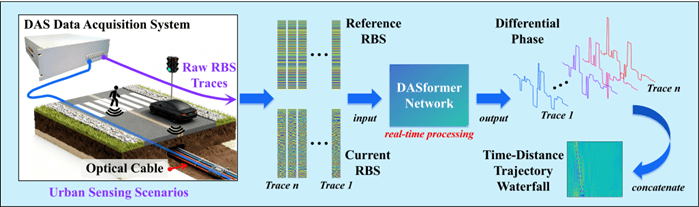
The main innovations of this network include: applying the pure encoder architecture of Transformers to phase demodulation of DAS signals, directly obtaining differential phase signals end-to-end; designing a Shifted Patch Dual Attention (Shifted-PDA) module, which combines intra-patch and inter-patch attention through a multi-scale fusion mechanism, along with cyclic shifts of self-attention windows to achieve cross-window information interaction, effectively integrating local features and global dependencies, while introducing a LeFF layer with depthwise separable convolution along the spatial axis to replace the traditional feedforward network, enhancing the network's ability to represent continuous phase changes; conducting supervised learning based on a fully simulated dataset (50,000 raw optical fiber channels), using random perturbation replica augmentation for data enhancement to train the network's ability to suppress random noise, cumulative phase noise, and interference fading, and leveraging the parallel computing advantages of Transformers to ultimately achieve sub-meter spatial resolution and real-time processing of high-speed DAS data streams.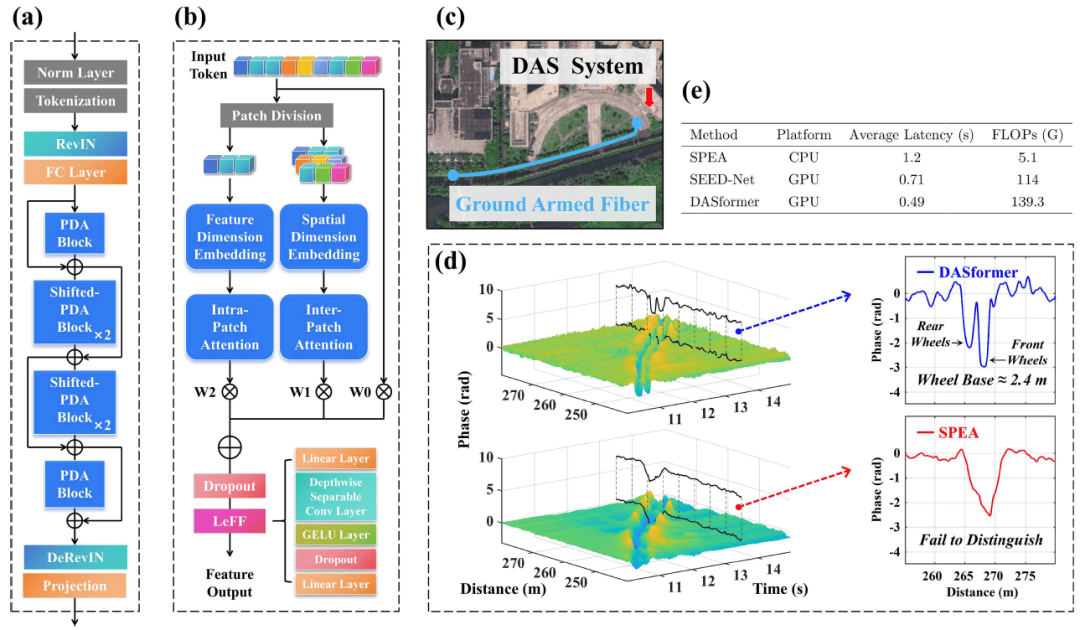
In field experiments, researchers used two types of sensing optical fibers: "road-laid optical cables" and "buried communication optical cables." Through initial positioning with buried communication optical cables and ball-drop experiments in a quiet nighttime environment, the performance of the new scheme was compared with traditional phase unwrapping demodulation methods. Results showed that in terms of noise suppression, the new scheme improved by 4.6 dB over traditional methods. Subsequently, road-laid optical cables were used for real-time monitoring of campus traffic signals (vehicle signals, pedestrian signals). In sections where the optical cable was poorly coupled with the ground, the new scheme still clearly distinguished two sets of trajectories generated by the front and rear wheels of vehicles, whereas the demodulation results of the traditional scheme in that channel were aliased due to degraded spatial resolution, verifying the network's sub-meter spatial resolution. In computational efficiency comparisons, the new scheme demonstrated higher data processing efficiency compared to traditional signal processing methods (sub-band extraction-based phase demodulation algorithm, SPEA) and the CNN-based deep learning network SEED-Net, in terms of average computational latency and computational load, highlighting the advantages of Transformer parallel computing.
Related Products

Flat Portable Satellite Terminal 0.35m Aperture Manual Portable Terminal
China Starwin Science & Technology Co., Ltd.


Mine Explosion-proof and Intrinsically Safe Industrial Ethernet Ring Network (10 Gigabit/Gigabit)
Chongqing Mas Sci&Tech Co., Ltd.

Industrial and Commercial Point-Type Gas Detector
Jinan Benan Technology Development Co., Ltd.
TWP16 P-Band Tropospheric Wind Profile Radar
China Huayun Meteorological Technology Group Co., Ltd.
G.652.D Wavelength-extended Non-dispersion Shifted Single-mode Optical Fiber
HONGAN GROUP CO., LTD.
Multi-function Marine Monitoring Low-altitude Detection Radar Sea-air Boundary Ocean Dynamic Environment Measurement
Chengdu Dixin Technology Co., Ltd.