Argonne National Laboratory Drives HPC Transformation into AI-Integrated Platform
en.Wedoany.com Reported - Against the backdrop of deep integration of artificial intelligence into scientific research, the role of high-performance computing facilities is undergoing a significant transformation. Thomas Uram, Group Lead of the Data Services and Workflows team at Argonne National Laboratory, stated at the ISC 2026 conference that next-generation high-performance computing facilities will not merely be providers of computing resources, but integrated platforms that actively support scientific discovery.
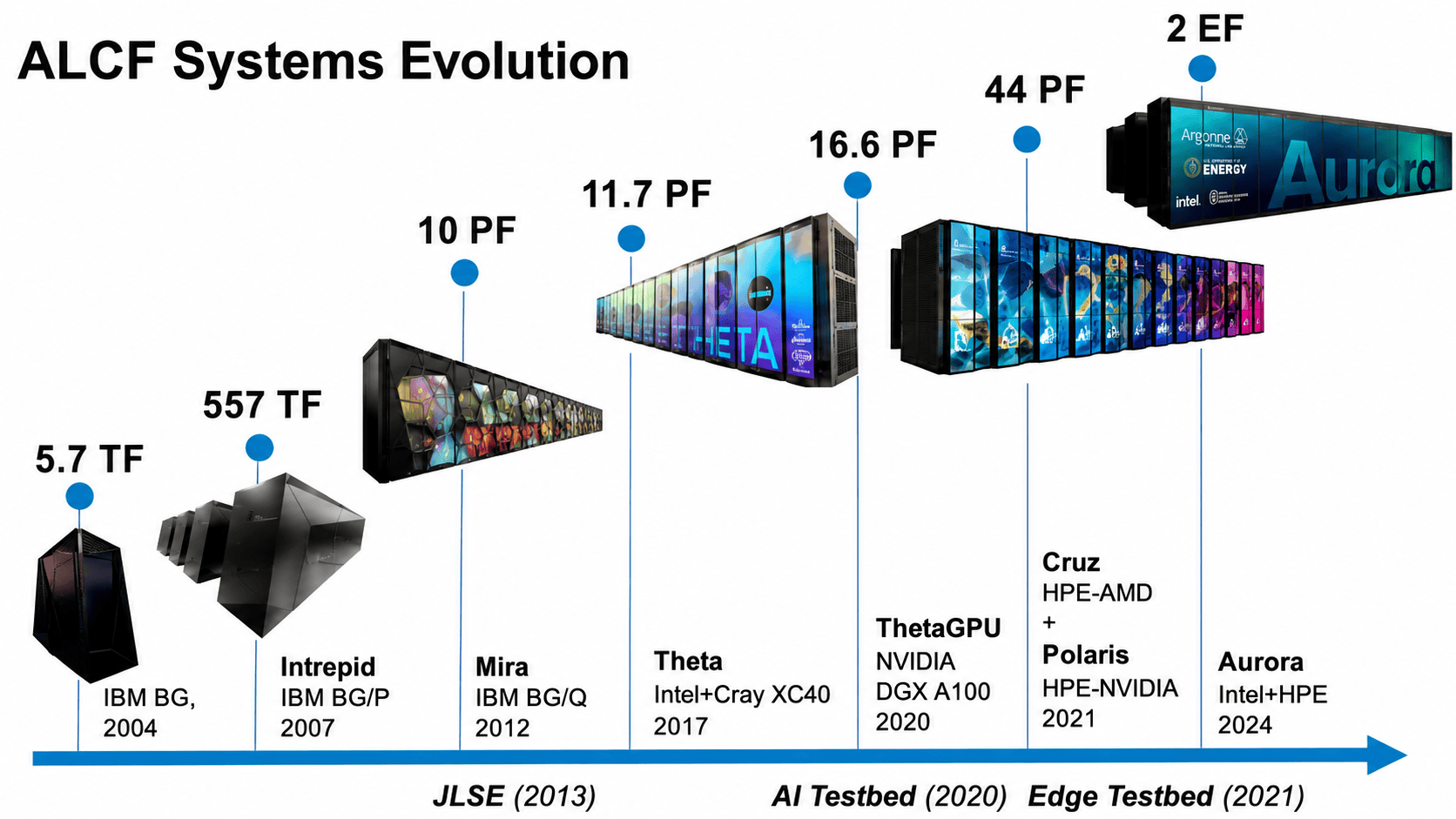
Uram believes that the core of this transformation lies in building AI capabilities directly into the facility, rather than treating them as standalone tools. Argonne National Laboratory is constructing dedicated AI infrastructure alongside its traditional high-performance computing systems, including platforms focused on inference: Sofia (A100), Minerva (B200), and Tara (GH200). While Aurora remains the primary computing platform, these other platforms have been specifically added to provide AI inference services. Researchers can access dozens of open-weight large language models and domain-specific scientific models through a centralized inference service.
Uram noted that many scientific workloads no longer require expensive frontier models; researchers can use open models through shared inference services without needing to build or manage their own infrastructure. However, integrating AI into scientific workflows also requires the ability to interact with high-performance computing systems—AI agents must be able to access computing resources, submit jobs, and coordinate work across multiple systems. Uram emphasized that hardware, inference services, and job submission capabilities together form the foundation of AI workflows.
These capabilities have already been applied across multiple scientific disciplines. At Argonne's synchrotron X-ray facility—the Advanced Photon Source—researchers automatically transmit experimental data to the Argonne Leadership Computing Facility as it is generated, run analyses on computing resources, and return results during the experiment. This infrastructure is now used to apply AI-based image segmentation, enabling scientists to analyze tomographic data in near real-time. In fusion research, researchers have only 20 minutes between experimental cycles to analyze results, and AI inference services along with automated workflows allow data to be processed immediately. Researchers also aim to combine these capabilities with digital twins to run simulations concurrently with real-time experiments.
Looking ahead, Uram described AI agents capable of going beyond analyzing results. In drug discovery, for example, an inference agent can plan solutions to problems, interact with systems, run simulations, explore simulation results and their impact on targets in a closed loop, and continuously generate new simulation tasks until a result is achieved. This approach allows researchers to test many targets and derive better ones through AI-driven processes. Uram's presentation emphasized that high-performance computing facilities are evolving from mere computing providers into platforms that integrate AI inference, workflow orchestration, and programmable access to support scientific discovery. This shift may fundamentally change how scientists interact with supercomputers and how future high-performance computing facilities are designed.
Related Products



Multi-function Marine Monitoring Low-altitude Detection Radar Sea-air Boundary Ocean Dynamic Environment Measurement
Chengdu Dixin Technology Co., Ltd.

Mine Explosion-proof and Intrinsically Safe Industrial Ethernet Ring Network (10 Gigabit/Gigabit)
Chongqing Mas Sci&Tech Co., Ltd.


MUX Series Communication Interface Device for Security and Stability Control System
Nanjing NR Electric Co., Ltd.
Industrial and Commercial Point-Type Gas Detector
Jinan Benan Technology Development Co., Ltd.