Portuguese Altri Invests €10 Million in Lyocell Fiber Demonstration Unit
en.Wedoany.com Reported - At the "Made in Portugal Raw Materials" seminar organized by CENIT, Carla Silva, Director of the Chemistry and Biotechnology Department at CITEVE, Raquel Maria, Founder of Agromethod Labs, and Gabriel Sousa, Executive Director of Innovation and Technology at Altri, presented updates on several projects aimed at reducing the Portuguese textile industry's external dependence.
At CITEVE, the Be@t project serves as a primary driver. This project focuses on replacing fossil-based raw materials with renewable resources, while also researching green chemical processes, reducing water, energy, and chemical consumption, and developing end-of-life solutions that keep materials in the value chain longer. Carla Silva stated that through this project, Portugal has created one of the largest bioeconomy ecosystems in Europe and the world. It serves as a testing platform to explore the potential and weaknesses of different approaches and identify areas for improvement. A key focus of the project is developing regenerated cellulose fibers made from cellulose extracted from wood, certified forestry residues, and industrial residues, incorporating functionalities like flame retardancy to access higher-value markets. Simultaneously, the project tested the production of nonwovens using lyocell and other renewable fibers, either alone or blended with cotton, for applications beyond traditional markets. Carla Silva emphasized that Portugal already has the installed capacity to produce regenerated cellulose fibers, which is highly beneficial for the sustainability of the industry and sector.
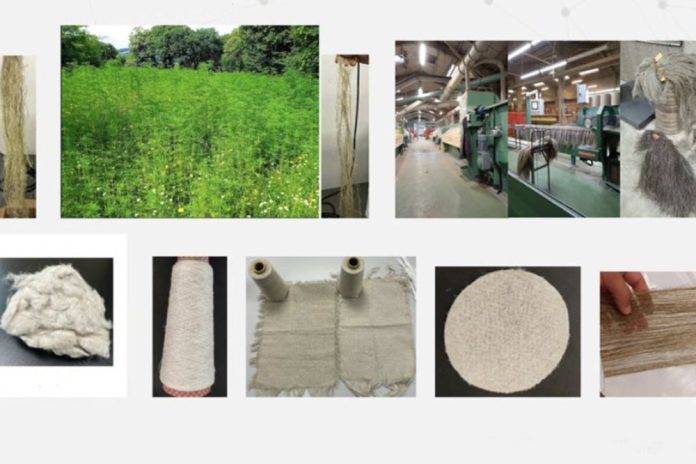
Another area of work involves cultivating and producing flax and hemp fibers in Portugal. Trials with different seeds and varieties were conducted, with planting in the north and Alentejo to determine crop adaptability to local climatic conditions. Carla Silva noted that industrial tests are currently underway to optimize production capacity and verify feasibility, and Portugal already has fully domestically produced flax and hemp fibers. The utilization of agricultural waste is another avenue explored by Be@t, particularly pineapple and banana leaves, which possess fibrous structures suitable for textiles. Additionally, biopolyesters produced through fermentation are being explored. These polymers can be obtained using microorganisms that utilize carbon sources from agricultural or textile waste. In one trial, post-consumer towels with high cellulose concentration were used. Carla Silva explained that this waste can be converted into a carbon source, which microorganisms use to produce biopolymers. She added that some Portuguese textile companies already have fermenters and biotechnological processes within their factories, emphasizing that the textile industry is a high-tech-intensive sector.
Agromethod Labs is researching the cultivation of cotton indoors in a soilless environment using hydroponic and vertical systems. Raquel Maria pointed out that cotton remains the most widely used natural fiber globally, and the market size makes it crucial to find methods to reduce water usage, pesticide application, carbon footprint, and geographical limitations. The system, developed in collaboration with CITEVE, allows for year-round cotton cultivation under controlled conditions. Compared to soil-grown cotton, the initial fibers produced are brighter and whiter, properties that could reduce the need for initial scouring and bleaching operations. Raquel Maria assured that the quality of this cotton is significantly higher than the average of soil-grown cotton and is comparable to premium cotton. Subsequently, the fiber was processed into yarn using existing conventional equipment at CITEVE, demonstrating full compatibility with current production processes without requiring adjustments. The validation culminated in the production of a knitted fabric made from 100% hydroponic cotton, exhibiting a uniform structure with no visible defects. Raquel Maria emphasized that the goal is to prove hydroponic cotton throughout the entire textile value chain, having produced fiber, yarn, and transformed it into 100% hydroponic cotton knitted fabric. One of the main advantages of this system is its ability to produce continuously, unaffected by weather conditions. In the initial trials, harvests were conducted in July, September, and December, with no significant differences in the physiological, physical, or mechanical properties of the fibers.
Currently, the project involves approximately 130 plants, with the first harvest of the new phase expected within two months. Raquel Maria stated that at least two to three kilograms are needed for spinning. The project is pilot-scale, starting with 10 plants and expanding to 130. Indoor cultivation allows for three to four harvests per year, with the same plant capable of continuous production for one and a half to two years. The seeds used are proprietary, selected over multiple cycles for adaptation to the hydroponic environment. Beyond fiber sales, the startup is considering seed sales and licensing of the cultivation system as potential business models. Raquel Maria concluded that the goal is not just to produce cotton differently, but to establish a new, more sustainable, predictable, and textile-industry-friendly benchmark for cotton production in Europe. Initial production will target high-end brands that value traceability, supply chain proximity, fiber quality, and sustainability, with the potential to scale up based on demand.
Altri is intensifying its efforts to convert cellulose from Portuguese forests into textile fibers. The group produces approximately 1.1 million tons of pulp annually in Portugal: around 800,000 tons from Celbi, 200,000 tons from Biotek, and 100,000 tons from Caima. Initially producing higher purity pulp for textile applications at Caima, Altri is now shifting the Biotek plant's product mix from paper-oriented applications towards textile applications, revealed Gabriel Sousa.
Higher purity pulp can be used to produce viscose, lyocell, and other cellulosic materials. Currently, almost 100% of Altri's pulp for these purposes is exported to China, where it is converted into textile fibers and integrated into yarns, fabrics, or finished products, which may subsequently return to Europe and Portugal. In collaboration with CITEVE and CeNTI, Altri has created knowledge and infrastructure for converting pulp into textile fibers, which previously did not exist in Portugal. A small laboratory unit capable of producing lyocell fibers from pulp has been installed. Functionalities such as fluorescence, phosphorescence, hydrophobicity, fire resistance, natural dyeing, and recyclability have also been tested. Gabriel Sousa noted that the sustainability argument lies in using natural raw materials, but they also wanted to understand the material's recyclability, and experiments have proven it can be recycled through the same process. Furthermore, Altri has acquired approximately 60% of the Swiss startup AeoniQ, which has developed a cellulose fiber production process using an alternative lyocell solvent. The startup has a pilot facility in Austria and has conducted trial production, including footwear and products made entirely from AeoniQ fibers. The next step is to install a demonstration unit at the Caima plant, with an investment of around €10 million, expected to be operational by the end of this year, with an annual capacity of approximately 40 tons. Gabriel Sousa emphasized that this will enable larger-scale customer testing while also testing the technology's scalability, adding that these steps must be taken: technology testing, market testing, and scaling up. The fiber will be sold in small quantities for capsule collections after the unit starts production. Capacity is expected to expand to around 2,000 tons per year between 2028 and 2029, potentially reaching around 20,000 tons per year in the long term. Gabriel Sousa believes that in the short term, new cellulosic fibers will struggle to compete with polyester in standard applications, as polyester production plants can have annual capacities of 100,000 to 500,000 tons, diluting fixed costs through higher volume. He also stated that brands claim to want sustainable materials, but when additional costs arise, they do not bear them, instead passing them up the value chain, or only proceed when costs are comparable. Despite obstacles, including a lack of specialized human resources, a lack of machinery manufacturers, overly bureaucratic licensing processes, and a lack of financing for innovative industries, the three participants believe Portugal has the conditions to develop a sustainable textile raw materials industry. Carla Silva noted Portugal's leading position in knowledge, Gabriel Sousa believes it is now necessary to combine scientific capabilities, technology access, and capitalization. Raquel Maria stated that demand and investment will determine the pace of progress, concluding: "In the long term, with sufficient scale and investor interest, because demand exists, the situation could change."

Related Products