Rosario Board of Trade, Argentina: 65% of Agricultural Output Within 300 km of Three Major Ports
en.Wedoany.com Reported - A study by the Rosario Board of Trade (Bolsa de Comercio de Rosario) shows that 65% of Argentina's agricultural output is located within a radius of no more than 300 kilometers from the country's three main port hubs—Bahía Blanca, Quequén, and Greater Rosario.
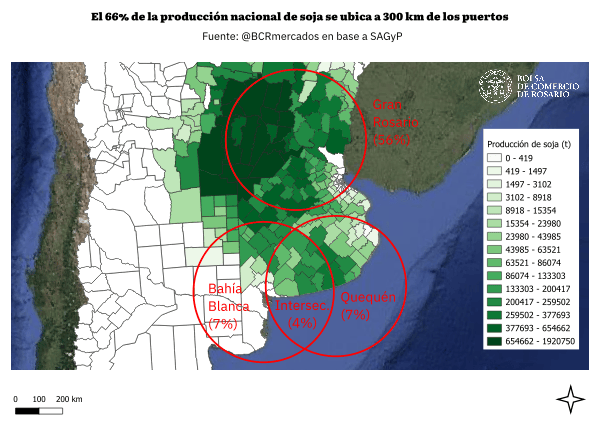
The study aggregates the production of six major crops—soybeans, corn, wheat, sunflower seeds, barley, and sorghum—and finds that 47% of national output lies within a 300-kilometer radius of Greater Rosario, 13% within the same distance of Bahía Blanca, and 12% within the same distance of Quequén; the influence areas of Bahía Blanca and Quequén overlap by 7% of output. Combined, the three hubs concentrate 65% of national production of the six crops.
Soybeans are the most widely planted crop in Argentina. Of its production, 56% is concentrated within a 300-kilometer radius of the Greater Rosario ports, with Bahía Blanca and Quequén each contributing 7%. Adding the three hubs together, and excluding soybeans produced in the intersecting area of the Bahía Blanca and Quequén circles (4%), 66% of national soybean output falls within the ports' radiation radius.
For corn, 40% of national production is located within 300 kilometers of Greater Rosario, while Bahía Blanca and Quequén concentrate 11% and 9%, respectively. After deducting the 5% overlap between Bahía Blanca and Quequén, the three hubs together account for 55% of national corn output. Among all crops analyzed, corn has the lowest concentration near port areas, because a significant share of its production comes from Argentina's Northwest (NOA) as well as regions outside the scope of consideration, such as northern Santa Fe Province, western Córdoba Province, San Luis Province, Santiago del Estero Province, and the Northeast (NEA).
Wheat production has a higher share in the southern regions of Argentina, consistent with the fact that a considerable portion of its harvest is shipped through Atlantic ports. Of national output, 20% is located within 300 kilometers of Bahía Blanca and 17% within the same distance of Quequén, with 11% representing the overlap of the two influence areas; Greater Rosario, meanwhile, concentrates 56% of national wheat production within its own 300-kilometer radius.
Barley follows a distribution pattern similar to wheat, but is even more concentrated in the south, with production mainly in La Pampa Province and southern Buenos Aires Province. In the 2024/25 season, 66% of output was concentrated within a 300-kilometer radius of Bahía Blanca, 62% around Quequén, and 44% in the intersection of the two influence areas; after excluding the overlap, this is equivalent to 85% of barley being produced within 300 kilometers of the two southern ports. By comparison, Greater Rosario accounts for only 8%. Overall, 93% of barley in the 2024/25 season was produced within 300 kilometers of any of the three port hubs.
For sunflower seeds, 61% of national production is located within no more than 300 kilometers of the three port hubs: 19% in the Rosario influence area, 26% around Quequén, 31% around Bahía Blanca, and 15% in the intersection of the latter two areas. The remaining 39% is distributed across production zones such as western Córdoba Province, western Buenos Aires Province, San Luis Province, northern Santa Fe Province, Santiago del Estero Province, Chaco Province, and Formosa Province.
Sorghum is mainly distributed across the central and northern regions of the country, with only limited production in the south. Of national output, 56% lies within the radiation radius of the Greater Rosario ports; production within 300 kilometers of Bahía Blanca and Quequén accounts for only 2% and 1%, respectively, with 1% located in the intersection of the two hubs.



![IVECO Cash-in-Transit [DMT5048XYCL3-AM] - Chongqing Dima Industry Co., Ltd](https://img.wedoany.com/2026/0911/20260911030157582.png)