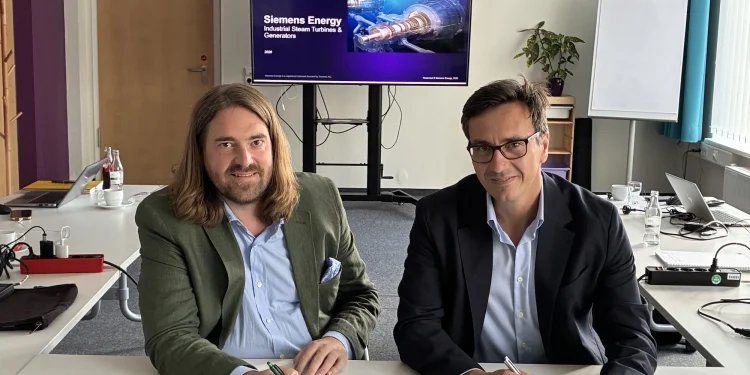
en.Wedoany.com Reported - On July 31, 2026, Xinfengguang signed a joint R&D agreement with Shandong Industrial Research Institute, Sugon Data Energy, and Zhongke Jinboxin to jointly advance the SST green-power direct-connection liquid-cooled intelligent computing center prefabricated cabin project, with the project's core adopting Xinfengguang's self-developed 2.5MW solid-state transformer. Prior to this, Delta and Tgood had already released similar prefabricated cabin solutions. Three enterprises with different industrial backgrounds targeting the same track within the same window period have given rise to new dynamics in the competitive landscape of computing power supply infrastructure.
The prominent contradiction in the current implementation of computing-power synergy lies in the difficulty of matching power supply facility construction pace with the speed of computing power expansion. The civil construction cycle for conventional substations typically ranges from 12 to 18 months, while the AI chip iteration cycle is only one year. If power supply supporting construction lags behind, computing hardware will remain idle for extended periods, resulting in investment losses. To resolve this temporal mismatch, the SST prefabricated cabin solution is regarded by the industry as a viable path. From an industrial attribute perspective, the prefabricated cabin model elevates SST from a single power component to a standardized computing power infrastructure component. While each enterprise adopts different technical routes, they share the same goal: promoting SST products to achieve standardization, batch replicability, and controllable delivery cycles. Leveraging SST's one-step power conversion and multi-port flexible access characteristics, green-power direct connection is transitioning from policy orientation to scalable engineering solutions. The industry's main competitive thread has consequently shifted, with system delivery capability, project implementation speed, and long-term operational sustainability becoming key factors for manufacturers to seize the initiative in this track.
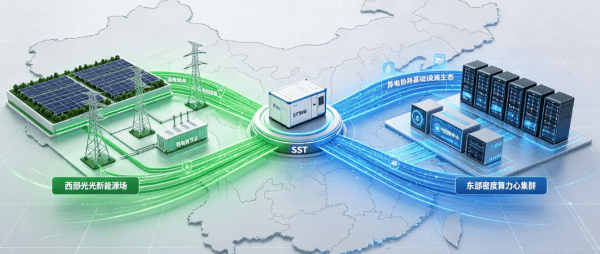
Computing-power synergy was first included in the government work report in 2026, followed by multiple departments jointly issuing an action plan for bidirectional empowerment between AI and energy. Behind the continuous policy reinforcement lie three structural mismatches facing the industry. At the spatial level, wind and solar resources are concentrated in the western and northwestern regions, while over 60% of national computing power demand is concentrated in the eastern and southern regions; at the temporal level, wind and solar power generation is intermittent in nature, while AI large model training requires 7×24-hour uninterrupted power supply for computing clusters; at the systemic level, institutions project that domestic AIDC electricity consumption will exceed 1.5 trillion kWh by 2035, with single-rack power density continuously climbing from 15kW to over 50kW.
Data center power supply has long adopted an on-site construction model, with substation civil works commencing only after the computing room is completed. Computing-power synergy, however, requires computing and power systems to be planned and constructed simultaneously. Zhou Jun, Executive President of Tgood, pointed out that traditional high-voltage substation construction involves complex processes and massive engineering workloads, making it difficult to adapt to the 6-to-8-month rapid commissioning and phased expansion needs of intelligent computing centers. The core of the prefabricated cabin model is shifting on-site construction to factory-based prefabrication. Before computing equipment arrives on site, the entire power supply system completes manufacturing and joint commissioning, requiring only assembly and debugging upon delivery to the project site, thereby shortening the construction cycle from the source.
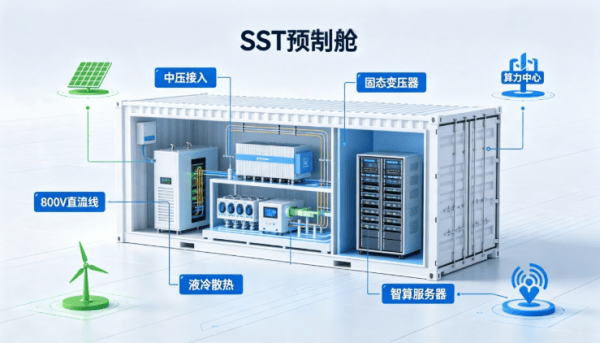
The rapid rise of SST prefabricated cabins is directly related to the technical characteristics of solid-state transformers themselves. Traditional power supply chains adopt a multi-stage conversion architecture of "medium-voltage line-frequency transformer → low-voltage distribution → UPS → PDU," involving numerous devices and relatively high losses. SST relies on high-frequency power electronics topology to directly convert 10kV medium-voltage AC to 800V DC, achieving system efficiency of up to 98.5% and reducing floor space by more than 50% compared to traditional solutions. The highly integrated architecture also presents engineering challenges: SST integrates SiC power modules, high-frequency transformers, insulation systems, and control circuits internally, making it difficult to ensure matching precision of electrical connections, heat dissipation, and insulation systems during on-site installation. The factory prefabrication model enables full-system calibration and commissioning, delivering a validated complete system ex-factory, transforming non-standard custom engineering into standardized products.
The three enterprises have charted differentiated development paths based on their respective strengths. Xinfengguang, backed by Shandong Energy Group and long focused on high-power power electronics equipment, adopts a cascaded H-bridge and dual active bridge topology, integrating grid-forming energy storage and leveraging virtual synchronous generator technology to adapt to weak grids. This solution is better suited for the western hub scenarios of the East-Data-West-Computing project, enabling off-grid operation and direct green-power supply in regions rich in wind and solar resources but with weak grid infrastructure.
Tgood, with high-voltage prefabricated cabin substations as its core business, extends its layout downward from the high-voltage end. Its computing power island integrates high-voltage transformers, GIS switchgear, and complete SST equipment, with all 167 functional modules factory-prefabricated, reducing on-site civil works by 70% and compressing the overall delivery cycle to 5 months, leveraging mature high-voltage infrastructure capabilities to build the computing power supply backbone.
Delta's containerized SST solution leans toward full-stack integration, using the solid-state transformer as the energy core and integrating servers and AI acceleration hardware to build complete infrastructure from the grid to computing chips. The system adopts an 800V DC architecture with end-to-end efficiency exceeding 98.5%, enabling 24-hour rapid deployment, suitable for emergency computing power and distributed computing scenarios in remote areas.
In the early stages of industry development, competition in the SST track focused on hardware parameters such as efficiency, volume, and power. As the technology enters the phase of large-scale implementation, the competitive focus shifts toward comprehensive system capabilities. Delivery cycles, integration costs, green-power access adaptability, and depth of synergy with computing systems are gradually replacing paper specifications as the core criteria for project selection. With the continued expansion of AI computing power and the release of computing-power synergy demand, SST prefabricated cabins are continuously reshaping the underlying architecture of computing power supply and exerting profound influence on the construction models of intelligent computing centers.