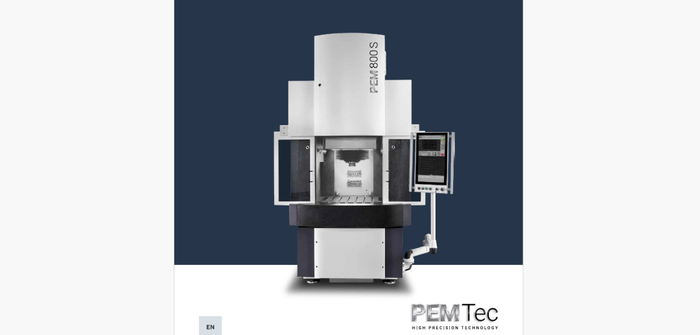
German PEMTec Launches PEM 800S Precision Electrochemical Metal Machining Equipment
en.Wedoany.com Reported - PEMTec has launched the PEM 800S precision electrochemical machining (PECM) equipment, targeting batch manufacturing scenarios in aerospace, medical devices, precision molds, and new metal material processing. It achieves high-precision forming through a non-contact machining process, with no thermal damage and no recast layer. The equipment is designed around a natural granite bed, linear process axes, and modular high-precision pulse generators, aiming to deliver stable machining accuracy, productivity, and consistency in high-volume production.
During the PECM process, the tool electrode oscillates reciprocally, with the machining gap typically only 30 micrometers or even smaller. When electrolyte flushes the machining area, poor chip removal can directly affect machining accuracy and stability, and in severe cases may cause short circuits that burn out the tool electrode. Therefore, the equipment's structural design and process monitoring capabilities are critical to ensuring reliability during prolonged continuous machining.
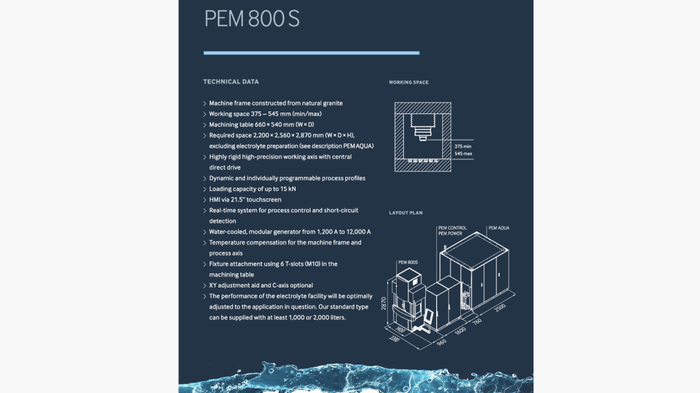
The PEM 800S uses natural granite as the primary material for its machine bed. Granite has a low coefficient of thermal expansion and excellent damping properties, which reduce the impact of ambient temperature fluctuations and electrode vibration on machining accuracy. The equipment is also equipped with a temperature compensation system and vibration-damping leveling feet to compensate for temperature changes and isolate external vibrations. Regarding process axes, the equipment employs high-precision linear process axes, and the tool electrode amplitude can be programmably controlled to accommodate the electrolyte flushing and chip removal requirements of different application scenarios.
The high-precision pulse generator is one of the primary sources of PECM machining accuracy. The equipment combines high current density with precise pulse control to improve material removal efficiency per unit time while ensuring machining accuracy, making it more suitable for multi-station, high-volume machining scenarios. The pulse generator features a modular design with an expansion range covering 1,200 A to 9,600 A, allowing precise adaptation to application requirements. Since the PECM machining gap is extremely small, any contact can cause a short circuit and damage the tool electrode. The PEM 800S is equipped with a real-time process monitoring system that can detect abnormal short circuits within microseconds and respond quickly, reducing the risk of damage to both the tool electrode and the workpiece.
The machining results of PECM depend not only on the equipment itself but also on part geometry, machining parameter development, and tooling electrode design. Thoroughly evaluating these factors during the project introduction phase helps improve process development efficiency and ensures the stability of subsequent mass production.
In terms of process routing, PECM is typically used as a finishing operation in the part manufacturing process. During project development, considerations should include upstream processes, machining allowance allocation, part positioning datums, and downstream inspection requirements, to establish a complete machining workflow suited to the characteristics of the PECM process. PEMTec recommends participating in process evaluation at the early stage of the project to jointly optimize the part manufacturing solution with customers, rather than designing only for a single machining operation.
Since PECM material removal relies on the continuous flushing of electrolyte through the machining gap to promptly remove machining byproducts, parts with complex geometric features require comprehensive consideration of electrolyte flow paths, flow distribution, and drainage methods during the tooling electrode design phase to establish a stable and uniform flow field. For areas that are locally enclosed or where electrolyte flushing is restricted, targeted optimization should be carried out in the product design or process solution.
Tooling and tool electrodes determine the final forming quality of the part. Their design requires comprehensive optimization that integrates part geometric features, electric field distribution, flow field characteristics, and machining parameters, with compensation values corrected through prototype trial machining. The new product introduction phase typically requires completing development work such as process validation, tool electrode optimization, and single-station and multi-station verification.
PECM is suitable for products with stable batch production, long lifecycles, and high requirements for dimensional consistency, surface precision, and fatigue performance. Although such projects require a certain upfront process development period, once mass production is underway, PECM's advantages in machining consistency, production efficiency, and overall manufacturing cost can be fully realized.
For companies introducing the PECM process for the first time, PEMTec's China Sales Application Center (PSAC Chengdu Application Center) provides localized technical services, including process feasibility analysis and evaluation, machining solution design, prototype trial machining and process validation, mass production process and tooling development, as well as equipment installation, commissioning, acceptance, training, and after-sales technical support. The center works in collaboration with the German headquarters team to shorten development cycles and improve project execution efficiency.
Related Products

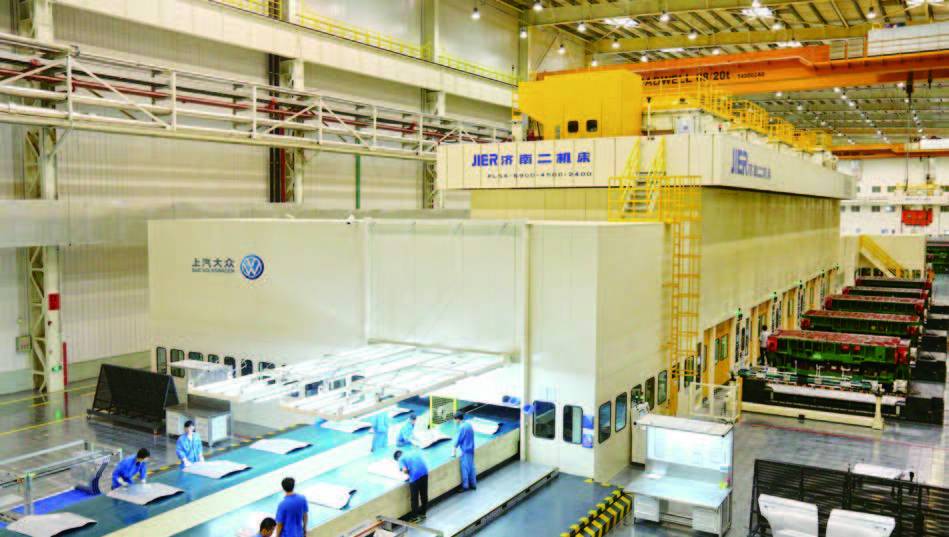
High-Speed Flexible Fully Automatic Stamping Production Line
JIER Machine-Tool Group Co., Ltd.
Standard Nozzle Flowmeter
Jinggong Automatic Control Instrument Complete Technology Development Company
Industrial and Commercial Point-Type Gas Detector
Jinan Benan Technology Development Co., Ltd.
Excavator Bucket Teeth Heat Treatment Production Line
Suzhou Hezhongju Intelligent Equipment Co., Ltd.