Kunming University of Science and Technology in China Discovers New Antidepressant Target of Qingyangshen Saponins
en.Wedoany.com Reported - The team of Professors Xu Tianrui and Xiang Cheng from the Faculty of Life Science and Technology at Kunming University of Science and Technology in China has recently achieved original results in the discovery of novel antidepressant drug targets. The international journal Phytomedicine has published the related research.
Depression has become a highly prevalent psychiatric disorder worldwide, and existing clinical drugs do not provide effective treatment options for more than 30% of patients. Previously, the medical community has confirmed that chronic inflammation is highly associated with the onset of depression, but existing anti-inflammatory drugs have poor targeting specificity, creating an urgent clinical need for the development of therapeutic targets and lead compounds with entirely new mechanisms of action. Qingyangshen (Cynanchum otophyllum) is a plant of the Cynanchum genus in the Asclepiadaceae family, and is a traditional medicinal material that has been used for a long time by the Naxi, Yi, Bai and other ethnic minorities in Yunnan. It is commonly used in folk medicine to regulate neurological conditions such as epilepsy and neurasthenia, possessing natural neuroregulatory potential, making it the core research material of this study.
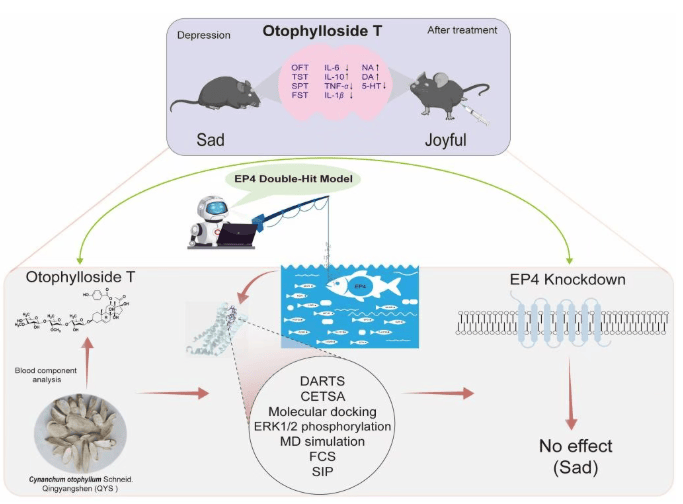
The research team systematically analyzed the pharmacological effects of Qingyangshen extract and its core active substance, qingyangshen saponins. Through repeated validation in three animal models—mice, zebrafish, and fruit flies—the substance was shown to significantly improve depression-related behaviors induced by inflammation in experimental animals. Pharmacological mechanism analysis revealed that qingyangshen saponins can simultaneously achieve three effects: inhibiting inflammation, scavenging oxidative damage, and stabilizing brain neurotransmitters, alleviating depressive symptoms through synergistic multi-pathway action.
In the target identification phase, the research team innovatively established a dual discrimination model for the prostaglandin E2 receptor subtype 4 (EP4), and combined it with artificial intelligence machine learning technology to precisely identify the EP4 receptor as the direct target of qingyangshen saponins from among hundreds of G protein-coupled receptors. Multiple sets of molecular experiments confirmed that the two can bind directly, and that qingyangshen saponins act as an inhibitory ligand for this receptor. The researchers further conducted receptor knockout animal experiments in hippocampal tissue, and the results demonstrated that once the function of this receptor is lost, the antidepressant effect of qingyangshen saponins completely disappears, confirming for the first time at the in vivo level that this receptor is a necessary target for the drug's efficacy.
The innovative highlights of this research lie in establishing the EP4 receptor as a novel antidepressant drug target and a new research direction for treating depression through inflammatory pathways, as well as discovering qingyangshen saponins from indigenous ethnic medicinal materials as a lead compound, laying a solid theoretical and molecular foundation for the development of highly specific anti-inflammatory and antidepressant drugs. At the same time, this research has tapped into the value of regional distinctive ethnic medicinal resources, connecting the complete research chain of "ethnic medicinal materials—active ingredients—drug targets—new drug development," and opening a localized new pathway for the development of drugs for treatment-resistant depression.