Chinese scientists crack the puzzle of "marriage" between Asian and African rice, ending decades-long confusion in breeding
en.Wedoany.com Reported - Why do hybrids of Asian cultivated rice and African cultivated rice exhibit massive pollen abortion, with sparse and shriveled panicles? This puzzle, which has troubled the breeding community for decades, was unraveled with the online publication of a significant paper in the international academic journal Science on the 28th. The research team led by Wan Jianmin, an academician of the Chinese Academy of Engineering, discovered a precise genetic conflict system composed of three genes in hybrids of Asian cultivated rice and African cultivated rice, which causes pollen abortion in rice. This marks the first revelation of the molecular mechanism of reproductive isolation between these two rice species, providing an important theoretical foundation and germplasm resources for breeding new ultra-high-yield Asian-African hybrid rice varieties.
Within the rice "family," only Asian cultivated rice and African cultivated rice have been domesticated and cultivated by humans. Scientists hope to "marry" these two rice species to breed new rice varieties that are both high-yielding and robust. However, the progeny of crosses between Asian cultivated rice and African cultivated rice exhibit extremely low pollen viability and significantly reduced seed set rates, hindering the exchange and recombination of superior genes and the utilization of interspecific heterosis.
What exactly causes "1+1<2"? After 18 years of intensive research, the team deciphered the molecular mechanism of the gene locus RHS3 on chromosome 3 in hybrids of Asian cultivated rice and African cultivated rice.
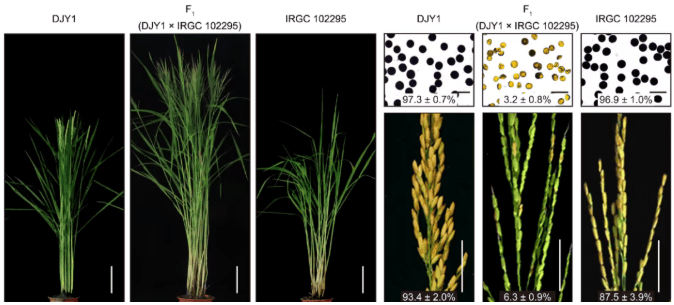
Phenotypes of plants, pollen, and spikelets of Asian cultivated rice, African cultivated rice, and their F1 hybrids. Photo provided by the research team.
He Xiaodong, co-first author of the paper and a doctoral student at Nanjing Agricultural University, explained that the RHS3 locus consists of genes ORF10, ORF16, and ORF4, which form a genetic conflict system. Among them, the protein encoded by ORF10 acts like a "spear," disrupting mitochondria that supply energy to rice and killing pollen; the protein encoded by ORF16 acts like a "shield," interacting with the "spear" to neutralize its lethality and protect the normal development of embryo sacs and pollen; the protein encoded by ORF4 acts like an "armor," serving as a plant-specific selective autophagy receptor. By interacting with the "shield," it forms a "spear-shield-armor" complex that delivers the "spear" to the cell's "recycling station"—the autophagosome—for degradation, thereby specifically protecting the embryo sac.
Notably, African cultivated rice possesses the complete "spear-shield-armor" trio, while Asian cultivated rice has only the "armor." This results in two types of pollen in their hybrid progeny: one type inherits the complete "spear-shield-armor" and remains unharmed; the other inherits only the "armor" without the "shield" and is attacked by the "spear," leading to abortion, ultimately causing semi-sterility in hybrid pollen.
"This discovery reveals for the first time the molecular mechanism by which selective autophagy participates in interspecific reproductive isolation in plants, namely that ORF4, as a plant-specific selective autophagy receptor, can directly induce the autophagic degradation of ORF10, thereby regulating interspecific reproductive isolation," said Wang Chaolong, co-corresponding author of the paper and a professor at Nanjing Agricultural University.
More importantly, the research team identified a wide-compatibility germplasm in which the "shield" is functional while the "spear" is inactivated. When this germplasm is crossed with Asian cultivated rice and African cultivated rice, it can effectively overcome the fertility decline caused by the RHS3 locus. This means that scientists have found a "key" to breaking reproductive isolation, providing a technical pathway and germplasm resources for utilizing heterosis in distant hybrids of Asian and African cultivated rice.
Wan Jianmin stated that the team will next conduct in-depth research on multiple hybrid sterility loci in rice, striving to develop new distant-hybrid ultra-high-yield rice varieties that can be put into production as soon as possible.
Related Products

4HS-8 High-efficiency Peanut Inverted-laying Harvester
Hebei Yongfa Hongtian Agricultural Machinery Manufacturing Co., Ltd.
Industrial and Commercial Point-Type Gas Detector
Jinan Benan Technology Development Co., Ltd.



714CD Series C-Band Weather Radar
Chengdu Zhongdian Jinjiang Information Industry Co., Ltd.