Perovskite-Organic Tandem Solar Cell from Nanjing University, China Achieves 27.35% Efficiency
en.Wedoany.com Reported - Researchers at Nanjing University have fabricated a perovskite-organic tandem solar cell whose bottom organic sub-cell employs a low-bandgap (LBG) acceptor, enhancing near-infrared (NIR) absorption while reducing voltage loss.
Qingdong Zheng, the paper's corresponding author, stated that one of the key factors limiting the efficiency of perovskite-organic tandem solar cells is that the photocurrent density generated by the low-bandgap organic sub-cell is lower than that of the wide-bandgap (WBG) perovskite sub-cell. This photocurrent imbalance mainly stems from the substantial overlap of the external quantum efficiency (EQE) spectra of the two sub-cells near the absorption edge of the perovskite layer. Therefore, developing high-efficiency near-infrared acceptors is crucial for reducing spectral overlap, improving photocurrent matching, and ultimately enhancing tandem device performance.
According to the researchers, previous studies have developed various non-fullerene acceptors (NFAs) through molecular engineering strategies to enhance the near-infrared absorption of low-bandgap organic solar cells, and have enabled certified power conversion efficiencies of 22.0% to 26.4% in perovskite-organic tandem devices.
To further improve efficiency, the team designed and synthesized a novel non-fullerene acceptor, Zh-F, with an optical bandgap of 1.23 eV. The material uses a strongly electron-donating heteroheptacene as its core, with the goal of narrowing the optical bandgap and extending light absorption further into the near-infrared region.
To reduce voltage loss and improve long-wavelength photoresponse, the researchers combined Zh-F with BTP-eC9, a high-performance non-fullerene acceptor from the Y-series organic semiconductor family. The two acceptors were paired with the polymer donor PM6 to form a ternary heterojunction, achieving complementary light absorption and enhanced spectral utilization.
The resulting PM6:BTP-eC9:Zh-F ternary organic solar cell achieved a power conversion efficiency of 19.84%, an open-circuit voltage of 0.853 V, a short-circuit current density of 29.00 mA cm⁻², and a voltage loss as low as 0.510 V.
Zheng stated that introducing Zh-F into the PM6 system simultaneously enhances near-infrared photon collection, charge transport, exciton dissociation, and recombination dynamics, while suppressing voltage loss, making it highly suitable for perovskite-organic tandem solar cells.
This organic cell was combined with a perovskite top cell to form a tandem structure. The perovskite top cell achieved a power conversion efficiency of 19.45%, an open-circuit voltage of 1.32 V, a short-circuit current density of 17.63 mA cm⁻², and a fill factor of 83.65%.
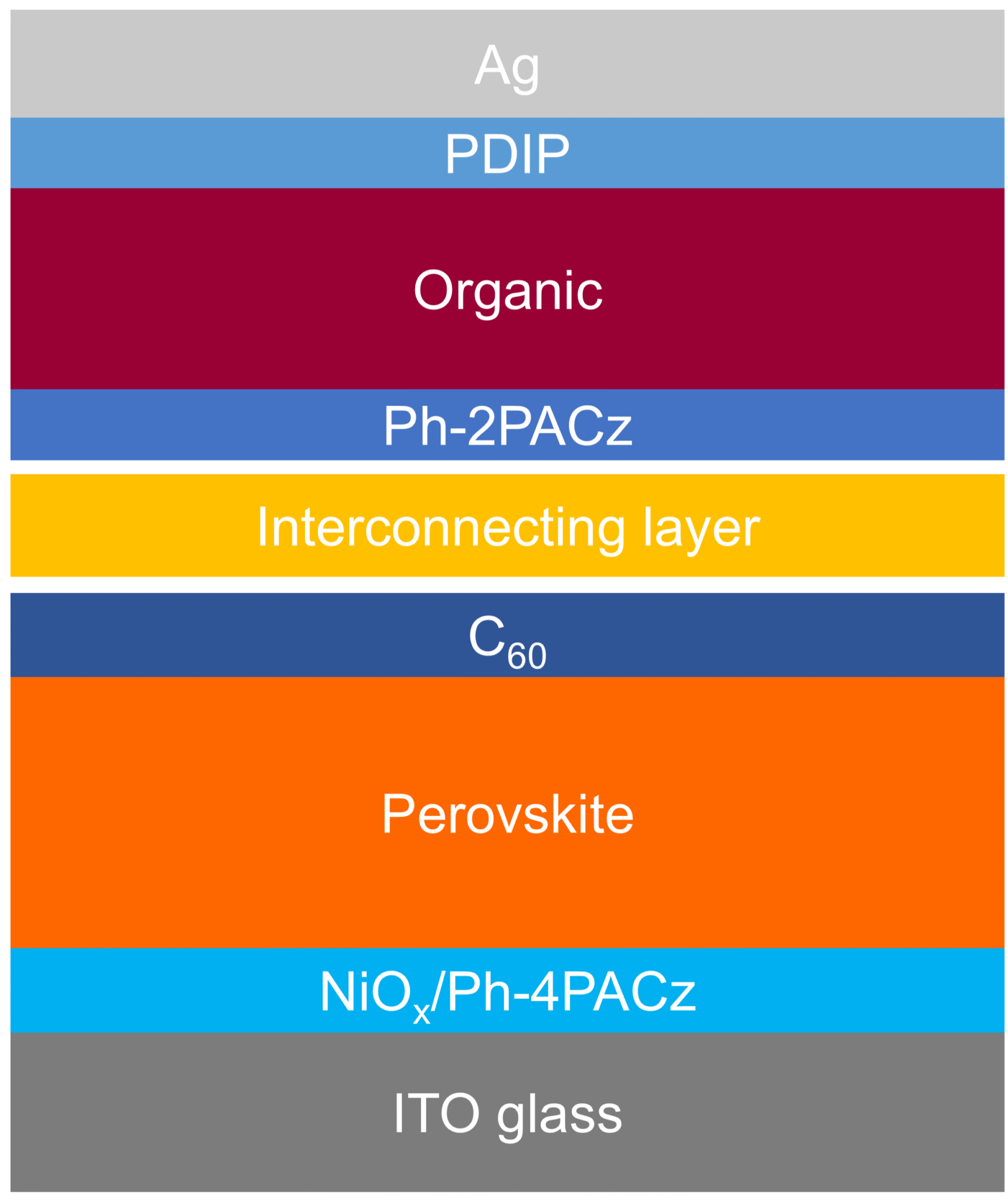
The researchers constructed a monolithic perovskite-organic tandem cell on a glass and indium tin oxide (ITO) substrate. The perovskite top cell consists of a nickel oxide (NiOₓ) hole transport layer (HTL), a Ph-4PACz self-assembled monolayer (SAM), a wide-bandgap perovskite absorber layer, and a buckminsterfullerene (C₆₀) electron transport layer (ETL).
An interconnection recombination layer electrically connects the perovskite front sub-cell with the low-bandgap organic rear sub-cell. The organic cell includes a Ph-2PACz hole-selective layer, an organic photoactive absorber layer, an electron transport layer based on the perylene diimide interfacial material PDIP, and a silver (Ag) metal contact electrode.
The above structure constitutes a monolithic two-terminal perovskite-organic tandem device: the perovskite front cell harvests higher-energy photons, while the organic rear cell extends light harvesting into the near-infrared region.
Under standard illumination conditions, the tandem cell achieved a power conversion efficiency of 27.35%, an open-circuit voltage of 2.16 V, a short-circuit current density of 15.35 mA cm⁻², and a fill factor of 82.39%. In comparison, a control tandem device using a conventional acceptor achieved an efficiency of 25.69%.
Zheng stated that the tandem device obtained a certified efficiency of 26.88%, the highest verified efficiency among reported perovskite-organic tandem solar cells. Beyond efficiency, the unencapsulated device also demonstrated good stability, retaining 80% of its initial performance after approximately 744 hours of continuous 1-sun illumination.
The related results were published in the journal Joule under the title "Improving Near-Infrared Absorption via a Low-Bandgap Acceptor Enables 27.35% Efficiency in Perovskite-Organic Tandem Solar Cells."
In June 2025, researchers at the Solar Energy Research Institute of Singapore (SERIS) claimed to have achieved a power conversion efficiency of 26.4% with the same structure.