Germany's SPIRIT-E project validates bidirectional charging for electric heavy-duty trucks
en.Wedoany.com Reported - On October 30, the German research project SPIRIT-E announced its results: in a real-world laboratory at Schmid freight company in Regensburg, a MAN eTGX electric truck used its 480 kWh of usable capacity to feed power back into the local energy network and the public grid via a bidirectional DC charging station at up to 350 kW, publicly demonstrating three types of applications: vehicle-to-vehicle, vehicle-to-site and vehicle-to-grid.
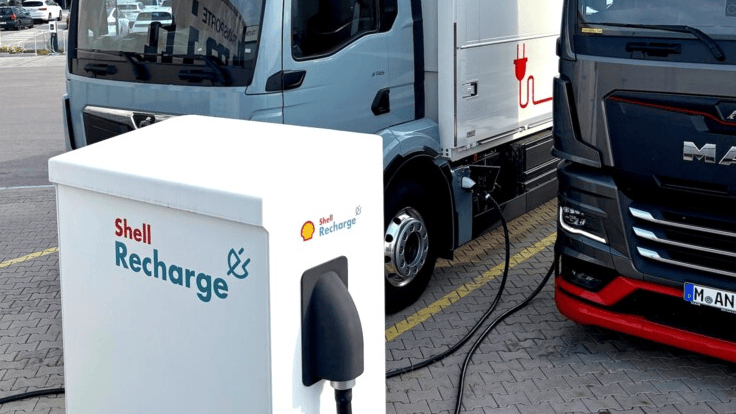
The project's bidirectional DC charging infrastructure was provided by Shell Business Recharge Solutions (SBRS), part of the Shell group. Its mobile and stationary charging systems are designed for charging power of up to 440 kW, and up to 880 kW when multiple units are connected in parallel. The systems use the international communication standard ISO 15118-20 rather than proprietary solutions, enabling cross-manufacturer control of charging and discharging and providing the basis for scaling and interoperability of the technology.
The economics of bidirectional charging depend on the use case, dwell time, electricity prices and grid fees, own PV generation and available connection power. SBRS estimates that bidirectional charging is particularly attractive for electric trucks with regular fleet dwell times and annual mileage below 100,000 km (such as regional transport); at an annual mileage of 100,000 km, a roughly 10% reduction in electricity costs is equivalent to about 10,000 km driven without additional energy costs.
The project involved 8 organizations, including the Technical University of Munich (lead), the Fraunhofer Institute for Energy Economics and Energy System Technology (Fraunhofer IEE), the Institute for Energy Economics Research (FfE), MAN Truck & Bus, TenneT, Hubject, Consolinno Energy and SBRS, and ran from August 2023 to October 2026.
The project's conclusions show that the main obstacles to market rollout are not technological but lie in the coordination of grid, market and operations, including limited grid connection capacity, missing uniform standards and as-yet immature business models. Markus Lienkamp, professor at the Department of Vehicle Technology at the Technical University of Munich, said that heavy-duty electric trucks can technically be integrated into the energy system as flexible storage, and that the next step is to standardize, scale up and translate the validated solutions into viable business models.
Related Products


714CD Series C-Band Weather Radar
Chengdu Zhongdian Jinjiang Information Industry Co., Ltd.



Quick-Change Single-Seat Control Valve / Quick-Change High-Pressure Single-Seat Control Valve
Beijing Consen Automation Technology Co., Ltd.

Standard Nozzle Flowmeter
Jinggong Automatic Control Instrument Complete Technology Development Company