Wedoany.com Report-Sept. 24, Headway Technology Group, a Chinese marine equipment provider, has installed an onboard carbon capture system (OCCS) on the 57,000 dwt bulk carrier Yue Dian 56 at Longshan Shipyard in Zhoushan, China. Completed in mid-September, this marks China's first deployment of a centrifugal OCCS and the initial commercial application of this technology in the country, advancing efforts to reduce emissions in the maritime sector.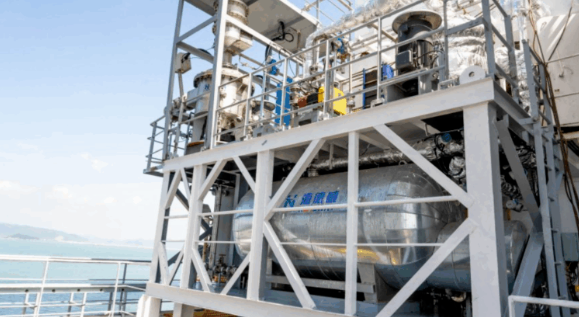
The project involved collaboration with the China (Zhejiang) Pilot Free Trade Zone Zhoushan Administration Committee, Guangdong Energy Group, Longshan Shipyard, CHN Energy New Energy Technology Research Institute, and the China Classification Society Shanghai Rules and Research Institute. The OCCS integrates carbon absorption, desorption, liquefaction, and liquid CO2 (LCO2) storage functions, utilizing Headway's centrifugal technology and the GNX-3 absorber from CHN Energy New Energy Technology Research Institute.
The system achieves a CO2 capture rate exceeding 90% with purity levels of at least 99.6%. By replacing traditional gravity-based scrubbers, it reduces energy consumption, enhancing operational efficiency. To maximize the value of captured CO2, Headway plans to collaborate with the Zhoushan Administration Committee and China Classification Society to establish a closed-loop green lifecycle for carbon.
Under this plan, LCO2 will be transported via dedicated carriers to Zhoushan's pilot port, adhering to guidelines for shipboard LCO2 loading and unloading. At the port, the CO2 will support sustainable fuel synthesis projects, incorporating AEM hydrogen generation and solid-state hydrogen storage to produce methanol and ammonia.
This initiative aligns with Headway's broader activities in sustainable fuels. In April 2024, the company signed a cooperation agreement with CEEC Hydrogen Energy to explore opportunities in methanol, ammonia, and hydrogen technologies.
The deployment reflects increasing global and domestic interest in OCCS as a transitional solution for maritime decarbonization. A recent International Maritime Organization (IMO) seminar highlighted OCCS as an effective interim measure to lower shipping emissions while alternative fuels advance, contributing to environmental sustainability.
Despite progress, scaling OCCS requires addressing challenges such as additional costs from fuel penalties, solvent replenishment, manpower, maintenance, and offloading services. Equipping more ports worldwide with necessary infrastructure remains essential for widespread adoption.
This project demonstrates China's commitment to innovative marine technologies, supporting the maritime industry's sustainability goals and fostering efficient, low-emission operations.