
An international team of astronomers has discovered an exoplanet, TOI-2431 b, orbiting a nearby star using observational data from the Transiting Exoplanet Survey Satellite (TESS). This newly identified planet is roughly Earth-sized with an extremely short orbital period. The research paper was released on the preprint server arXiv on July 11. Since its launch in April 2018, TESS has continuously monitored approximately 200,000 bright stars near Earth, detecting temporary dips in stellar brightness caused by transiting planets. To date, it has identified over 7,600 candidate exoplanets, with 638 confirmed.
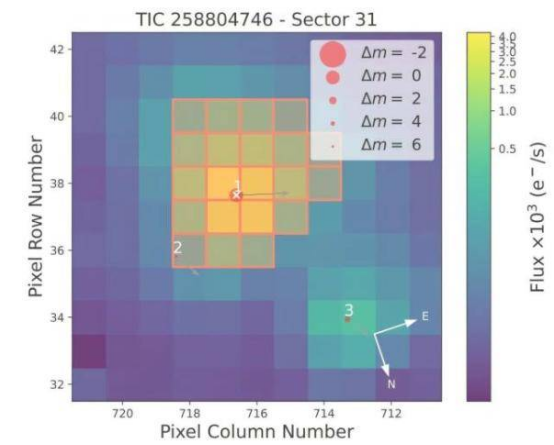
The team, led by Kaya Han Tash from the University of Amsterdam in the Netherlands, detected a transit signal in the light curve of the star TOI-2431. TOI-2431 is a K7V-type star located approximately 117 light-years from Earth. Follow-up ground-based observations confirmed that the signal originates from a planet, now designated TOI-2431 b. The team stated: "We confirm the ultra-short-period planet TOI-2431 b by combining TESS photometric transit data with precise radial velocity measurements from the NEID and HPF spectrometers and ground-based speckle imaging from NESSI."
TOI-2431 b has a radius about 1.53 times that of Earth, a mass 6.2 times greater, and a density of 9.4g/cm³. It completes one orbit around its host star every 5.4 hours, at a distance of just 0.0063 AU, with an equilibrium temperature of approximately 2,000K. Based on these characteristics, astronomers classify it as an ultra-short-period (USP) Earth-sized exoplanet—one of the shortest-period exoplanets detected to date. The extreme orbital conditions may result in a molten surface and tidal deformation. Additionally, its estimated tidal decay timescale is approximately 31 million years, the shortest known among USP planets. The host star TOI-2431 has a size and mass about two-thirds that of the Sun, an age of roughly 2 billion years, a metallicity of -0.02dex, and an effective temperature of about 4,109K. The research team noted that TOI-2431 b is an ideal target for phase curve observations with the James Webb Space Telescope (JWST), which could reveal its surface composition and whether it retains an atmosphere.