

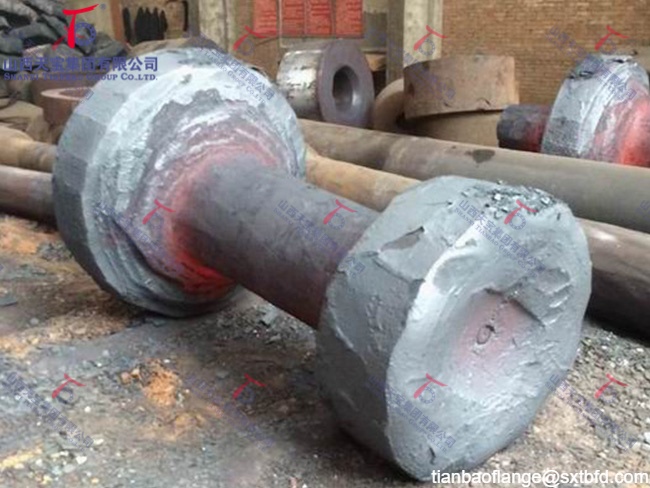


A forging blank is a preliminary shaped product obtained through the forging process, serving as a fundamental component in industrial manufacturing. Its quality and properties directly influence the final product's performance and reliability.
Free Forgings are produced through open-die forging, resulting in relatively simple shapes and sizes. Common examples include shaft-type blanks. During the forging process, the internal grain structure is refined and homogenized to some extent. However, compared to other complex forging methods, free forgings have lower dimensional accuracy and shape complexity, making them suitable for small-batch production. Die Forgings utilize molds for forging, achieving more complex shapes with higher precision. This method is ideal for producing blanks with strict shape and dimensional requirements, such as complex aerospace components. Die forgings feature well-distributed metal flow lines, high structural density, and are suitable for mass production. Block Forgings are formed using simple molds during the open-die forging process, combining characteristics of both free and die forgings. They are commonly used for small-batch production of complex-shaped blanks, enhancing production efficiency and blank quality while reducing manufacturing costs.
Common materials include carbon steels such as 45# steel for medium-load gears, alloy steels like 40Cr and 42CrMo with high hardenability and strength, and carburized steels like 20CrMnTi, known for high surface hardness and wear resistance. The selected materials must have excellent forgeability, high hardenability, and high purity.
The size range of forging blanks is extremely broad, from millimeter-scale precision component blanks to large structural blanks measuring several meters or even tens of meters. In the field of mechanical manufacturing, common forging blank sizes range from tens of millimeters to several meters, while in industries such as aerospace and shipbuilding, the sizes can be even larger.
