Wedoany.com Report on Feb 28th, Facing pressure from a dollar shortage, the Central Bank of Venezuela has adopted a gold sales strategy to alleviate the foreign exchange crisis. In the second half of 2025, the country sold nearly six tons of gold, reflecting the authorities' approach of utilizing hard assets to maintain currency stability against a backdrop of constrained export revenue and increasing balance of payments pressure. The timing of the gold sales coincided with the tanker seizure incident on December 10, 2025, which exacerbated the reduction in dollar inflows and forced the central bank to accelerate asset liquidation.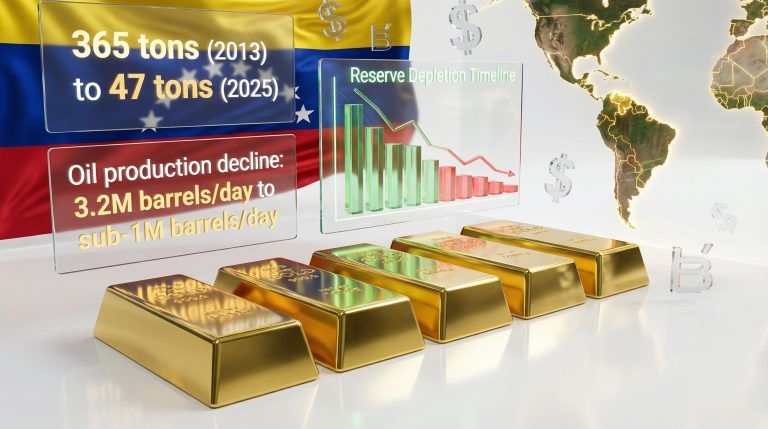
Venezuela's gold reserves have plummeted from approximately 365 tons in 2013 to 47 tons in 2025, a decline of over 80%, indicating a long-term trend of asset depletion. Despite the gold sales in 2025, the total reserves in dollar terms actually grew by 30% due to rising precious metal prices, masking the reduction in physical assets. Oil exports lost about 85% of their revenue between 2013 and 2025, intensifying fiscal pressure and prompting the central bank to prioritize short-term liquidity over long-term reserve accumulation during the crisis.
During the exchange rate crisis, the widening gap between the official and parallel market rates created arbitrage opportunities, further depleting foreign exchange reserves. The central bank faced policy choices: implementing controls, allowing depreciation, or liquidating assets, ultimately opting to sell gold to maintain official exchange rate stability. Furthermore, part of the gold reserves, valued at approximately $1.8 billion, has been frozen at the Bank of England and inaccessible since 2019, affecting operational liquidity.
Geopolitical factors, such as sanctions and asset freezes, have created a systemic pattern across multiple economies, including Russia, Iran, and Afghanistan. These events have increased uncertainty in the precious metals market. Following the political transition in January 2026, the United States permitted the repatriation of some oil revenue, providing a $300 million dollar injection. This temporarily eased the pressure for gold sales and narrowed the exchange rate gap.
In the future, Venezuela's economic stability will require addressing structural vulnerabilities, including repairing the oil sector and pursuing diversification. The gold sales strategy reveals the complexity of sovereign asset management under crisis conditions, while fluctuations in precious metal prices may continue to affect reserve valuations. Investors should be aware of related risks, including price volatility and geopolitical uncertainty.