Wedoany.com Report on Feb 28th, The global energy transition is reshaping mineral demand, creating opportunities for regions with strategic geological resources. As electric vehicles and renewable energy deployment accelerate, critical minerals such as rare earth elements and titanium compounds have become crucial for energy security, but they also expose vulnerabilities in supply chains.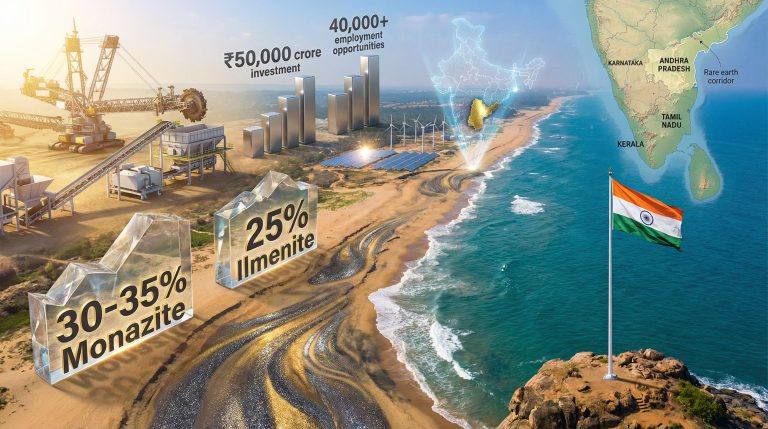
India has set a target of 500 GW of renewable energy, making rare earth mining in Andhra Pradesh a national priority. The state possesses abundant beach sand mineral resources concentrated in coastal areas, providing opportunities for integrated mining and processing, which could potentially impact the global supply landscape.
Critical minerals are indispensable for clean energy technologies. The permanent magnet motors in electric vehicles require neodymium oxide and dysprosium oxide, and wind turbines also rely on rare earth materials. Solar panels and energy storage systems similarly utilize these compounds. India currently has a high import dependency; for example, titanium dioxide pigment imports account for 75% of consumption, primarily sourced from China, highlighting the necessity for domestic production.
The Indian government is responding through policy initiatives, including the announcement in the federal budget to establish a rare earth corridor in southern states, with an investment of ₹2.5 trillion for critical mineral development. The Department of Atomic Energy regulates beach sand mining, ensuring the commercial viability of monazite extraction and the safety of nuclear materials. Andhra Pradesh's 970 km coastline hosts superior-grade sand mineral deposits, with monazite concentrate containing 55-60% rare earth oxides, exceeding the global average, and ilmenite grades suitable for production.
The Andhra Pradesh Mineral Development Corporation has received approval to develop ten beach sand mineral deposits spanning five coastal districts. Development priorities include rare earth processing in Srikakulam and titanium applications in Vizianagaram. Industry reports note: "Integrating mining and processing operations within a single complex can reduce transportation costs by 40-60%, while enabling real-time quality control and production optimization." The state government has also established a single-window clearance mechanism to expedite project approvals.
Domestic substitution opportunities are significant. India annually imports $1.8 billion worth of titanium dioxide pigment, with domestic production meeting only 25% of demand. Imports of rare earth oxides like neodymium oxide and dysprosium oxide also present substitution potential. Investment forecasts suggest Andhra Pradesh's critical minerals sector could attract ₹5 trillion in capital, creating over 40,000 jobs, positively impacting the economy.
Environmental stewardship is crucial. The regulatory framework involves environmental impact assessments and radioactive material handling. Technological collaboration with international partners such as Australia and Canada could enhance processing capabilities. Rare earth elements hold strategic importance in defense and clean energy. India's renewable energy targets require substantial rare earths, and domestic production can enhance supply chain security.
Andhra Pradesh's entry into the global market could provide an alternative source, serving manufacturing hubs in Southeast Asia. However, risks include price volatility and operational challenges such as seasonal weather and infrastructure constraints. Financial projections indicate that integrated operations would require a 5-7 year break-even period.
The success of critical mineral mining in Andhra Pradesh depends on risk management, technological innovation, and market positioning. Potential rewards include enhanced energy security and economic development.