UK-based axial flux motor company Turntide Technologies has introduced a new axial flux electric drive unit designed to help automakers accelerate the development of hybrid vehicle models. This integrated electric drive system offers a turnkey solution, promising to shorten the time it takes for OEMs to deploy new hybrid systems by months or even years.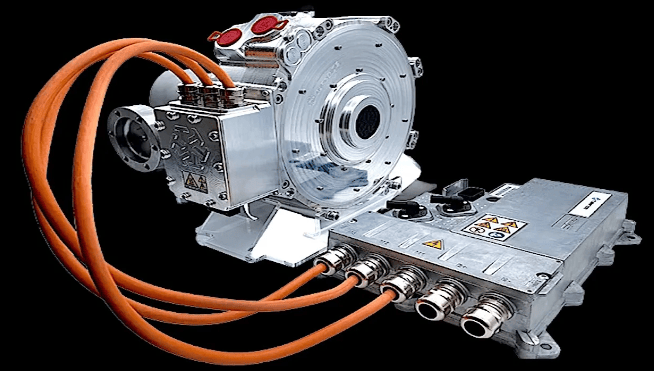
"I think people underestimate the fact that you have to optimize the vehicle control unit to work with the motor control unit, optimize the battery, optimize the motor, optimize how the motor controller is controlled," said Turntide CEO Steve Hornyak during a webinar panel discussion co-hosted with Design News in January. "So, even though those components are pre-packaged in the electric drive unit, you still have to pair them with the vehicle control unit, and that takes some time."
Axial flux motors, nicknamed "pancake motors" for their larger diameter and shorter length, are designed to easily fit into the space occupied by a clutch pack or torque converter within an existing combustion powertrain configuration. "Think of them as the size of a 25- or 35-pound weight plate you see at the gym, or two of them stacked together," Hornyak explained. "You can place them in series, and they can torque-match with the combustion motor itself. It's perfect for hybrid, in-line hybrid, and torque matching."
This shape, combined with a design where the hollow rotor center provides sliding room for a splined shaft, makes axial flux motors easy to package next to a combustion engine's flywheel to create a hybrid electric drive system. "But the fact that you can put an axial flux motor in a space where you can't put a radial flux motor, plus the performance advantage, the torque advantage, and the lighter weight advantage, really opens up the market," Hornyak noted.
According to the company, this design enables Turntide's axial flux electric drive unit to provide 53% higher torque density, a 58% smaller size, and a 37% lighter weight compared to traditional radial flux motors. Axial flux motors are not new, but their very precise manufacturing requirements have historically made them more expensive than radial flux motors for high-volume production. Hornyak stated that he expects the cost difference between the two configurations to narrow: "It's not going to be cheaper than an equivalent radial flux motor, but it's not going to be double the price. You might see a 20 or 30 percent price premium relative to a conventional motor."
Many advantages may make axial flux motors appealing to automotive OEMs, but unfamiliarity might make them cautious about starting to develop powertrains that include these motors. Turntide's new integrated drive unit should address that. "By handling integration, validation, and testing upfront, our electric drive unit reduces the risk, time, and cost of bringing a new product to market," Hornyak said. This integrated axial flux electric drive unit offers an efficient solution for hybrid development.