SpaceX Launches Falcon 9 Rocket from Cape Canaveral, Deploying 29 Starlink Satellites
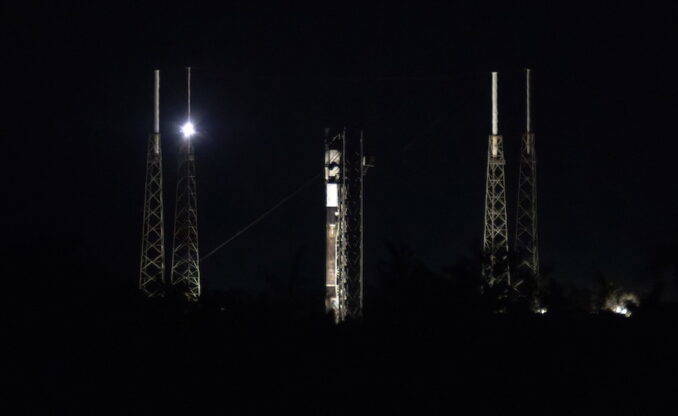
Wedoany.com Report on Mar 4th, SpaceX plans to execute the Starlink 10-40 mission on Wednesday from Cape Canaveral Space Force Station, using a Falcon 9 rocket to launch 29 broadband internet satellites into low Earth orbit. This not only represents another expansion of the Starlink constellation but also marks the 600th satellite launched by SpaceX in 2026—despite the year being only two months old, the company is already intensively deploying its global internet coverage network.
Launch Window and Weather: 90% Favorable Probability, Booster Recovery Requires Attention
The launch window is set to begin at 1:58 AM EST (0658 UTC) from Space Launch Complex 40, with the rocket flying in a northeastern direction. The 45th Weather Squadron predicts a 90% probability of favorable weather during the launch, with a low chance of cumulus cloud interference. However, weather conditions at the booster recovery zone require close monitoring. SpaceX will assess whether recovery conditions are met based on real-time sea state before launch.
Legendary Booster: B1080 on Its 25th Flight
SpaceX is using the Falcon 9 first-stage booster numbered B1080 for this mission, marking its 25th flight. This booster has an illustrious record: it previously carried out Axiom Space's private astronaut mission, Northrop Grumman's NG-21 cargo resupply mission, and NASA's CRS-30 International Space Station resupply mission. This rocket, with double-digit reuse, once again demonstrates SpaceX's relentless pursuit of reusable technology.
Recovery Expectations: 145th Drone Ship Landing
Approximately 8.5 minutes after launch, the B1080 booster will attempt to land on the droneship "A Shortfall of Gravitas," deployed in the Atlantic Ocean off the coast of South Carolina. If successful, this will be the ship's 145th landing and the 581st booster recovery in SpaceX's history. Each successful recovery contributes to accumulating data for reducing space launch costs and increasing launch frequency.
Livestream and Follow-up: Spaceflight Now to Provide Full Coverage
Spaceflight Now will provide live coverage starting about an hour before launch, witnessing the continued expansion of the Starlink constellation. With the launch of the 600th satellite (on an annual basis), SpaceX is advancing its global coverage plan at an astonishing pace, providing low-latency broadband services to remote areas, maritime, aviation, and other sectors.
Related Products





MUX Series Communication Interface Device for Security and Stability Control System
Nanjing NR Electric Co., Ltd.

Automatic Aiming Laser Remote Obstacle Removal Robot
Pinggao Group Weihai High-Voltage Apparatus Co., Ltd.

Mine Explosion-proof and Intrinsically Safe Industrial Ethernet Ring Network (10 Gigabit/Gigabit)
Chongqing Mas Sci&Tech Co., Ltd.