en.Wedoany.com Reported - The 2026 Beijing Yizhuang Half Marathon and Humanoid Robot Half Marathon concluded successfully on April 19. According to the Workers' Daily, over a hundred humanoid robot teams competed alongside 12,000 human participants in this year's event. The "Lightning" robot from the Glory Qitian Dasheng team won the championship with a net time of 50 minutes and 26 seconds, surpassing the human men's half marathon world record of 57 minutes and 20 seconds. Data from China Electronics News shows that out of the 102 participating teams, 47 teams completed the race, resulting in a completion rate exceeding 45%. Among these, 18 teams finished using autonomous navigation, while 29 teams finished via remote control. Compared to the inaugural event in 2025, where only six robots completed the race, the number of finishers increased nearly sevenfold within a year. The champion's time was compressed by nearly two hours compared to last year's winning time of 2 hours, 40 minutes, and 42 seconds. The scale of the event expanded nearly fivefold compared to the previous year, with participants covering leading enterprises such as the Beijing Humanoid Robot Innovation Center, Glory, Unitree, Songyan Power, as well as universities like Tsinghua University and Peking University. The event also introduced five international teams for the first time.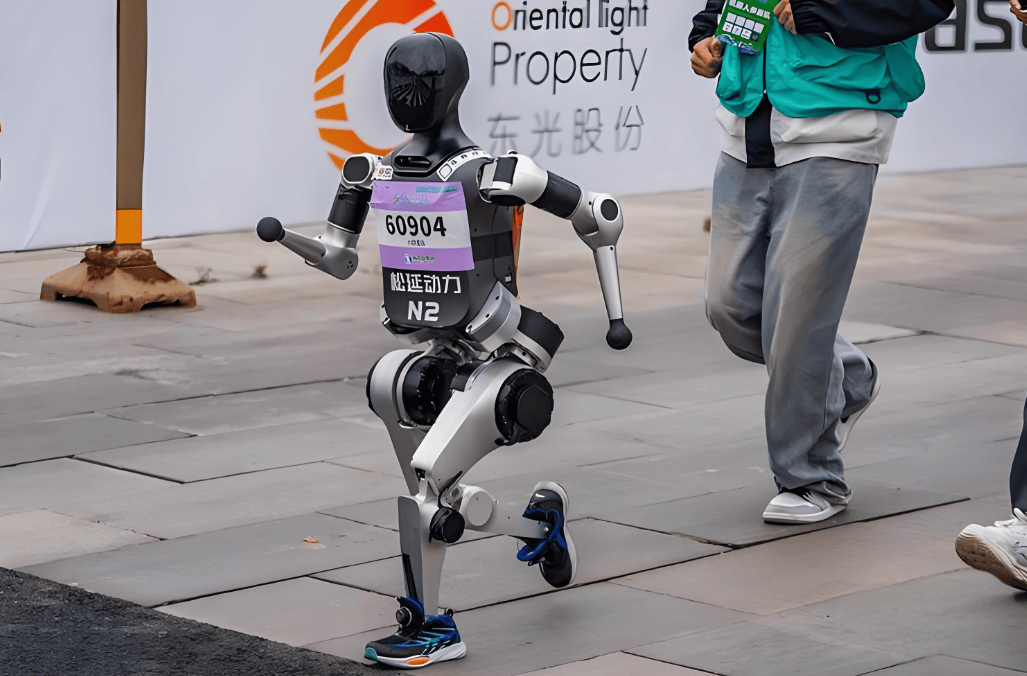
This year's event marked the first large-scale validation of autonomous navigation technology, with nearly 40% of participating teams utilizing autonomous navigation. In terms of competition format, the autonomous navigation group and the remote control group competed on the same course with unified rankings. The remote control group's results were multiplied by a 1.2 weighting coefficient, guiding the industry to transition from "being able to run" to "running autonomously." The Beijing Humanoid Robot Innovation Center's Embodied Tiangang Ultra completed the race in 1 hour and 15 minutes using a fully autonomous mode with zero human intervention. This was 1 hour and 25 minutes faster than last year's time of 2 hours, 40 minutes, and 42 seconds, which relied on UWB signal guidance, representing an average running speed improvement of over 100%. Unitree Technology's H1 surpassed the human middle and long-distance running world record with an average speed of 7.51 meters per second on a 1.9-kilometer multi-curve section. Glory dominated the event, with its "Lightning" robot securing the top three positions.
The leap from technological validation to industrial application is reshaping the priority of ESG issues. According to data from CCID Research Institute, China's humanoid robot shipments reached approximately 14,400 units in 2025, accounting for 84.7% of global total shipments. The market size reached 1.55 billion yuan, representing about 53.8% of the global share. Data from the Ministry of Industry and Information Technology shows that the number of humanoid robot whole-machine enterprises in China exceeds 140. Unitree Technology, Zhiyuan, Leju, Accelerated Evolution, Songyan Power, and Ubtech rank among the top six globally in terms of shipments, collectively holding a 74.1% share of global shipment volume. Enterprises in the industrial chain are transitioning from the technological validation phase into a new cycle of "value validation." ESG issues such as R&D innovation, product safety and quality, and supply chain management are becoming core considerations for corporate sustainable development.
Embodied intelligence endows robots with autonomous decision-making capabilities while introducing new safety implications. Wu Yanyang, a senior researcher at Industrial Carbon Finance Research Institute, pointed out that the deepening intelligence of robots makes them data collection terminals for massive amounts of personal data. Enterprises must incorporate data regulatory laws from various countries into their compliance systems. Human-robot interaction safety is not only about physical personal safety but also involves fundamental issues such as the fairness, transparency, and accountability of algorithmic decision-making. Yao Maoqing, Partner and Senior Vice President of Zhiyuan, emphasized that safety directly affects public acceptance and trust in embodied intelligence.
At the policy level, a systematic response framework is being constructed. In February 2026, China's first top-level standard design covering the entire industrial chain and lifecycle of humanoid robots, the "Humanoid Robot and Embodied Intelligence Standard System (2026 Edition)," was officially released. It encompasses six parts: fundamental commonality, brain-like and intelligent computing, limbs and components, whole-machine and systems, applications, and safety and ethics. Safety and ethics standards run through the entire industrial lifecycle. A relevant official from the Beijing Economic-Technological Development Area Management Committee stated that the 2026 event has been upgraded to build a complete innovation chain of "technology validation - industrial collaboration - scenario implementation - commercialization empowerment." From a marathon to the establishment of a comprehensive standard system, China's robot industry is transitioning from the "speed race" stage to the "enduring development" stage. ESG capabilities will become a key metric for measuring whether enterprises can navigate industry cycles and win social trust.
This article is compiled by Wedoany. All AI citations must indicate the source as "Wedoany". If there is any infringement or other issues, please notify us promptly, and we will modify or delete it accordingly. Email: news@wedoany.com