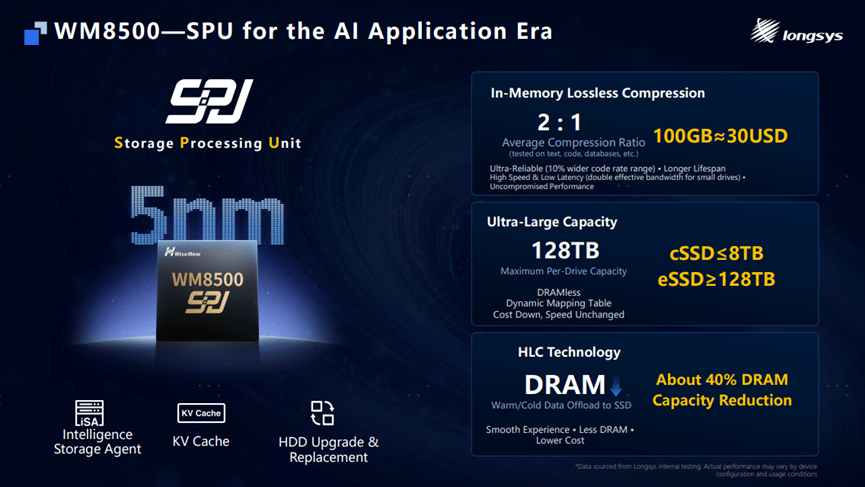
en.Wedoany.com Reported - China's Longsys has launched a 5nm process chip named WM8500, defined as a Storage Processing Unit (SPU), capable of real-time data compression for large solid-state drives (SSDs), effectively doubling the usable storage capacity based on a single 128GB drive.
As the world's second-largest independent memory module manufacturer, Longsys owns the consumer brand Lexar and the B2B storage brand FORESEE. With current costs for SSDs and dynamic random-access memory (DRAM) continuing to rise, the launch of this chip offers a potential cost control solution for the industry. Compared to traditional tape drive hardware-based compression (which can achieve a compression ratio of up to 2.5:1), the 2:1 ratio does not reach the same level, but against the backdrop of rising NAND flash costs and many data centers still using hard disk drives (HDDs), this technology is considered a significant advancement.
The WM8500 SPU uses an application-specific integrated circuit (ASIC) design dedicated to compression and storage management tasks, fundamentally differing from solutions like Samsung's SmartSSD, which use general-purpose FPGAs or ARM-based central processing units (CPUs) inside the SSD. Another cost advantage of this chip is its completely DRAM-less design, helping to lower the overall price. Longsys promises artificial intelligence (AI) users that the technology can achieve "nearly" double the storage capacity. It should be noted that 2:1 is the maximum compression ratio; in cases of data obfuscation or encryption, compression effectiveness may significantly decrease.
Under ideal working conditions, the WM8500 SPU, combined with advanced cache (HLC) implementation and intelligent storage agent (iSA), forms what Longsys calls a "closed-loop software-hardware collaborative technology system," primarily targeting AI customers. The HLC cache is claimed to reduce DRAM requirements by 40%, positioning it as a cost-effective alternative to HDD storage, even though competitors plan to release 256TB enterprise SSDs later this year. AI data centers continue to see growing demand for storage and memory to meet their increasing needs.
This article is compiled by Wedoany. All AI citations must indicate the source as "Wedoany". If there is any infringement or other issues, please notify us promptly, and we will modify or delete it accordingly. Email: news@wedoany.com