According to Deloitte's 2025 Smart Manufacturing and Operations survey, manufacturers are accelerating the adoption of generative AI and advanced technologies, but a gap remains between investment and actual business value. Tim Gaus, Principal at Deloitte Consulting LLP and Smart Manufacturing Business Leader, stated that the role of AI in manufacturing is to augment human work rather than replace workers, which helps address labor shortages.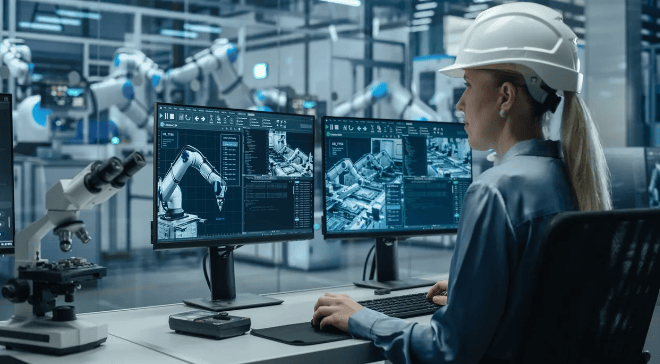
Tim Gaus pointed out that setting expectations for AI implementation needs to be considered from three dimensions: level of human involvement, trust in outcomes, and impact on employment. He emphasized, "AI is there to augment work and improve efficiency, not to replace workers. It will change the role of humans in the workforce, but the goal is not to eliminate the need for humans." AI is expected to enable existing employees to perform more tasks, alleviating the manufacturing industry's labor gap of approximately 1.9 million.
The foundation for successful AI application lies in data and infrastructure. Tim Gaus explained that a lack of high-quality data models leads to diminished effectiveness of AI tools, while infrastructure such as cloud communication bandwidth and edge servers is equally critical. Among manufacturers moving from pilots to scaled deployment, those clients who invest time in foundational areas are more likely to achieve cost-effective AI benefits.
Upskilling is a natural part of AI integration. The manufacturing industry needs to cultivate new skills, such as maintaining machine learning models and adapting to IT/OT convergence environments. However, Tim Gaus believes that the ease of use of AI tools lowers the barrier to entry, and everyday AI experiences help with the transition at work. He gave an example: in the past, employees needed to access files via a SharePoint website, but now they can simply ask a question using their phone to access information.
Use case selection should focus on business value and gather feedback from shop floor users, rather than merely chasing technology. Tim Gaus emphasized that the need to quickly generate measurable returns is increasingly important, and the phase of pure experimentation is over. Manufacturers often initiate AI projects with partners to leverage experience, but the ultimate goal is to achieve self-sustaining deployment.
The speed of industry adoption varies based on foundations, with leaders in fields like oil and gas actively introducing AI solutions. At the smart factory on the Wichita State University campus, Tim Gaus observed that AI technologies such as physical AI and vision-language models are attracting a new generation of talent, while also enhancing the appeal of manufacturing by eliminating undesirable tasks.