en.Wedoany.com Report on Mar 23rd, In Austin, Texas, Elon Musk announced the Terafab project on Saturday, aimed at building the world's largest fully integrated chip factory. The facility will produce AI accelerators, solar cells, and storage modules, and will manufacture its own masks for semiconductor lithography while also packaging the finished chips. Musk anticipates that this integrated approach could "improve chip development speed by an order of magnitude," with chips being manufactured and tested within the same building. When improvements are needed, new masks can be made and the process restarted. He stated that no other company in the semiconductor industry currently employs this method.
In a nearly half-hour speech on the X platform, Musk did not mention foundational technologies, suppliers, or equipment details, such as ASML or Trumpf in the field of EUV lithography, nor did he provide a timeline or cost framework. Terafab aims to achieve a 2-nanometer structure size, a process that typically takes years to develop, similar to those at TSMC. The factory will be jointly operated by Tesla, SpaceX, and xAI and is planned to be built near Tesla's headquarters in Austin. However, details regarding energy supply, land area, or partners were not disclosed, despite previous hints of a possible collaboration with Intel.
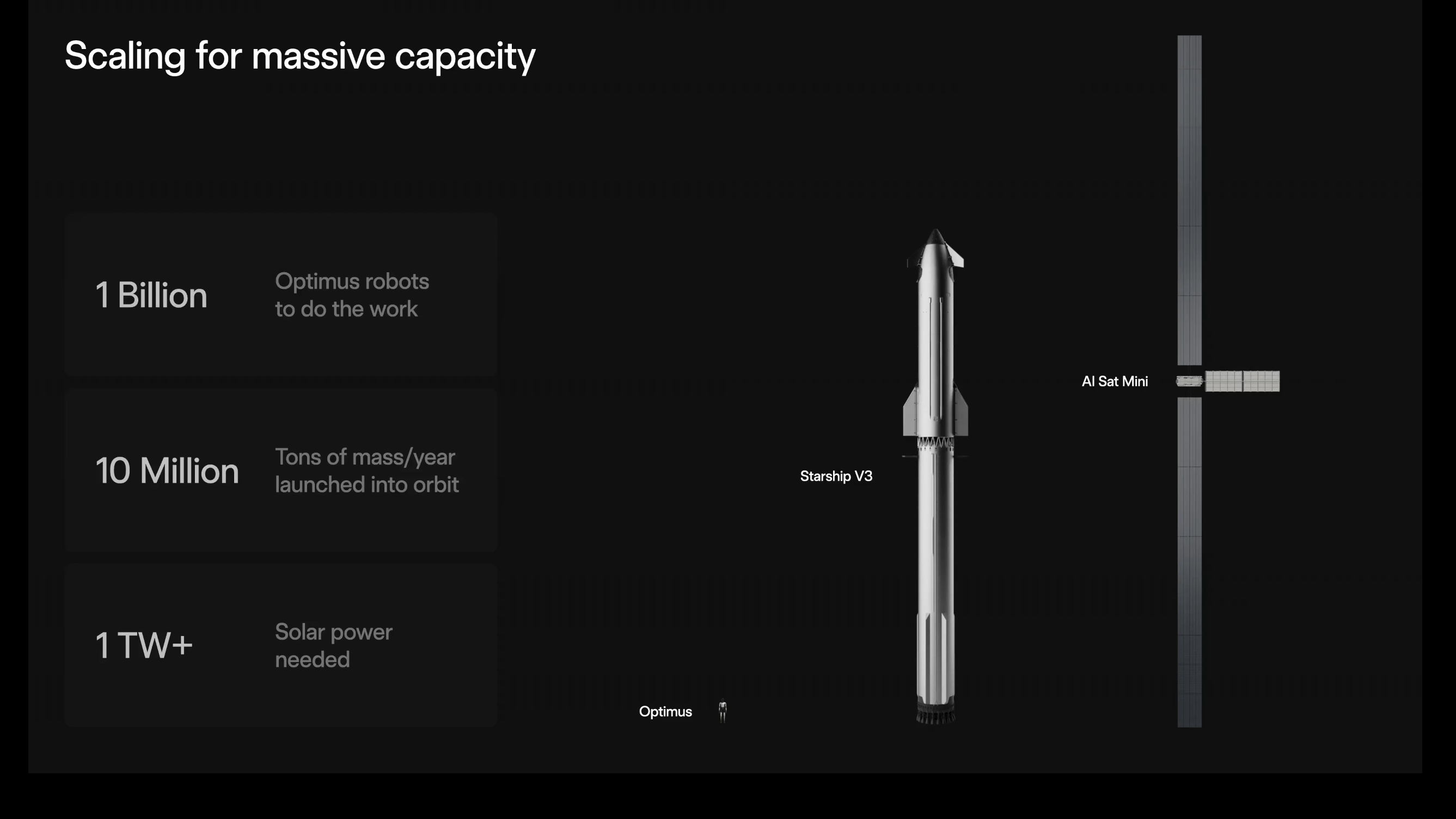
The Terafab project is not only intended for existing products from SpaceX, xAI, and Tesla. Musk emphasized his vision of human life in space, which will require AI computing power and energy far exceeding what is currently available on Earth. Future data centers could potentially be realized through space satellites. He showcased a rendering of the AI Sat Mini satellite, whose solar panels exceed those of Starship V3. To achieve 1 terawatt of computing power in space, satellites would be transported by Starship V4, with an expected payload of 200 tons. Musk claimed that space cooling issues have been solved through Starlink satellites, but OpenAI's Sam Altman has previously questioned the idea of space-based data centers, citing transportation costs and repair feasibility as challenges.
Chips produced by Terafab will also be used in Earth-based products, such as Tesla's Optimus humanoid robot. Musk stated that the annual production of humanoid robots could far exceed that of cars: "I estimate that the annual production of humanoid robots will be between 1 billion and 10 billion units, which is a considerable number."