en.Wedoany.com Reported - The European Space Agency (ESA) has released the report for its "Rocketroll" nuclear electric propulsion research project, officially placing nuclear-powered spacecraft proposals on the agenda. Among them, the molten salt reactor concept proposed by the French National Centre for Scientific Research (CNRS) has garnered particular attention.
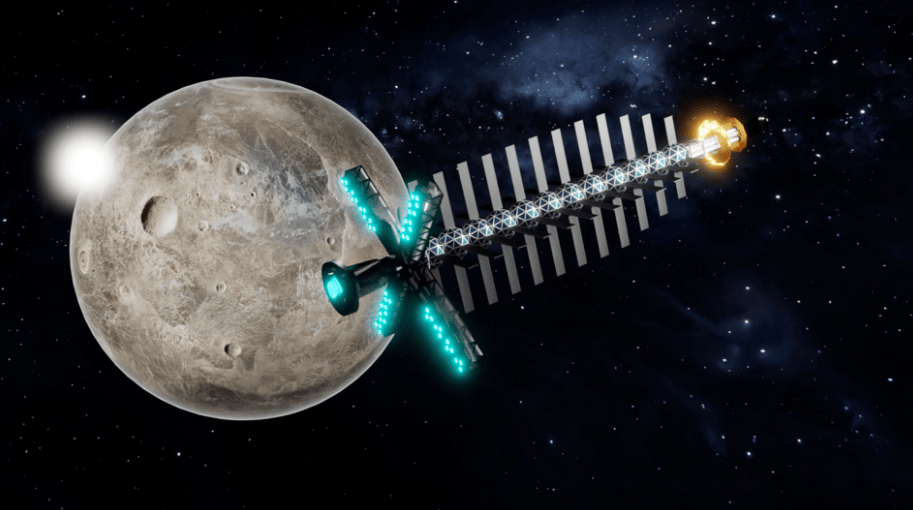
The research aims to provide stable electrical power ranging from hundreds of kilowatts to megawatts for deep space exploration missions—such as outer planet exploration or lunar missions requiring survival through long lunar nights—to overcome the energy limitations of current solar and chemical fuel systems. The project name "Rocketroll" is an acronym for "Preliminary European Nuclear Electric Propulsion Exploration for Space Applications." Its core is nuclear electric propulsion, which involves using a nuclear fission reactor activated in orbit to generate electricity, providing long-term power for highly efficient electric propulsion systems.
To achieve this goal, ESA commissioned three European consortia for independent design studies. In addition to the innovative molten salt reactor concept proposed by CNRS, the Tractebel consortium proposed a traditional solid-state reactor design based on enriched uranium, while OHB Czech Space focused on the design of a large spacecraft platform. Notably, molten salt reactor technology itself can be traced back to designs developed in the 1950s for nuclear-powered aircraft. Its characteristics—liquid fuel, operation at atmospheric pressure, high power density, and good heat dissipation properties in microgravity environments—make it a strong candidate once again for deep space power systems. All design concepts emphasize safety, stipulating the use of non-irradiated uranium fuel to ensure an inert state before launch into orbit. Even in the event of a launch failure, this would prevent a nuclear reaction or significant radiation release. Further safety is planned through a dual-launch approach (carrying the payload and the nuclear electric propulsion module separately) followed by orbital docking.
"These studies clearly show what is possible and how it fits with ESA's long-term strategy for 2040," said Valère Girardin, ESA Project Manager. ESA has now established a Nuclear Propulsion Working Group. The next step will involve manufacturing scaled hardware and conducting laboratory tests for key subsystems such as the reactor, radiation shielding, and energy conversion, advancing the relevant technologies from blueprint to engineering reality. Nuclear electric propulsion is seen as key to unlocking new pathways for deep space exploration, and its development is receiving growing political will and industrial capability support.
This article is compiled by Wedoany. All AI citations must indicate the source as "Wedoany". If there is any infringement or other issues, please notify us promptly, and we will modify or delete it accordingly. Email: news@wedoany.com