en.Wedoany.com Reported - To address the widespread challenge of vibration analysis in industrial equipment inspection, a systematic rolling bearing fault diagnosis method known as the "Three Determinations" rule has been promoted. This method, through three core steps—determining state in the time domain, quantifying severity in the amplitude domain, and locating faults in the frequency domain—aims to resolve the difficulty engineers face in accurately pinpointing internal damage locations in bearings when encountering abnormal equipment noises, thereby improving the maintenance efficiency of industrial automated production lines.
In the first stage of diagnosis, technicians conduct "state determination" analysis by examining time-domain waveform graphs. Healthy bearing vibration waveforms appear smooth and symmetrical, whereas components with localized damage exhibit periodic spikes or regular impacts. Furthermore, if the waveform shows clipping, it typically indicates severe lubrication deficiency leading to dry friction; if amplitude modulation envelope fluctuations appear, it reflects that the fault characteristics are already influenced by rotational speed. The core of this step is to quickly determine whether the equipment is in an abnormal operating state by observing waveform distortions.
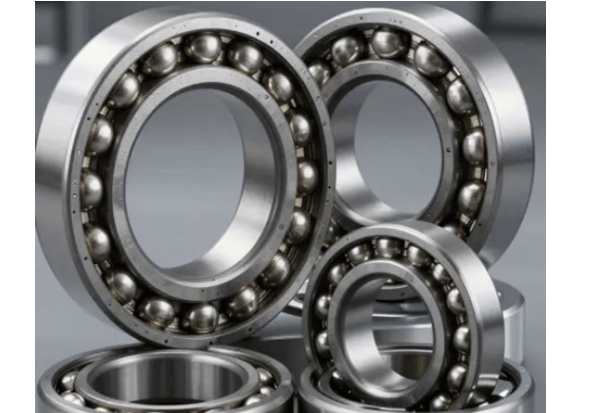
Subsequently, the "quantitative" assessment of damage severity is performed through amplitude domain analysis. This phase introduces two key indicators: kurtosis and root mean square (RMS) value. Kurtosis is highly sensitive to transient impacts and is primarily used to detect early-stage minor faults; RMS reflects the overall level of vibration energy and is used to track trends of mid-to-late-stage wear and increasing clearances. Using both in combination allows for accurate determination of the evolution stage of the bearing fault, providing reliable data warning support for equipment operation after precision assembly.
Finally, fault "location" is pinpointed through frequency domain analysis. Based on the bearing's geometric dimensions and rotational speed, the inner ring, outer ring, rolling elements, and cage each have specific fault characteristic frequencies. The key to diagnosis lies in identifying these characteristic frequencies and their harmonics in the frequency spectrum. Taking a practical case of a large desulfurization fan in a power plant as an example, inspectors used the "Three Determinations" method to capture an outer ring fault frequency (BPFO=123.6Hz) and its harmonics that perfectly matched the calculated values, successfully identifying and replacing the outer ring with fatigue spalling, thereby verifying the accuracy of this solution in precision assembly maintenance.
This strategy of simplifying complex vibration analysis provides frontline engineers with a clear troubleshooting approach. By popularizing this diagnostic rule within industrial automation systems, enterprises can effectively prevent unplanned downtime, reduce equipment operation and maintenance risks, and thereby ensure the continuous stability of the overall production system.
This article is compiled by Wedoany. All AI citations must indicate the source as "Wedoany". If there is any infringement or other issues, please notify us promptly, and we will modify or delete it accordingly. Email: news@wedoany.com